

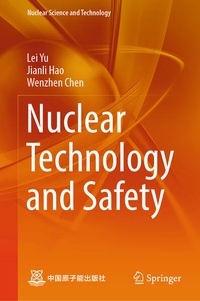
Nuclear Technology and Safety
Description

This book is a comprehensive overview, covering fundamentals, applications, and development of nuclear technology as well as the history, principles, policy, and practice of nuclear safety. It begins with the background and significance of the subject and conducts in-depth discussion into these sub-topics through nine chapters.
The dissemination of nuclear knowledge and the assurance of nuclear safety rely on highly qualified personnel in nuclear facilities and well-designed education. This book is useful for a broad audience, including practitioners in nuclear-related industries such as nuclear construction, agriculture, and medicine, as well as researchers, engineers, and operators familiar with nuclear technology. Additionally, it can serve as a textbook for college students and professionals, a reference for operational and managerial staff at nuclear facilities, and a resource for engineers and technicians in other related fields.
More details
Other editions
Additional editions
Persons
Lei YU, currently a professor at the College of Nuclear Science and Technology, Naval University of Engineering. Graduated with a Ph.D. from Naval University of Engineering in 2008. Primarily engaged in teaching and research in the field of nuclear reactor safety analysis. He has won a second-class National Science and Technology Progress Award. Published four textbooks, and received the Second Prize in the Inaugural National Excellent Textbook Award for one of his publications.
Jianli HAO, currently an associate professor at the College of Nuclear Science and Technology, Naval University of Engineering. Graduated with a Ph.D from Naval University of Engineering in 2013. Primarily engaged in teaching and research in the field of nuclear reactor safety analysis. Published one monograph and three textbooks, and received the Second Prize in the Inaugural National Excellent Textbook Award for one of his publications.
Wenzhen CHEN, currently a professor at the College of Nuclear Science and Technology, Naval University of Engineering. Graduated with a Ph.D. from Huazhong University of Science and Technology in 1994, and completed his postdoctoral studies at Shanghai Jiao Tong University in 1998. Primarily engaged in teaching and research in the field of nuclear reactor safety analysis. He has won two second-class Natural Science Awards from Hubei Province, published two monographs and four textbooks, and received the Second Prize in the Inaugural National Excellent Textbook Award for one of his publications.
Content
Chapter 1: Introduction.- Chapter 2: Basic Knowledge of Nuclear Physics.- Chapter 3: Application of Nuclear Technology.- Chapter 4: Nuclear Power Technology and Application.- Chapter 5: Safety Problems and Safety Design of Nuclear Reactors.- Chapter 6: Safety Evaluation of Nuclear Reactors.- Chapter 7: Nuclear Safety Legal System and Supervision.- Chapter 8: Radiation Safety and Protection.- Chapter 9: Overview of Nuclear Safety Culture.- References.
