

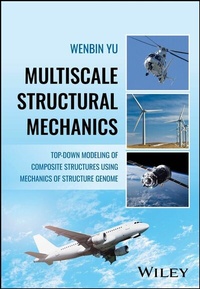
Multiscale Structural Mechanics
Description

Master composites modelling with this insightful and authoritative resource from a leading voice in the field
Multiscale Structural Mechanics: Top-Down Modeling of Composite Structures Using Mechanics of Structure Genome delivers a unified approach to composites modelling based on the concept of structure gene. Dr. Wenbin Yu, distinguished engineer, industry leader, and author, brings together micromechanics and structural mechanics using the Mechanics of Structure Genome. This approach allows multiscale constitutive modelling for general anisotropic and heterogeneous materials and structures without invoking assumptions commonly used in other approaches.
The book introduces readers unfamiliar with vectors and tensors, continuum mechanics, micromechanics, and structural mechanics to the basics of each of these topics. It goes on to bridge the gap between micromechanics and structural mechanics, offering readers multiscale structural models that remain as simple as classical engineering models but with the accuracy expected of more complex theories capturing microstructural details. Specifically, the book offers:
- A brief introduction to vectors and tensors, as well as continuum mechanics, classical structural models including kinematics, kinetics, and energetics, and composite materials
- Fulsome discussions of the mechanics of structure genome (MSG) and its application to construct multiscale models for beams, plates, shells, and 3D solids
- Complete explorations of both micromechanics and structural mechanics, including the theories of beams, plates, and shells
- An introduction to the calculus of variations, variational asymptotic method, and their applications to model general anisotropic and heterogeneous materials and structures
- Information sufficient to allow readers to construct efficient high-fidelity models for composites using MSG introduced in this book
- Detailed discussions of stress and failure analysis of composite laminates
Perfect for graduate students in aerospace, mechanical, and other disciplines making use of anisotropic and heterogeneous materials such as composites, Multiscale Structural Mechanics will also earn a place in the libraries of researchers and engineers in university, government, and industry laboratories who work with composite materials and structures. It is the ideal resource for composites modelling across a wide spectrum of engineering applications.
Wenbin Yu, PhD, is the Milton Clauser Professor of the School of Aeronautics and Astronautics at Purdue University. He obtained his doctorate in Aerospace Engineering from Georgia Tech in 2002. He is Chief Technology Officer of AnalySwift LLC (analyswift.com) and Director of the Composites Design and Manufacturing HUB (cdmhub.org).
More details
Other editions
Additional editions
Content
List of Figures xv
List of Tables xxi
Foreword xxiii
Preface xxv
Acknowledgments xxxi
Acronyms xxxiii
1 Introduction 1
1.1 Continuum Hypothesis 1
1.2 Isotropic vs. Anisotropic Materials 4
1.3 Homogeneous vs. Heterogeneous Materials 4
1.4 Materials vs. Structures 4
1.5 3D Structures, Plates, Shells, and Beams 6
1.6 Structures, Models, and Assumptions 8
1.7 Composite Materials 20
1.8 Benefits of Using Composites 24
1.9 Mechanics of Composite Materials 25
1.10 Challenges for Modeling Composites 26
1.11 Multiscale Modeling* 28
2 Mathematical Preliminaries 43
2.1 Scalars, Vectors, and Tensors 43
2.2 Cartesian Coordinate System 44
2.3 Index Notation 44
2.4 Vectors 48
2.5 Transformation Between Different Coordinate Systems 52
2.6 Second-order Tensors 55
2.7 Quotient Rule and Higher-order Tensors 60
2.8 Special Tensors 61
2.9 Isotropic Tensors 62
2.10 Tensor Calculus 62
2.11 General Coordinate Systems* 63
2.12 Calculus of Variations* 73
3 Theory of Anisotropic Elasticity 103
3.1 Kinematics 103
3.2 Kinetics 109
3.3 Constitutive Relations 114
3.4 Theory of Linear Elasticity 147
3.5 Boundary Conditions and Continuity Conditions 149
3.6 A Few Anisotropic Elasticity Problems 151
3.7 Variational Principles for Anisotropic Elasticity* 173
4 Micromechanics 187
4.1 Introduction 187
4.2 Microstructures and Their Idealizations 188
4.3 Volume Average 192
4.4 Effective Stiffness and Compliance 192
4.5 Voigt and Reuss Rules of Mixtures 193
4.6 Hybrid Rules of Mixtures 202
4.7 Macro and Micro Coordinates* 209
4.8 Average Stress Theorem* 210
4.9 Average Strain Theorem* 211
4.10 Hill-Mandel Macro-homogeneity Condition* 213
4.11 Computational Homogenization* 216
5 Composite Plate Models 233
5.1 Introduction 233
5.2 Composite Laminates 234
5.3 Why Composite Plate Theories? 236
5.4 Kirchhoff-Love Model Derived Using the Newtonian Method 238
5.5 Reissner-Mindlin Model* 288
5.6 MSG-based Composite Plate Models* 292
6 Composite Beam Models* 301
6.1 Introduction 301
6.2 Ad Hoc Methods 303
6.3 Beam Models Derived Using MSG 319
6.4 A Few Composite Beam Problems 328
7 Mechanics of Structure Genome* 337
7.1 Introduction 338
7.2 Kinematics 339
7.3 Variational Statement for SG 349
7.4 MSG Illustrated 353
7.5 Numerical Examples 359
8 Failure of Composite Materials 371
8.1 Introduction 371
8.2 Failure Criteria for Isotropic Materials 374
8.3 Failure Criteria for Orthotropic Materials 382
8.4 Strength Ratio 399
8.5 Failure Envelope 403
8.6 Progressive Failure Analysis 406
8.7 Nonlocal Approach for Computing Strength 408
Problems 409
References 413
Index 421
