

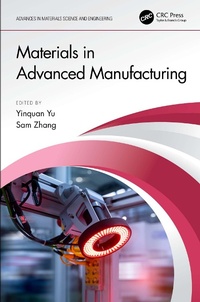
Materials in Advanced Manufacturing
1st Edition
Published on 21. December 2022
385 pages
978-1-000-82121-5 (ISBN)
Description

This book introduces the latest processing technologies for a variety of materials in advanced manufacturing and applications. Design criteria and considerations of processing or devices are theoretically introduced, and numerical simulation and experimental study are included.
FEATURES
Covers a variety of materials, including hard materials, soft materials, metals, and composites
Describes nanotechnology approaches, modern piezoelectric techniques, and physical and mechanical studies of the structure-sensitive properties of the materials
Reviews advanced manufacturing for antenna applications and embroidered RFID tags for wearable applications
Considers additive manufacturing of cellular solids and metal additive manufacturing
Discusses advanced materials for sound absorption
Aimed at engineers, researchers, and advanced students in materials processing and advanced manufacturing, this work helps readers to understand which processing technology is suitable for a specific material and the design rules for a particular application.
FEATURES
Covers a variety of materials, including hard materials, soft materials, metals, and composites
Describes nanotechnology approaches, modern piezoelectric techniques, and physical and mechanical studies of the structure-sensitive properties of the materials
Reviews advanced manufacturing for antenna applications and embroidered RFID tags for wearable applications
Considers additive manufacturing of cellular solids and metal additive manufacturing
Discusses advanced materials for sound absorption
Aimed at engineers, researchers, and advanced students in materials processing and advanced manufacturing, this work helps readers to understand which processing technology is suitable for a specific material and the design rules for a particular application.
More details
Series
Edition
1. Auflage
Language
English
Place of publication
London
United Kingdom
Publishing group
Taylor & Francis Ltd
Target group
Professional and scholarly
College/higher education
Illustrations
31 Tables, black and white; 89 Line drawings, black and white; 108 Halftones, black and white; 197 Illustrations, black and white
ISBN-13
978-1-000-82121-5 (9781000821215)
Copyright in bibliographic data and cover images is held by Nielsen Book Services Limited or by the publishers or by their respective licensors: all rights reserved.
Schweitzer Classification
Other editions
Additional editions
Yinquan Yu | Sam Zhang
Materials in Advanced Manufacturing
Book
06/2024
1st Edition
CRC Press
€84.38
The article will not be published
Yinquan Yu | Sam Zhang
Materials in Advanced Manufacturing
Book
12/2022
1st Edition
CRC Press
€230.27
Shipment within 10-20 days
Persons
Professor Yu Yinquan ????? was born and brought up in the famous city, Anqing, China. He received his Bachelor of Engineering in Mechanical in 1991 from Chongqing University (China), Master of Engineering in Mechatronics in 2008 from National University of Singapore, and Ph.D. degree in 2014 from National University of Singapore. He was a Scientist (since 2015) at the Agency for Science, Technology and Research (A*star), Singapore. In January 2019, he joined School of Mechatronics and Vehicle Engineering, East China Jiao Tong University, Nanchang, China and assumed duty as Director of the Institute of Intelligent Manufacturing and Precision Research. His current research interests include Smart Manufacturing, Smart Permanent Magnet Synchronous Motor (SPMSM), Machine Health Monitoring and Fault Diagnosis, Mechatronics and Robotics, Shock Absorption and Noise Reduction of High-Speed and High-Precision Equipment, Intelligent Manufacturing and Precision Machining. Prof. Yu is a Fellow of SAS, a member of ASME, and Singapore executive committee member ASME (2017-2018), senior member of IEEE & IES, a mentor of the Lean Launch Pad Singapore, Member of Organizer, APMRC 2010, Member of Technical Program Committee, ICEEAC 2017, and A*STAR professional appraisers for purchasing large equipment.
Professor Sam Zhang Shanyong ?????, better known as Sam Zhang, was born and brought up in the famous "City of Mountains" Chongqing, China. He received his Bachelor of Engineering in Materials in 1982 from Northeastern University (Shenyang, China), Master of Engineering in Materials in 1984 from Iron & Steel Research Institute (Beijing, China) and Ph.D. degree in Ceramics in 1991 from The University of Wisconsin-Madison, USA. He was a tenured full professor (since 2006) at the School of Mechanical and Aerospace Engineering, Nanyang Technological University. In January 2018, he joined School of Materials and Energy, Southwest University, Chongqing, China and assumed duty as Director of the Centre for Advanced Thin Film Materials and Devices of the university.
Prof. Zhang was the founding Editor-in-Chief for Nanoscience and Nanotechnology Letters (2008-Dec.2015) and Principal Editor for Journal of Materials Research (USA) responsible for thin films and coating field (since 2003). Prof. Zhang has been serving the world's first "Thin Films Society" (www.thinfilms.sg) as its founding and current president since 2009. Prof. Zhang has authored/edited 14 books, of them 12 are published with CRC Press/Taylor & Francis. Prof Zhang is also the Series Editor for Advances in Materials Science and Engineering Book Series published by CRC Press/Taylor & Francis.
Prof. Zhang was elected as Fellow of Royal Society of Chemistry (FRSC) and Fellow of Thin Films Society (FTFS) in 2018 and Fellow of Institute of Materials, Minerals and Mining (FIoMMM) in 2007. Prof. Zhang's current research centers in areas of energy films and coatings for solar cells, hard yet tough nanocomposite coatings for tribological applications by physical vapor deposition, measurement of fracture toughness of ceramic films and coatings, and electronic/optical thin films. Over the years, he has authored/co-authored over 360 peer reviewed international journal papers. As of 2020: (http://www.researcherid.com/rid/A-3867-2011), his Articles in Web of Science: 355, the Sum of the Times Cited: 10,169, h-index: 53
Professor Sam Zhang Shanyong ?????, better known as Sam Zhang, was born and brought up in the famous "City of Mountains" Chongqing, China. He received his Bachelor of Engineering in Materials in 1982 from Northeastern University (Shenyang, China), Master of Engineering in Materials in 1984 from Iron & Steel Research Institute (Beijing, China) and Ph.D. degree in Ceramics in 1991 from The University of Wisconsin-Madison, USA. He was a tenured full professor (since 2006) at the School of Mechanical and Aerospace Engineering, Nanyang Technological University. In January 2018, he joined School of Materials and Energy, Southwest University, Chongqing, China and assumed duty as Director of the Centre for Advanced Thin Film Materials and Devices of the university.
Prof. Zhang was the founding Editor-in-Chief for Nanoscience and Nanotechnology Letters (2008-Dec.2015) and Principal Editor for Journal of Materials Research (USA) responsible for thin films and coating field (since 2003). Prof. Zhang has been serving the world's first "Thin Films Society" (www.thinfilms.sg) as its founding and current president since 2009. Prof. Zhang has authored/edited 14 books, of them 12 are published with CRC Press/Taylor & Francis. Prof Zhang is also the Series Editor for Advances in Materials Science and Engineering Book Series published by CRC Press/Taylor & Francis.
Prof. Zhang was elected as Fellow of Royal Society of Chemistry (FRSC) and Fellow of Thin Films Society (FTFS) in 2018 and Fellow of Institute of Materials, Minerals and Mining (FIoMMM) in 2007. Prof. Zhang's current research centers in areas of energy films and coatings for solar cells, hard yet tough nanocomposite coatings for tribological applications by physical vapor deposition, measurement of fracture toughness of ceramic films and coatings, and electronic/optical thin films. Over the years, he has authored/co-authored over 360 peer reviewed international journal papers. As of 2020: (http://www.researcherid.com/rid/A-3867-2011), his Articles in Web of Science: 355, the Sum of the Times Cited: 10,169, h-index: 53
Content
1. Advanced Manufacturing of Hard Magnetic Materials, 2. Advanced Manufacturing of Flexible Piezoelectric Arrays, 3. Application and Research Trends of Flexible Piezoelectric Arrays, 4. Advanced Manufacturing of Carbon Fiber Material, 5. Laser Micro-Processing of Sapphire, 6. Metal Additive Manufacturing, 7. Additive Manufacturing of Lattice Structures, 8. Antennas Manufactured from Conductive Fabric Materials
