

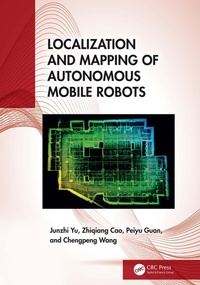
Localization and Mapping of Autonomous Mobile Robots
1st Edition
Published on 31. October 2025
206 pages
978-1-040-39702-2 (ISBN)
Description

Localization and mapping play a critical role in the autonomous task execution of mobile robots. This book covers the theoretical and technological aspects of robot localization and mapping, including visual localization and mapping, visual relocalization, LiDAR localization and mapping, and place recognition.
It provides the theoretical foundations of robot localization and mapping. It employs both traditional methods, such as geometry-based visual localization, and state-of-the-art deep learning techniques that improve robot perception. The authors also address LiDAR-based localization, exploring techniques to improve both efficiency and accuracy when processing dense point clouds. Key topics include visual localization using deep features, integration of visual solutions under ROS-based software architecture, and distribution-based LiDAR localization.
This book will be of great interest to students and professionals in the fields of robotics and artificial intelligence. It will also be an excellent reference for engineers and technicians involved in the development of robot localization.
It provides the theoretical foundations of robot localization and mapping. It employs both traditional methods, such as geometry-based visual localization, and state-of-the-art deep learning techniques that improve robot perception. The authors also address LiDAR-based localization, exploring techniques to improve both efficiency and accuracy when processing dense point clouds. Key topics include visual localization using deep features, integration of visual solutions under ROS-based software architecture, and distribution-based LiDAR localization.
This book will be of great interest to students and professionals in the fields of robotics and artificial intelligence. It will also be an excellent reference for engineers and technicians involved in the development of robot localization.
More details
Edition
1. Auflage
Language
English
Place of publication
London
United Kingdom
Publishing group
Taylor & Francis Ltd
Target group
College/higher education
Professional and scholarly
Illustrations
30 Tables, black and white; 45 Line drawings, black and white; 40 Halftones, black and white; 85 Illustrations, black and white
File size
44,78 MB
ISBN-13
978-1-040-39702-2 (9781040397022)
Copyright in bibliographic data and cover images is held by Nielsen Book Services Limited or by the publishers or by their respective licensors: all rights reserved.
Schweitzer Classification
Other editions
Additional editions
Junzhi Yu | Zhiqiang Cao | Peiyu Guan
Localization and Mapping of Autonomous Mobile Robots
Book
10/2025
1st Edition
CRC Press
€96.10
Shipment within 10-20 days
Persons
Junzhi Yu is a professor in the Department of Advanced Manufacturing and Robotics, College of Engineering, Peking University, China, and also a guest researcher at the Institute of Automation, Chinese Academy of Sciences. His research interests include intelligent robots, motion control, and intelligent mechatronic systems. He has authored or co-authored seven monographs and published more than 200 science citation index papers in prestigious robotics and automation-related journals. He has successively been listed among the Most Cited Researchers in China between 2014 and 2023. He is a fellow of the Institute of Electrical and Electronics Engineers.
Zhiqiang Cao is currently a professor at the State Key Laboratory of Multimodal Artificial Intelligence Systems from the Institute of Automation, Chinese Academy of Sciences. His current research interests include service robot and intelligent robot.
Peiyu Guan is currently an assistant professor at the State Key Laboratory of Multimodal Artificial Intelligence Systems from the Institute of Automation, Chinese Academy of Sciences. Her research interests include service robots, visual localization and mapping, and computer vision.
Chengpeng Wang is at the State Key Laboratory of Multimodal Artificial Intelligence Systems from the Institute of Automation, Chinese Academy of Sciences. His research interests include intelligent robot, robot localization and navigation.
Zhiqiang Cao is currently a professor at the State Key Laboratory of Multimodal Artificial Intelligence Systems from the Institute of Automation, Chinese Academy of Sciences. His current research interests include service robot and intelligent robot.
Peiyu Guan is currently an assistant professor at the State Key Laboratory of Multimodal Artificial Intelligence Systems from the Institute of Automation, Chinese Academy of Sciences. Her research interests include service robots, visual localization and mapping, and computer vision.
Chengpeng Wang is at the State Key Laboratory of Multimodal Artificial Intelligence Systems from the Institute of Automation, Chinese Academy of Sciences. His research interests include intelligent robot, robot localization and navigation.
Content
1 Introduction 2 Mathematical Foundation of Localization and Mapping Theory 3 Real-time Semantic Visual SLAM with Points and Objects 4 Visual Relocalization from the Perspective of Scene Coordinate Regression Network 5 Visual Relocalization from the Perspective of Place Recognition 6 Robot Visual Localization Framework Based on Offline Hybrid Map 7 Hierarchical LiDAR Odometry via Maximum Likelihood Estimation with Tightly Associated Distributions 8 Hierarchical Distribution-based Tightly-Coupled LiDAR Inertial Odometry 9 LiDAR Place Recognition Based on Range Image and Column-Shift-Invariant Attention 10 Summary and Outlook
