

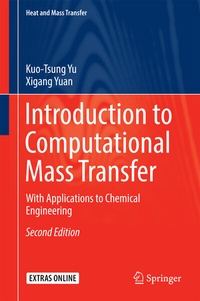
Introduction to Computational Mass Transfer
Description

This book offers an easy-to-understand introduction to the computational mass transfer (CMT) method. On the basis of the contents of the first edition, this new edition is characterized by the following additional materials. It describes the successful application of this method to the simulation of the mass transfer process in a fluidized bed, as well as recent investigations and computing methods for predictions for the multi-component mass transfer process. It also demonstrates the general issues concerning computational methods for simulating the mass transfer of the rising bubble process. This new edition has been reorganized by moving the preparatory materials for Computational Fluid Dynamics (CFD) and Computational Heat Transfer into appendices, additions of new chapters, and including three new appendices on, respectively, generalized representation of the two-equation model for the CMT, derivation of the equilibrium distribution function in the lattice-Boltzmann method, and derivation of the Navier-Stokes equation using the lattice-Boltzmann model. This book is a valuable resource for researchers and graduate students in the fields of computational methodologies for the numerical simulation of fluid dynamics, mass and/or heat transfer involved in separation processes (distillation, absorption, extraction, adsorption etc.), chemical/biochemical reactions, and other related processes.
More details
Other editions
Additional editions
Persons
Professor Kuo-Tsong Yu is a member of the Chinese Academy of Sciences.
Dr. Xigang Yuan is a professor at the School of Chemical Engineering and Technology, Tianjin University, China.
Content
Basic Models of Computational Mass Transfer.- Application of Computational Mass Transfer (I): Distillation Process.- Application of Computational Mass Transfer (II): Chemical Absorption Process.- Application of Computational Mass Transfer (III): Chemical Adsorption Process.- Application of Computational Mass Transfer (IV): Fixed Bed Catalytic Reaction.- Application of Computational Mass Transfer (V): Fluidized Chemical Process.- Mass Transfer in Multi-component Systems.- Micro Behaviors Around Rising Bubbles.- Simulation of Interfacial Effect on Mass Transfer.- Simulation of Interfacial Behaviors by the Lattice-Boltzmann Method.
