

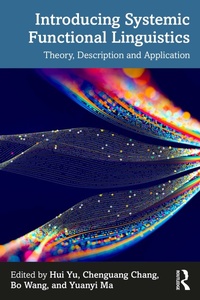
Introducing Systemic Functional Linguistics
Theory, Description and Application
1st Edition
Published on 12. September 2025
350 pages
978-1-040-39080-1 (ISBN)
Description

This book provides a comprehensive introduction to Systemic Functional Linguistics (SFL), covering key concepts and contributions to the field and instructing beginners to apply SFL to different areas.
Authored by contributors with extensive experience of teaching SFL, this book is composed of 14 chapters covering theories, descriptions, and applications of SFL. It encompasses the following topics:
SFL theory and the organizing principles;
descriptions of various lexicogrammatical and semantic systems;
grammatical metaphor;
register studies;
different areas of SFL application, including translation studies, multimodal discourse analysis, and educational linguistics.
Suitable to be used as teaching materials, the chapters are carefully organized into sections of learning outcomes, key terms, exercises, and suggested readings. By introducing the theory and applications of SFL in accessible terms and requiring no prior knowledge, this practical book is a key reading for students new to the area.
Authored by contributors with extensive experience of teaching SFL, this book is composed of 14 chapters covering theories, descriptions, and applications of SFL. It encompasses the following topics:
SFL theory and the organizing principles;
descriptions of various lexicogrammatical and semantic systems;
grammatical metaphor;
register studies;
different areas of SFL application, including translation studies, multimodal discourse analysis, and educational linguistics.
Suitable to be used as teaching materials, the chapters are carefully organized into sections of learning outcomes, key terms, exercises, and suggested readings. By introducing the theory and applications of SFL in accessible terms and requiring no prior knowledge, this practical book is a key reading for students new to the area.
More details
Edition
1. Auflage
Language
English
Place of publication
London
United Kingdom
Publishing group
Taylor & Francis Ltd
Target group
College/higher education
Illustrations
33 Tables, black and white; 70 Line drawings, black and white; 11 Halftones, black and white; 81 Illustrations, black and white
File size
9,71 MB
ISBN-13
978-1-040-39080-1 (9781040390801)
Copyright in bibliographic data and cover images is held by Nielsen Book Services Limited or by the publishers or by their respective licensors: all rights reserved.
Schweitzer Classification
Other editions
Additional editions
Hui Yu | Chenguang Chang | Bo Wang
Introducing Systemic Functional Linguistics
Theory, Description and Application
Book
09/2025
1st Edition
Routledge
€208.40
Shipment within 10-20 days
Hui Yu | Chenguang Chang | Bo Wang
Introducing Systemic Functional Linguistics
Theory, Description and Application
Book
09/2025
1st Edition
Routledge
€64.40
Shipment within 10-20 days
Persons
Hui Yu is a Professor in the School of Foreign Languages and Literature, Beijing Normal University, China. She has published extensively in areas including genre analysis (Essentials to Genre Analysis, 2018), Systemic Functional Grammar, academic writing, and knowledge structure (research grant by Ministry of Education: A comparative study of knowledge structure across different educational discourses).
Chenguang Chang is a Professor of Linguistics in the School of International Studies, Sun Yat-sen Univesity, China. His recent publications include Linguistic Sustainability (co-edited with Yu Changsen, 2020) and Critical Discourse and Corpus Approaches to Systemic Functional Grammar (co-edited with Josef Schmied and Matthias Hofmann, 2021).
Bo Wang is a researcher in Nanaimo, British Columbia, Canada. He is the co-author of Lao She's Teahouse and Its Two English Translations (Routledge, 2020), Systemic Functional Translation Studies (2021), Introducing M.A.K. Halliday (Routledge, 2022), and Systemic Functional Insights on Language and Linguistics (2022).
Yuanyi Ma is currently a researcher in the Faculty of Education, Vancouver Island University, Canada. She is the co-author of Translating Tagore's Stray Birds into Chinese (Routledge, 2021) and co-editor of Key Themes and New Directions in Systemic Functional Translation Studies (Routledge, 2022) and Theorizing and Applying Systemic Functional Linguistics: Developments by Christian M.I.M. Matthiessen (Routledge, 2024).
Chenguang Chang is a Professor of Linguistics in the School of International Studies, Sun Yat-sen Univesity, China. His recent publications include Linguistic Sustainability (co-edited with Yu Changsen, 2020) and Critical Discourse and Corpus Approaches to Systemic Functional Grammar (co-edited with Josef Schmied and Matthias Hofmann, 2021).
Bo Wang is a researcher in Nanaimo, British Columbia, Canada. He is the co-author of Lao She's Teahouse and Its Two English Translations (Routledge, 2020), Systemic Functional Translation Studies (2021), Introducing M.A.K. Halliday (Routledge, 2022), and Systemic Functional Insights on Language and Linguistics (2022).
Yuanyi Ma is currently a researcher in the Faculty of Education, Vancouver Island University, Canada. She is the co-author of Translating Tagore's Stray Birds into Chinese (Routledge, 2021) and co-editor of Key Themes and New Directions in Systemic Functional Translation Studies (Routledge, 2022) and Theorizing and Applying Systemic Functional Linguistics: Developments by Christian M.I.M. Matthiessen (Routledge, 2024).
Content
Part 1: Theory and description
1. Getting started: What is Systemic Functional Linguistics?
Hui Yu
2. TRANSITIVITY: How do we construe our experiences?
Zhiying Xin
3. MOOD: How do we interact with each other?
Dongbing Zhang
4. MODALITY: Is it likely or is it desirable?
Yingmei Qu
5. APPRAISAL: How do we express our attitudes?
Chenguang Chang
6. Theme and information structure: How do we organize our messages?
Yong Wang
7. Cohesion: How are different parts of a text connected?
Man Zhang
8. Groups and phrases: What are their functions?
Bingjun Yang
9. Clause complex: How do we combine clauses?
Linxiu Yang & Lei Zeng
10. Grammatical metaphor: How can lexicogrammatical resources be expanded?
Yanning Yang & Chenguang Chang
11. Register: How does language use vary in different contexts?
Yanmei Gao
Part 2: Applications
12. Systemic Functional Linguistics and translation studies
Bo Wang, Christian M.I.M. Matthiessen & Yuanyi Ma
13. Systemic Functional Linguistics and multimodality
Dezheng (William) Feng
14. Systemic Functional Linguistics and language education
Xiaotang Cheng
1. Getting started: What is Systemic Functional Linguistics?
Hui Yu
2. TRANSITIVITY: How do we construe our experiences?
Zhiying Xin
3. MOOD: How do we interact with each other?
Dongbing Zhang
4. MODALITY: Is it likely or is it desirable?
Yingmei Qu
5. APPRAISAL: How do we express our attitudes?
Chenguang Chang
6. Theme and information structure: How do we organize our messages?
Yong Wang
7. Cohesion: How are different parts of a text connected?
Man Zhang
8. Groups and phrases: What are their functions?
Bingjun Yang
9. Clause complex: How do we combine clauses?
Linxiu Yang & Lei Zeng
10. Grammatical metaphor: How can lexicogrammatical resources be expanded?
Yanning Yang & Chenguang Chang
11. Register: How does language use vary in different contexts?
Yanmei Gao
Part 2: Applications
12. Systemic Functional Linguistics and translation studies
Bo Wang, Christian M.I.M. Matthiessen & Yuanyi Ma
13. Systemic Functional Linguistics and multimodality
Dezheng (William) Feng
14. Systemic Functional Linguistics and language education
Xiaotang Cheng
