

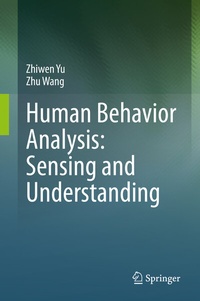
Human Behavior Analysis: Sensing and Understanding
Description

Over the last decade, there has been a growing interest in human behavior analysis, motivated by societal needs such as security, natural interfaces, affective computing, and assisted living. However, the accurate and non-invasive detection and recognition of human behavior remain major challenges and the focus of many research efforts.
Traditionally, in order to identify human behavior, it is first necessary to continuously collect the readings of physical sensing devices (e.g., camera, GPS, and RFID), which can be worn on human bodies, attached to objects, or deployed in the environment. Afterwards, using recognition algorithms or classification models, the behavior types can be identified so as to facilitate advanced applications. Although such traditional approaches deliver satisfactory performance and are still widely used, most of them are intrusive and require specific sensing devices, raising issues such as privacy and deployment costs.
In this book, we will present our latest findings on non-invasive sensing and understanding of human behavior. Specifically, this book differs from existing literature in the following senses. Firstly, we focus on approaches that are based on non-invasive sensing technologies, including both sensor-based and device-free variants. Secondly, while most existing studies examine individual behaviors, we will systematically elaborate on how to understand human behaviors of various granularities, including not only individual-level but also group-level and community-level behaviors. Lastly, we will discuss the most important scientific problems and open issues involved in human behavior analysis.
More details
Other editions
Additional editions
Persons
Zhiwen Yu is a Full Professor of Computer Science at Northwestern Polytechnical University, China. He worked as an Alexander Von Humboldt Fellow at Mannheim University, Germany, from November 2009 to October 2010, and as a research fellow at Kyoto University, Japan, from February 2007 to January 2009. His research interests include pervasive computing, context-aware systems, and personalization. He has served as an Associate Editor or Guest Editor for a number of publications, e.g. IEEE Communications Magazine, IEEE THMS, and ACM TIST.
Zhu Wang is an Associate Professor of Computer Science at Northwestern Polytechnical University, China. He received his B.Eng., M.Eng. and Ph.D. degrees in Computer Science and Technology in 2006, 2009, and 2013, respectively, from the same university. From 2010 to 2012, he was a research fellow at the Institute TELECOM SudParis, France. His research interests include pervasive computing, social network analysis, and healthinformatics.
