

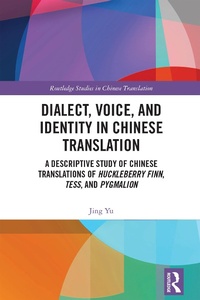
Dialect, Voice, and Identity in Chinese Translation
A Descriptive Study of Chinese Translations of Huckleberry Finn, Tess, and Pygmalion
1st Edition
Published on 12. July 2023
234 pages
978-1-000-89670-1 (ISBN)
Description

Dialect, Voice, and Identity in Chinese Translation is the first book-length attempt to undertake a descriptive investigation of how dialect in British and American novels and dramas is translated into Chinese.
Dialect plays an essential role in creating a voice of difference for the regional, social, or ethnic Others in English fiction. Translating dialect involves not only the textual representation of a different voice with target linguistic resources but also the reconstruction of various cultural, social, and ethnic identities and relations on the target side. This book provides a descriptive study of 277 Chinese translations published from 1931 to 2020 for three fictions - The Adventures of Huckleberry Finn, Tess of the d'Urbervilles, and Pygmalion - with a special focus on how the Dorset dialect, African American Vernacular English, and cockney in them have been translated in the past century in China. It provides a comprehensive description of the techniques, strategies, tendencies, norms, and universals as well as diachronic changes and stylistic evolutions of the language used in dialect translation into Chinese. An interdisciplinary perspective is adopted to conduct three case studies of each fiction to explore the negotiation, reformulation, and reconstruction via dialect translation of the identities for Others and Us and their relations in the Chinese context.
This book is intended to act as a useful reference for scholars, teachers, translators, and graduate students from disciplines such as translation, sociolinguistics, literary and cultural studies, and anyone who shows interest in dialect translation, the translation of American and British literature, Chinese language and literature, identity studies, and cross-cultural studies.
Dialect plays an essential role in creating a voice of difference for the regional, social, or ethnic Others in English fiction. Translating dialect involves not only the textual representation of a different voice with target linguistic resources but also the reconstruction of various cultural, social, and ethnic identities and relations on the target side. This book provides a descriptive study of 277 Chinese translations published from 1931 to 2020 for three fictions - The Adventures of Huckleberry Finn, Tess of the d'Urbervilles, and Pygmalion - with a special focus on how the Dorset dialect, African American Vernacular English, and cockney in them have been translated in the past century in China. It provides a comprehensive description of the techniques, strategies, tendencies, norms, and universals as well as diachronic changes and stylistic evolutions of the language used in dialect translation into Chinese. An interdisciplinary perspective is adopted to conduct three case studies of each fiction to explore the negotiation, reformulation, and reconstruction via dialect translation of the identities for Others and Us and their relations in the Chinese context.
This book is intended to act as a useful reference for scholars, teachers, translators, and graduate students from disciplines such as translation, sociolinguistics, literary and cultural studies, and anyone who shows interest in dialect translation, the translation of American and British literature, Chinese language and literature, identity studies, and cross-cultural studies.
More details
Series
Edition
1. Auflage
Language
English
Place of publication
London
United Kingdom
Publishing group
Taylor & Francis Ltd
Target group
College/higher education
Professional and scholarly
Illustrations
24 Tables, black and white; 31 Line drawings, black and white; 31 Illustrations, black and white
ISBN-13
978-1-000-89670-1 (9781000896701)
Copyright in bibliographic data and cover images is held by Nielsen Book Services Limited or by the publishers or by their respective licensors: all rights reserved.
Schweitzer Classification
Other editions
Additional editions
Jing Yu
Dialect, Voice, and Identity in Chinese Translation
A Descriptive Study of Chinese Translations of Huckleberry Finn, Tess, and Pygmalion
Book
11/2024
1st Edition
Routledge
€63.20
Shipment within 10-20 days
Jing Yu
Dialect, Voice, and Identity in Chinese Translation
A Descriptive Study of Chinese Translations of Huckleberry Finn, Tess, and Pygmalion
Book
07/2023
1st Edition
Routledge
€196.20
Shipment within 10-20 days
Person
Jing Yu is an associate professor at School of Foreign Languages, Shanghai Jiao Tong University, China, with a PhD in translation and interpreting studies from The Hong Kong Polytechnic University. Her research interests include literary translation, translation theories, dialect translation, and audio-visual translation, on which she has published two books in Chinese and over two dozen articles in peer-reviewed journals including Target, Translation and Interpreting Studies, Perspectives, IRCL, Neohelicon, Language and Literature, and Chinese Translators Journal.
Content
Acknowledgments
1. Translating dialect, recreating a voice of difference
1.1 Distinguishing literary dialect from dialect literature
1.2 Voice of difference and the construction of identity for Others
1.3 The (un)translatability of literary dialect
1.4 Approaches and research methods
1.5 Originality and contribution
1.6 Outline of the book
2. Dialect in literature and the various voices in translation
2.1 Dialect in society
2.2 Literary dialect in British and American fiction
2.3 Dialect in Chinese literature
2.4 Literary dialect in translation
3. Standard Chinese and the standardization of dialect
3.1 Dialect in Huck, Tess, and Pygmalion
3.2 Publication of the Chinese translations
3.3 Standardization and the norm of standard Chinese
3.4 Colloquialization and the norm of colloquial speech
4. Creating a different voice: Strategies, tendencies and norms
4.1 Linguistic features and varieties for creating a different voice
4.2 Linguistic varieties for creating a different voice
4.3 Lexicalization and the universal of dialect normalization
4.4 Phoneticization and the translation of African American English
4.5 A diachronic tendency from heterogeneity to homogeneity
5. Register varieties in dialect translation and the reconstruction of Jim's identity in Huck
5.1 Misconception about standard language in dialect translation
5.2 The myth of standard language and the colloquial variety
5.3 Register variety as identity index
5.4 The multiple variations in Twain's Huck
5.5 The vulgar variety and the reconstruction of Jim as Us
5.6 Translating dialects and registers: An integrated approach
6. Dialect frequency and the translation of various dialect voices in Tess
6.1 Dialect frequency and the sub-voices in literary dialect
6.2 A quantitative method for dialect frequency measure
6.3 Translating the various dialectal voices in Tess
6.4 The simplification tendency between early and late translations
6.5 Pioneer translators and follower translators
7. Eliza's two voices and the translation of gender identity in Pygmalion
7.1 Identity reframing in translation
7.2 Multiple themes of Shaw's Pygmalion and Eliza's gendered voice
7.3 Eliza's engendered voice in the 1945 translation
7.4 Eliza's equalitarian voice in the 1956 translation
7.5 The paradox of gender (in)equality and (in)visibility
8. Conclusion
Appendix: List of Chinese translations for Huckleberry Finn, Tess, and Pygmalion from 1931 to 2020
Index
1. Translating dialect, recreating a voice of difference
1.1 Distinguishing literary dialect from dialect literature
1.2 Voice of difference and the construction of identity for Others
1.3 The (un)translatability of literary dialect
1.4 Approaches and research methods
1.5 Originality and contribution
1.6 Outline of the book
2. Dialect in literature and the various voices in translation
2.1 Dialect in society
2.2 Literary dialect in British and American fiction
2.3 Dialect in Chinese literature
2.4 Literary dialect in translation
3. Standard Chinese and the standardization of dialect
3.1 Dialect in Huck, Tess, and Pygmalion
3.2 Publication of the Chinese translations
3.3 Standardization and the norm of standard Chinese
3.4 Colloquialization and the norm of colloquial speech
4. Creating a different voice: Strategies, tendencies and norms
4.1 Linguistic features and varieties for creating a different voice
4.2 Linguistic varieties for creating a different voice
4.3 Lexicalization and the universal of dialect normalization
4.4 Phoneticization and the translation of African American English
4.5 A diachronic tendency from heterogeneity to homogeneity
5. Register varieties in dialect translation and the reconstruction of Jim's identity in Huck
5.1 Misconception about standard language in dialect translation
5.2 The myth of standard language and the colloquial variety
5.3 Register variety as identity index
5.4 The multiple variations in Twain's Huck
5.5 The vulgar variety and the reconstruction of Jim as Us
5.6 Translating dialects and registers: An integrated approach
6. Dialect frequency and the translation of various dialect voices in Tess
6.1 Dialect frequency and the sub-voices in literary dialect
6.2 A quantitative method for dialect frequency measure
6.3 Translating the various dialectal voices in Tess
6.4 The simplification tendency between early and late translations
6.5 Pioneer translators and follower translators
7. Eliza's two voices and the translation of gender identity in Pygmalion
7.1 Identity reframing in translation
7.2 Multiple themes of Shaw's Pygmalion and Eliza's gendered voice
7.3 Eliza's engendered voice in the 1945 translation
7.4 Eliza's equalitarian voice in the 1956 translation
7.5 The paradox of gender (in)equality and (in)visibility
8. Conclusion
Appendix: List of Chinese translations for Huckleberry Finn, Tess, and Pygmalion from 1931 to 2020
Index
