

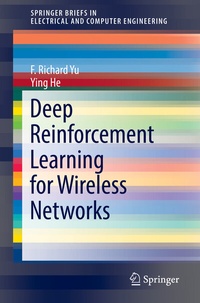
Deep Reinforcement Learning for Wireless Networks
Description

This Springerbrief presents a deep reinforcement learning approach to wireless systems to improve system performance. Particularly, deep reinforcement learning approach is used in cache-enabled opportunistic interference alignment wireless networks and mobile social networks. Simulation results with different network parameters are presented to show the effectiveness of the proposed scheme.
There is a phenomenal burst of research activities in artificial intelligence, deep reinforcement learning and wireless systems. Deep reinforcement learning has been successfully used to solve many practical problems. For example, Google DeepMind adopts this method on several artificial intelligent projects with big data (e.g., AlphaGo), and gets quite good results..
Graduate students in electrical and computer engineering, as well as computer science will find this brief useful as a study guide. Researchers, engineers, computer scientists, programmers, and policy makers will also find this brief to be a useful tool.
More details
Other editions
Additional editions
Content
1.1 - A Brief Journey Through ``Deep Reinforcement Learning for Wireless Networks'' [Seite 6]
2 - Contents [Seite 8]
3 - 1 Introduction to Machine Learning [Seite 10]
3.1 - 1.1 Supervised Learning [Seite 10]
3.1.1 - 1.1.1 k-Nearest Neighbor (k-NN) [Seite 11]
3.1.2 - 1.1.2 Decision Tree (DT) [Seite 11]
3.1.3 - 1.1.3 Random Forest [Seite 12]
3.1.4 - 1.1.4 Neural Network (NN) [Seite 14]
3.1.4.1 - Random NN [Seite 14]
3.1.4.2 - Deep NN [Seite 15]
3.1.4.3 - Convolutional NN [Seite 15]
3.1.4.4 - Recurrent NN [Seite 15]
3.1.5 - 1.1.5 Support Vector Machine (SVM) [Seite 16]
3.1.6 - 1.1.6 Bayes' Theory [Seite 16]
3.1.7 - 1.1.7 Hidden Markov Models (HMM) [Seite 18]
3.2 - 1.2 Unsupervised Learning [Seite 18]
3.2.1 - 1.2.1 k-Means [Seite 18]
3.2.2 - 1.2.2 Self-Organizing Map (SOM) [Seite 19]
3.3 - 1.3 Semi-supervised Learning [Seite 20]
3.4 - References [Seite 20]
4 - 2 Reinforcement Learning and Deep Reinforcement Learning [Seite 23]
4.1 - 2.1 Reinforcement Learning [Seite 23]
4.2 - 2.2 Deep Q-Learning [Seite 24]
4.3 - 2.3 Beyond Deep Q-Learning [Seite 25]
4.3.1 - 2.3.1 Double DQN [Seite 25]
4.3.2 - 2.3.2 Dueling DQN [Seite 26]
4.4 - References [Seite 26]
5 - 3 Deep Reinforcement Learning for Interference Alignment Wireless Networks [Seite 28]
5.1 - 3.1 Introduction [Seite 28]
5.2 - 3.2 System Model [Seite 30]
5.2.1 - 3.2.1 Interference Alignment [Seite 30]
5.2.2 - 3.2.2 Cache-Equipped Transmitters [Seite 31]
5.3 - 3.3 Problem Formulation [Seite 32]
5.3.1 - 3.3.1 Time-Varying IA-Based Channels [Seite 32]
5.3.2 - 3.3.2 Formulation of the Network's Optimization Problem [Seite 33]
5.3.2.1 - System State [Seite 34]
5.3.2.2 - System Action [Seite 35]
5.3.2.3 - Reward Function [Seite 35]
5.4 - 3.4 Simulation Results and Discussions [Seite 38]
5.4.1 - 3.4.1 TensorFlow [Seite 39]
5.4.2 - 3.4.2 Simulation Settings [Seite 40]
5.4.3 - 3.4.3 Simulation Results and Discussions [Seite 42]
5.5 - 3.5 Conclusions and Future Work [Seite 49]
5.6 - References [Seite 50]
6 - 4 Deep Reinforcement Learning for Mobile Social Networks [Seite 52]
6.1 - 4.1 Introduction [Seite 52]
6.1.1 - 4.1.1 Related Works [Seite 54]
6.1.2 - 4.1.2 Contributions [Seite 55]
6.2 - 4.2 System Model [Seite 56]
6.2.1 - 4.2.1 System Description [Seite 56]
6.2.2 - 4.2.2 Network Model [Seite 57]
6.2.3 - 4.2.3 Communication Model [Seite 58]
6.2.4 - 4.2.4 Cache Model [Seite 59]
6.2.5 - 4.2.5 Computing Model [Seite 60]
6.3 - 4.3 Social Trust Scheme with Uncertain Reasoning [Seite 61]
6.3.1 - 4.3.1 Trust Evaluation from Direct Observations [Seite 62]
6.3.2 - 4.3.2 Trust Evaluation from Indirect Observations [Seite 63]
6.3.2.1 - Belief Function [Seite 64]
6.3.2.2 - Dempster's Rule of Combining Belief Functions [Seite 65]
6.4 - 4.4 Problem Formulation [Seite 66]
6.4.1 - 4.4.1 System State [Seite 66]
6.4.2 - 4.4.2 System Action [Seite 67]
6.4.3 - 4.4.3 Reward Function [Seite 68]
6.5 - 4.5 Simulation Results and Discussions [Seite 69]
6.5.1 - 4.5.1 Simulation Settings [Seite 70]
6.5.2 - 4.5.2 Simulation Results [Seite 71]
6.6 - 4.6 Conclusions and Future Work [Seite 75]
6.7 - References [Seite 76]
