

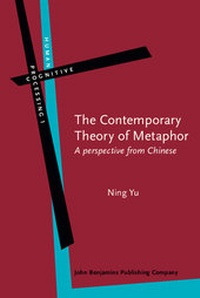
The Contemporary Theory of Metaphor
A perspective from Chinese
1st Edition
Published on 15. July 1998
X, 278 pages
978-90-272-8273-6 (ISBN)
Description

This comparative study of Chinese and English metaphor contributes to the search for metaphoric universals by placing the contemporary theory of metaphor in a broad cross-linguistic and cross-cultural perspective. The author explores to what degree abstract reasoning is metaphorical and which conceptual metaphors are culture specific, wide spread or universal in a cognitive and cultural context.
The empirical studies presented reinforce the view that metaphor is the main mechanism through which abstract concepts are comprehended and abstract reasoning is performed. They also support, from the perspective of Chinese, the candidacy of some conceptual metaphors for metaphorical universals. These include, for instance, the ANGER IS HEAT metaphor, the HAPPY IS UP metaphor (emotions), the TIME AS SPACE metaphor, and the Event Structure Metaphor. It seems that these conceptual metaphors are grounded in some basic human experiences that may be universal to all human beings.
The empirical studies presented reinforce the view that metaphor is the main mechanism through which abstract concepts are comprehended and abstract reasoning is performed. They also support, from the perspective of Chinese, the candidacy of some conceptual metaphors for metaphorical universals. These include, for instance, the ANGER IS HEAT metaphor, the HAPPY IS UP metaphor (emotions), the TIME AS SPACE metaphor, and the Event Structure Metaphor. It seems that these conceptual metaphors are grounded in some basic human experiences that may be universal to all human beings.
More details
Other editions
Additional editions
Book
07/1998
John Benjamins Publishing Co
€116.60
Shipment within 10-15 days
Person
Content
- The Contemporary Theory of Metaphor
- Editorial page
- Title page
- Copyright page
- Table of contents
- Acknowledgments
- Chapter 1. Introduction
- Chapter 2. The Contemporary Theory: A Review
- 2.1. Views of metaphor: Classical vs. contemporary
- 2.2. Cognitive linguistics and cognitive semantics
- 2.3. Conceptual and linguistic metaphors and metaphor systems
- 2.4. Experiential basis of metaphor: The notion of embodiment
- 2.5. Image schemas and the Invariance Principle
- 2.6. Conventional and novel metaphors
- 2.7. Summary of findings of the contemporary theory
- 2.8. Criticisms of the contemporary theory
- 2.9. Questions faced by the contemporary theory
- Chapter 3. Emotion Metaphors
- 3.1. Language of emotions
- 3.2. Anger metaphors in English
- 3.3. Anger metaphors in Chinese
- 3.4. Happiness metaphors in English
- 3.5. Happiness metaphors in Chinese
- 3.6. The underlying model of the metaphors
- 3.7. Summary and discussion
- Chapter 4. The Time as Space Metaphor
- 4.1. Conceptions of space and time
- 4.2. Alverson's cross-cultural and cross-linguistic study
- 4.3. Lakoffs studies in English
- 4.4. Time as space in Chinese
- 4.4.1. Evidence in the lexicon
- 4.4.1.1. The past, the present, and the future
- 4.4.1.2. The verbs in collocation with 'past'and 'future'
- 4.4.1.3. Seemingly contradictory cases
- 4.4.1.4. Spatial terms used in the temporal domain
- 4.4.2. Evidence in the inference patterns
- 4.4.2.1. Case One: time as moving object
- 4.4.2.2. Case Two: time as bounded space
- 4.4.2.3. The duality: mixture of Case One and Case Two
- 4.4.2.4. Another case: time and observer moving in the same direction
- 4.5. Summary and discussion
- Chapter 5. The Event Structure Metaphor
- 5.1. The conception of events
- 5.2. The Event Structure Metaphor in English
- 5.2.1. The location-dual
- 5.2.2. The object-dual
- 5.3. The location-version in Chinese
- 5.3.1. States
- 5.3.2. Changes
- 5.3.3. Causes
- 5.3.4. Actions
- 5.3.5. Purposes
- 5.3.6. Means
- 5.3.7. Difficulties
- 5.3.8. Others
- 5.4. The object-version in Chinese
- 5.4.1. Attributes
- 5.4.2. Changes
- 5.4.3. Causes
- 5.4.4. Actions
- 5.4.5. Purposes
- 5.5. Mixture of location-version and object-version
- 5.6. Summary and discussion
- Chapter 6. Conclusion
- Appendix
- The Character Version of the Chinese Examples
- Examples in Chapter 3.
- Examples in Chapter 4.
- Examples in Chapter 5.
- Notes
- Notesto Chapter 1.
- Notes to Chapter 2.
- Notes to Chapter 3.
- Notes to Chapter 4.
- Notes to Chapter 5.
- References
- Name Index
- Subject Index
