

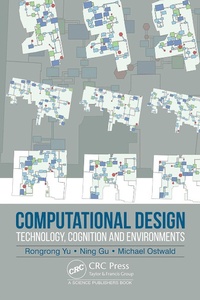
Computational Design
Technology, Cognition and Environments
1st Edition
Published on 25. July 2021
252 pages
978-0-429-52290-1 (ISBN)
Description

New computational design tools have evolved rapidly and been increasingly applied in the field of design in recent years, complimenting and even replacing the traditional design media and approaches. Design as both the process and product are changing due to the emergence and adoption of these new technologies. Understanding and assessing the impact of these new computational design environments on design and designers is important for advancing design in the contemporary context. Do these new computational environments support or hinder design creativity? How do those tools facilitate designers' thinking? Such knowledge is also important for the future development of design technologies. Research shows that design is never a mysterious non-understandable process, for example, one general view is that design process shares a common analysis-synthesis-evaluation model, during which designers interact between design problem and solution spaces. Understanding designers' thinking in different environments is the key to design research, education and practice.
This book focuses on emerging computational design environments, whose impact on design and designers have not been comprehensively and systematically studied. It comprises three parts. The history and recent developments of computational design technologies are introduced in Part I. The main categories of technologies cover from computer-aided drafting and modelling tools, to visual programming and scripting tools for algorithmic design, to advanced interfaces and platforms for interactions between designers, between designers and computers, and between the virtual environment and the physical reality. To critically explore design thinking, especially in these new computational design environments, formal approaches to studying design thinking and design cognition are introduced and compared in Part II, drawing on literature and studies from the 70s to the current era. Part III concludes the book by exploring the impact of different computational design technologies on design and designers, using a series of case studies conducted by the author team building on their close collaboration over the past five years. The book offers new insights into designers' thinking in the rapidly evolving computational design environments, which have not been critically and systematically studied and reported in the current literature.
The book is meant for design researchers, educators and students, professional practitioners and consultants, as well as people who are interested in computational design in general.
This book focuses on emerging computational design environments, whose impact on design and designers have not been comprehensively and systematically studied. It comprises three parts. The history and recent developments of computational design technologies are introduced in Part I. The main categories of technologies cover from computer-aided drafting and modelling tools, to visual programming and scripting tools for algorithmic design, to advanced interfaces and platforms for interactions between designers, between designers and computers, and between the virtual environment and the physical reality. To critically explore design thinking, especially in these new computational design environments, formal approaches to studying design thinking and design cognition are introduced and compared in Part II, drawing on literature and studies from the 70s to the current era. Part III concludes the book by exploring the impact of different computational design technologies on design and designers, using a series of case studies conducted by the author team building on their close collaboration over the past five years. The book offers new insights into designers' thinking in the rapidly evolving computational design environments, which have not been critically and systematically studied and reported in the current literature.
The book is meant for design researchers, educators and students, professional practitioners and consultants, as well as people who are interested in computational design in general.
More details
Edition
1. Auflage
Language
English
Place of publication
London
United Kingdom
Publishing group
Taylor & Francis Ltd
Target group
College/higher education
Illustrations
33 Tables, black and white; 7 Illustrations, color; 43 Illustrations, black and white
ISBN-13
978-0-429-52290-1 (9780429522901)
Copyright in bibliographic data and cover images is held by Nielsen Book Services Limited or by the publishers or by their respective licensors: all rights reserved.
Schweitzer Classification
Other editions
Additional editions
Rongrong Yu | Ning Gu | Michael J. Ostwald
Computational Design
Technology, Cognition and Environments
Book
09/2023
1st Edition
CRC Press
€84.50
Shipment within 15-20 days
Rongrong Yu | Ning Gu | Michael J. Ostwald
Computational Design
Technology, Cognition and Environments
Book
08/2021
1st Edition
CRC Press
€250.60
Shipment within 15-20 days
Persons
Dr. Rongrong Yu is a lecturer in Architecture & Design at Griffith University, Australia. Her research areas include computational design, design cognition and computational design analysis. Dr Yu's research has been published in high impact journals and major international conferences, within architecture and design computing fields. She's also a reviewer and editorial board member for a number of international journals and conferences.
Professor Ning Gu is Professor in Architecture at University of South Australia (UniSA). His most significant research contributions are in design computing and cognition. The outcomes of his research have been documented in over 190 peer-reviewed publications, supported by funding from the Australian Research Council, Office for Learning and Teaching and Cooperative Research Centres. He is an Associate Editor of Architectural Science Review and has guest edited/chaired major international journals/conferences in the field.
Professor Michael J. Ostwald is Associate Dean of Research and Professor of Architectural Analytics at UNSW, Sydney. He has a PhD in architectural history and theory and a DSc in design mathematics and computing. Michael is Co-Editor-in-Chief of the Nexus Network Journal: Architecture and Mathematics (Springer) and the editorial board member of ARQ (Cambridge) and Architectural Theory Review (Taylor and Francis).
Professor Ning Gu is Professor in Architecture at University of South Australia (UniSA). His most significant research contributions are in design computing and cognition. The outcomes of his research have been documented in over 190 peer-reviewed publications, supported by funding from the Australian Research Council, Office for Learning and Teaching and Cooperative Research Centres. He is an Associate Editor of Architectural Science Review and has guest edited/chaired major international journals/conferences in the field.
Professor Michael J. Ostwald is Associate Dean of Research and Professor of Architectural Analytics at UNSW, Sydney. He has a PhD in architectural history and theory and a DSc in design mathematics and computing. Michael is Co-Editor-in-Chief of the Nexus Network Journal: Architecture and Mathematics (Springer) and the editorial board member of ARQ (Cambridge) and Architectural Theory Review (Taylor and Francis).
Content
Introduction. Emergent technologies in computational design. Understanding design cognition in computational and generative design. Cognitive impacts and computational design environments. Conclusion.
