

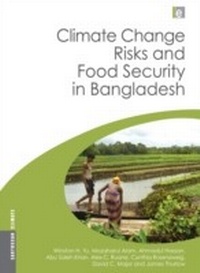
Climate Change Risks and Food Security in Bangladesh
1st Edition
Published on 23. September 2010
176 pages
978-1-136-53250-4 (ISBN)
Description

Managing climate variability and change remains a key development and food security issue in Bangladesh. Despite significant investments, floods, droughts, and cyclones during the last two decades continue to cause extensive economic damage and impair livelihoods. Climate change will pose additional risks to ongoing efforts to reduce poverty. This book examines the implications of climate change on food security in Bangladesh and identifies adaptation measures in the agriculture sector using a comprehensive integrated framework.
First, the most recent science available is used to characterize current climate and hydrology and its potential changes. Second, country-specific survey and biophysical data is used to derive more realistic and accurate agricultural impact functions and simulations. A range of climate risks (i.e. warmer temperatures, higher carbon dioxide concentrations, changing characteristics of floods, droughts and potential sea level rise) is considered to gain a more complete picture of potential agriculture impacts. Third, while estimating changes in production is important, economic responses may to some degree buffer against the physical losses predicted, and an assessment is made of these. Food security is dependent not only on production, but also future food requirements, income levels and commodity prices. Finally, adaptation possibilities are identified for the sector. This book is the first to combine these multiple disciplines and analytical procedures to comprehensively address these impacts. The framework will serve as a useful guide to design policy intervention strategies and investments in adaptation measures.
First, the most recent science available is used to characterize current climate and hydrology and its potential changes. Second, country-specific survey and biophysical data is used to derive more realistic and accurate agricultural impact functions and simulations. A range of climate risks (i.e. warmer temperatures, higher carbon dioxide concentrations, changing characteristics of floods, droughts and potential sea level rise) is considered to gain a more complete picture of potential agriculture impacts. Third, while estimating changes in production is important, economic responses may to some degree buffer against the physical losses predicted, and an assessment is made of these. Food security is dependent not only on production, but also future food requirements, income levels and commodity prices. Finally, adaptation possibilities are identified for the sector. This book is the first to combine these multiple disciplines and analytical procedures to comprehensively address these impacts. The framework will serve as a useful guide to design policy intervention strategies and investments in adaptation measures.
Reviews / Votes
'Bangladesh is projected as one of the countries to be most seriously affected by climate change. This study considers a range of climate risks and applies agroecological and economic models to assess the impact of climate change on the agricultural sector and the economy. A very useful book for agricultural researchers, development partners and policy makers.'Mahabub Hossain, Executive Director, BRAC, Dhaka, Bangladesh
'[This book presents] a clever integration of hydrologic, climatological, and economic models. Certainly one of the best attempts to assess quantitatively the effects of potential climate change on agricultural development in complex settings.'
Peter P. Rogers, Gordon McKay Professor of Environmental Engineering and Professor of City and Regional Planning, Harvard University
'The authors successfully draw together much of the current understanding of the situation in Bangladesh, enabling them to develop a framework for understanding and predicting changes in food security as a result of climate change.'
Institution of Environmental Sciences
More details
Series
Language
English
Place of publication
London
United Kingdom
Publishing group
Taylor & Francis Ltd
Target group
College/higher education
File size
5,67 MB
ISBN-13
978-1-136-53250-4 (9781136532504)
Copyright in bibliographic data and cover images is held by Nielsen Book Services Limited or by the publishers or by their respective licensors: all rights reserved.
Schweitzer Classification
Other editions
Additional editions
Winston Yu | Mozaharul Alam | Ahmadul Hassan
Climate Change Risks and Food Security in Bangladesh
Book
05/2016
1st Edition
Routledge
€76.94
Shipment within 10-20 days
Winston Yu | Mozaharul Alam | Ahmadul Hassan
Climate Change Risks and Food Security in Bangladesh
Book
06/2010
1st Edition
Earthscan Ltd
€215.41
Article not available at the moment
Persons
Winston H Yu is at the World Bank, Washington, DC, USA; Mozaharul Alam is at the Bangladesh Center for Advanced Studies, Dhaka, Bangladesh;
Ahmadul Hassan is at the Center for Environmental and Geographic Information Services, Dhaka, Bangladesh;
Abu Saleh Khan is at the Institute for Water Modeling, Dhaka, Bangladesh;
Alex Ruane, Cynthia Rosenzweig and David Major are at Columbia University, New York, USA;
James Thurlow is at the International Food Policy Research Institute, Washington DC, USA.
Ahmadul Hassan is at the Center for Environmental and Geographic Information Services, Dhaka, Bangladesh;
Abu Saleh Khan is at the Institute for Water Modeling, Dhaka, Bangladesh;
Alex Ruane, Cynthia Rosenzweig and David Major are at Columbia University, New York, USA;
James Thurlow is at the International Food Policy Research Institute, Washington DC, USA.
Content
1. Introduction
2. Vulnerability to Climate Risks
3. Future Climate Scenarios
4. Future Flood Hydrology
5. Future Crop Performance
6. Economy-Wide Impacts of Climate Risks
7. Adaptation Options in the Agriculture Sector
8. The Way Forward - Turning Ideas to Action
Annexes:
Annex 1 - Using DSSAT to Model Adaptation Impacts
Annex 2 - A Simple Economy-Wide CGE Model
Annex 3 - Constructing the Social Accounting Matrix for Bangladesh
Index
2. Vulnerability to Climate Risks
3. Future Climate Scenarios
4. Future Flood Hydrology
5. Future Crop Performance
6. Economy-Wide Impacts of Climate Risks
7. Adaptation Options in the Agriculture Sector
8. The Way Forward - Turning Ideas to Action
Annexes:
Annex 1 - Using DSSAT to Model Adaptation Impacts
Annex 2 - A Simple Economy-Wide CGE Model
Annex 3 - Constructing the Social Accounting Matrix for Bangladesh
Index
