

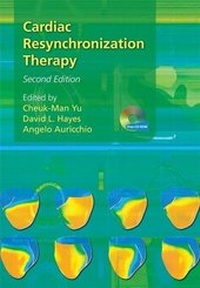
Cardiac Resynchronization Therapy
Description

More details
Other editions
Additional editions
Persons
Content
Foreword.
1 The epidemiology of heart failure and commonly associated conduction disorders: Maren E. Jeffery (University of Pennsylvnia School of Medicine) & Mariell Jessup (University of Pennsylvnia School of Medicine).
2 Comprehensive pharmacologic management strategies for heart failure: Garrie J. Haas (The Ohio State University Medical Center) & William T. Abraham (Ohio State University).
3 Electrical activation sequence: Cecilia Fantoni (IRCCS Policlinico San Donato, Italy) & Angelo Auricchio (Fondazione Cardiocentro Ticino, Switzerland).
4 Myocardial mechano-energetics: Tammo Delhaas (Maastricht University) & Frits W. Prinzen (Maastricht University).
5 Assessment of electrical and mechanical dyssynchrony: conventional echocardiography Ole-A. Breithardt (Academic Teaching Hospital of the University of Wuerzburg).
6 Newer echocardiographic techniques for the assessment of cardiac resynchronization therapy: Cheuk-Man Yu (The Chinese University of Hong Kong) & Qing Zhang (The Chinese University of Hong Kong).
7 Value of non-echocardiographic imaging techniques in cardiac resynchronization therapy: Claudia Ypenburg (Leiden University Medical Center), Gabe B. Bleeker (Leiden University Medical Center), Martin J. Schalij (Leiden University Medical Center) & Jeroen J. Bax (Leiden University Medical Center).
8 Programming and diagnostic features of cardiac resynchronization therapy devices: David Luria (Sheba Medical Center and Tel Aviv University), Osnat Gurevitz (Sheba Medical Center and Tel Aviv University) & Michael Glikson (Heart Institute, Sheba Medical Center).
9 Anatomy of the coronary sinus: Samuel J. Asirvatham (Mayo Clinic College of Medicine).
10 Techniques for visualizing the coronary sinus and coronary venous anatomy: Jagmeet P. Singh (Charlton Memorial Hospital, Boston) & Angelo Auricchio (Fondazione Cardiocentro Ticino, Switzerland).
11 Implantation techniques for cardiac resynchronization therapy: Michael O. Sweeney (Harvard Medical School).
12 Surgical approaches to epicardial left ventricular lead implantation for biventricular pacing: Sandhya K. Balaram (St. Luke's-Roosevelt Hospital Center, New York), Joseph J. DeRose, Jr (St Luke's-Roosevelt Hospital Center, New York), & Jonathan S. Steinberg (St Luke's-Roosevelt Hospital Center, New York).
13 Remote navigation implantation technique: Carlo Pappone (San Raffaele University-Hospital, Italy) & Vincenzo Santinelli (San Raffaele University-Hospital, Italy).
14 Clinical trials supporting current indications for CRT: David L. Hayes (Mayo College of Medicine) & William T. Abraham (Ohio State University).
15 Trials of CRT in atrial fi brillation and atrial rhythm management issues: Maurizio Gasparini (IRCCS Istituto Clinico Humanitas, Italy) & François Regoli (IRCCS Istituto Clinico Humanitas, Italy).
16 Ongoing trials to further shape the future of CRT: David L. Hayes (Mayo College of Medicine) & Cheuk-Man Yu (The Chinese University of Hong Kong).
17 Consideration of CRT in the pediatric population: Anne M. Dubin (Lucile Packard Children's Hospital at Stanford University).
18 Importance of the surface electrocardiogram for the assessment of cardiac resynchronization: S. Serge Barold (Tampa General Hospital), Michael C. Giudici (Genesis Heart Institute, Davenport) & Bengt Herweg (Tampa General Hospital).
19 Troubleshooting: Christophe Leclercq (CHU Pontchaillou, France), Philippe Mabo (CHU Pontchaillou, France) & J. Claude Daubert (CHU Pontchaillou, France).
20 Optimization of cardiac resynchronization therapy: Jeffrey Wing-Hong Fung (The Chinese University of Hong Kong), Stephane Garrigue (Clinique Saint-Augustin, France) & Cheuk-Man Yu (The Chinese University of Hong Kong).
21 Management strategies for patients not responding to CRT: John P. Boehmer (The Penn State College of Medicine, Hershey).
22 Device-based monitoring and lung impedance: Jeffrey Wing-Hong Fung (The Chinese University of Hong Kong), Philip B. Adamson (Oklahoma Cardiovascular Associates/Oklahoma Heart Hospital) & Cheuk-Man Yu (The Chinese University of Hong Kong).
23 Device-based patient management: Maria Rosa Costanzo (Edward Heart Hospital, Naperville) & Salpy Pamboukian (University of Alabama).
24 Health economics: Francisco Leyva (Good Hope Hospital, Sutton Coldfield)
