

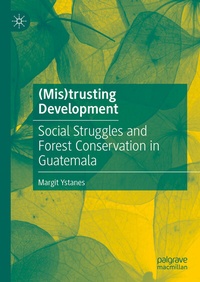
(Mis)trusting Development
Description

This book explores the role of trust in social struggles related to tropical forest preservation in El Petén, Guatemala. The author combines ethnographic exploration of how trust is formed in the local context with insights about postcolonial inequalities, which structure discourses on development and climate change in ways that exclude local actors.
Empirically, the book follows the complicated engagements of local concession-holding forest communities with outside actors aiming to develop archaeology-based tourism in Guatemala's Maya Biosphere Reserve. A central argument presented is that processes initiated for societal improvement need to be based on trusting relationships in order to be successful. This requires a context sensitive approach that takes into consideration how trust is formed and undermined in specific lifeworlds, as well as postcolonial inequalities. Theoretically, the book expands existing conceptualisations of trust and emphasises the potential for ethnographic research to further our understanding of this elusive phenomenon. "How do trust and mistrust permeate the fluid relations among communities living off the forests of northern Guatemala, outside stakeholders, and a global discourse of cultural heritage and climate change? This remarkable book by a pioneer of the anthropology of trust dissects a questionable development plan that threatens the rights and livelihood of a local population marginalized in a decision-making process aimed at protecting ancient archaeological sites, promoting tourism, and preserving the rain forest." - Antonius C. G. M. Robben, author of Argentina Betrayed: Memory, Mourning, and Accountability and Professor Emeritus of Anthropology at Utrecht University, the Netherlands"El Mirador is an extraordinary Mayan archaeological site in the jungles of northern Guatemala, accessible only by foot or helicopter. Poor mestizos, for whom the forest is home, have become expert tour guides and forest conservationists. Outsiders who view the ruins and forest as a resource primed for extraction have extravagant plans to "develop" the area. Ystanes offers a richly contextualized and theorized exploration of the struggles over caring for and living in and off this exceptional and fragile place, by focusing on the role of trust in the complex negotiations over its future and in identities more broadly. While showing how structural inequalities breed mistrust at every scale, this is a beautiful and nuanced take on existential questions of living in worlds shaped by violence and competition with historical knowledge, ecosystem survival, and livelihoods at stake." - Diane Nelson, Bass Chair and Eads Family Professor of Cultural Anthropology, Duke University, USA
Reviews / Votes
"How do trust and mistrust permeate the fluid relations among communities living off the forests of northern Guatemala, outside stakeholders, and a global discourse of cultural heritage and climate change? This remarkable book by a pioneer of the anthropology of trust dissects a questionable development plan that threatens the rights and livelihood of a local population marginalized in a decision-making process aimed at protecting ancient archaeological sites, promoting tourism, and preserving the rain forest." (Antonius C. G. M. Robben, author of Argentina Betrayed: Memory, Mourning, and Accountability and Professor Emeritus of Anthropology at Utrecht University)"El Mirador is an extraordinary Mayan archaeological site in the jungles of northern Guatemala, accessible only by foot or helicopter. Poor mestizos, for whom the forest is home, have become expert tour guides and forest conservationists. Outsiders who view the ruins and forest as a resource primed for extraction have extravagant plans to "develop" the area. Ystanes offers a richly contextualized and theorized exploration of the struggles over caring for and living in and off this exceptional and fragile place, by focusing on the role of trust in the complex negotiations over its future and in identities more broadly. While showing how structural inequalities breed mistrust at every scale, this is a beautiful and nuanced take on existential questions of living in worlds shaped by violence and competition with historical knowledge, ecosystem survival, and livelihoods at stake." (Diane Nelson, Bass Chair and Eads Family Professor of Cultural Anthropology, Duke University)
More details
Other editions
Additional editions
Person
Margit Ystanes
is Associate Professor at Volda University College, Norway. She is co-editor of
Trusting and Its Tribulations: Interdisciplinary Engagements with Intimacy, Sociality and Trust
(with Vigdis Broch-Due, 2016) and
The Social Life of Economic Inequalities in Contemporary Latin America: Decades of Change
(with Iselin Åsedotter Strønen, 2018).
