

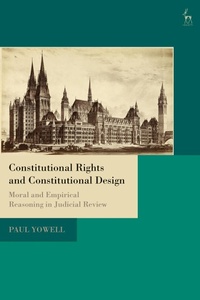
Constitutional Rights and Constitutional Design
Moral and Empirical Reasoning in Judicial Review
1st Edition
Published on 26. April 2018
192 pages
978-1-5099-1361-9 (ISBN)
Description

The decisions courts make in constitutional rights cases pervade our political life and touch on our most basic interests and values. The spread of judicial review of legislation around the world means that courts are increasingly called on to settle matters of moral and political controversy, including assisted suicide, data privacy, anti-terrorism measures, marriage, and abortion. But doubts regarding the institutional capacities of courts for deciding such questions are growing. Judges now regularly review social science research to assess whether a law will effectively achieve its aim, and at what cost to other interests. They cite studies and statistical information from psychology, sociology, medicine, and other disciplines in which they are rarely trained. This empirical reasoning proceeds alongside open-ended moral reasoning, with judges employing terms such as equality, liberty, and autonomy, then determining what these require in concrete circumstances. This book shows that courts were not designed for this kind of moral and empirical reasoning. It argues that in comparison to legislatures, the institutional capacities of courts are deficient. Legislatures are better equipped than courts for deliberating and decision-making in regard to the kinds of factual and moral issues that arise in constitutional rights cases. The book concludes by considering the implications of comparative institutional capacity for constitutional design. Is a system of judicial review of legislation something that constitutional framers should choose to adopt? If so, in what form? For countries with systems of judicial review, practical proposals are made to remedy deficiencies in the institutional capacities of courts.
More details
Edition
1. Auflage
Language
English
Place of publication
London
United Kingdom
Publishing group
Bloomsbury Publishing PLC
Target group
College/higher education
ISBN-13
978-1-5099-1361-9 (9781509913619)
Copyright in bibliographic data and cover images is held by Nielsen Book Services Limited or by the publishers or by their respective licensors: all rights reserved.
Schweitzer Classification
Other editions
Additional editions
Paul Yowell
Constitutional Rights and Constitutional Design
Moral and Empirical Reasoning in Judicial Review
Book
09/2020
Hart Publishing
€63.32
Shipment within 15-20 days
Paul Yowell
Constitutional Rights and Constitutional Design
Moral and Empirical Reasoning in Judicial Review
Book
04/2018
Hart Publishing
€116.80
Shipment within 15-20 days
Person
Paul Yowell is Associate Professor of Law at the University of Oxford, and the Benn Fellow and Tutor in Law at Oriel College, Oxford.
Photo courtesy of Faculty of Law, University of Oxford.
Photo courtesy of Faculty of Law, University of Oxford.
Content
1. Introduction
I. Removing the Blindfold
II. Scope of the Argument
III. Recovering Montesquieu
2. The Adjudication of Constitutional Rights
I. Constitutional Rights and Ordinary Legal Rights
II. Proportionality in Practice
III. Proportionality in the US?
IV. Absolute and Prima Facie Rights
V. Rights, Proportionality and Utilitarianism
VI. Rights as Interests
VII. Moral and Empirical Reasoning
VIII. Other Adjudicative Methods
IX. Conclusion
3. Are Rights Trumps?
I. The Shielded-Interest Theory
II. The Filtered-Preference Theory
III. Constitutional Rights and Statistics
IV. Revision of the Filtered-Preference Theory
4. Judicial Capacity and Empirical Research
I. Empirical Research and the Origins of Proportionality
II. Empirical Evidence in the US Supreme Court
III. Adjudicative Facts and Legislative Facts
IV. Finding Legislative Facts
V. The Courts and Social Science
VI. Case Studies
VII. Conclusion
5. Comparative Analysis of Institutional Capacities
I. The Basic Structure of Judicial Reasoning
II. The Basic Structure of Legislative Reasoning
III. Capacity for Empirical Reasoning
IV. Capacity for Moral Reasoning
V. The Tyranny of the Majority?
VI. Capacity to Protect Minorities
VII. An Historical Perspective
VIII. Conclusion
6. The Problem of Entrenchment
I. Legal Change and the Rule of Law
II. Rawls and the Perpetual Constitution
III. The Rarity of Constitutional Amendment
IV. The Legislative-Judicial Method of Reversing Nullification
Decisions
V. Conclusion
7. Judicial Review and Constitutional Design
I. The American and Kelsenian Models
II. Designing a Constitutional Court
III. Council of Revision
IV. Does the Legislature Need a Check?
V. Deference
VI. Conclusion
I. Removing the Blindfold
II. Scope of the Argument
III. Recovering Montesquieu
2. The Adjudication of Constitutional Rights
I. Constitutional Rights and Ordinary Legal Rights
II. Proportionality in Practice
III. Proportionality in the US?
IV. Absolute and Prima Facie Rights
V. Rights, Proportionality and Utilitarianism
VI. Rights as Interests
VII. Moral and Empirical Reasoning
VIII. Other Adjudicative Methods
IX. Conclusion
3. Are Rights Trumps?
I. The Shielded-Interest Theory
II. The Filtered-Preference Theory
III. Constitutional Rights and Statistics
IV. Revision of the Filtered-Preference Theory
4. Judicial Capacity and Empirical Research
I. Empirical Research and the Origins of Proportionality
II. Empirical Evidence in the US Supreme Court
III. Adjudicative Facts and Legislative Facts
IV. Finding Legislative Facts
V. The Courts and Social Science
VI. Case Studies
VII. Conclusion
5. Comparative Analysis of Institutional Capacities
I. The Basic Structure of Judicial Reasoning
II. The Basic Structure of Legislative Reasoning
III. Capacity for Empirical Reasoning
IV. Capacity for Moral Reasoning
V. The Tyranny of the Majority?
VI. Capacity to Protect Minorities
VII. An Historical Perspective
VIII. Conclusion
6. The Problem of Entrenchment
I. Legal Change and the Rule of Law
II. Rawls and the Perpetual Constitution
III. The Rarity of Constitutional Amendment
IV. The Legislative-Judicial Method of Reversing Nullification
Decisions
V. Conclusion
7. Judicial Review and Constitutional Design
I. The American and Kelsenian Models
II. Designing a Constitutional Court
III. Council of Revision
IV. Does the Legislature Need a Check?
V. Deference
VI. Conclusion
