

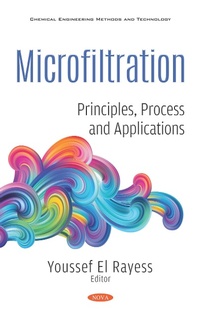
Microfiltration: Principles, Process and Applications
Published on 2. October 2019
242 pages
978-1-5361-6347-6 (ISBN)
Description

This book titled "Microfiltration: Principle, Process and Applications" is formed of 6 chapters covering many research aspects on microfiltration. These aspects include reviews and original research dealing mainly with fouling and cleaning of microfiltration membranes. In Chapter 1, mechanisms of fouling and factors affecting the fouling are presented. Also, it deals with techniques that assist mitigation of membrane fouling that occurs in microfiltration. The aim of Chapter 2 was the modelling and optimization by artificial neural network and genetic algorithm of yeast suspensions turbulence promoter assisted cross-flow microfiltration in concentration operation mode. Chapter 3 focuses on the principles, developments, implementation and application of microfiltration in wastewater treatment. In addition, the integration of microfiltration with other water and wastewater treatment technique is also included as well as the advantages and disadvantage of the microfiltration. The Chapter 4 objective is to introduce the most commonly used turbulence promoters' types. Furthermore, congenial studies on the turbulence promoters' application in the cross-flow MF regarding food industry streams and products are also presented within the chapter. In Chapter 5, the microfiltration process was used in order to obtain concentrated papaya (Carica papaya L.) pulp, evaluating the flux permeate from papaya treated pulp with enzyme pectinase and using different nominal mass molecular weights and different membranes materials. Chapter 6 discusses the performances and the quality of treated water of a Tunisian textile industry through a low-cost tubular ceramic membrane prepared by extrusion of a plastic paste prepared from clay powder mixed with organic additives and water.
More details
Other editions
Additional editions
Book
10/2019
Nova Science Publishers Inc
€210.94
Shipment within 15-20 days
Content
- Intro
- Contents
- Preface
- Chapter 1
- Intensification of Microfiltration Process
- Abstract
- Introduction
- Principles of Membrane Fouling in Microfiltration
- Concentration Polarization
- Membrane Fouling
- Fouling Mitigation in Cross-Flow Microfiltration
- Selection of Membrane and Membrane Material
- Module Design
- Optimization of Operating Conditions
- Dynamic Modules
- Static Turbulence Promoters
- Flux Improvement
- Turbulence Intensification
- Energy Consumption
- Conclusion
- Acknowledgments
- References
- Chapter 2
- Modelling and Optimization by Neural Networks and Genetic Algorithm of Yeast Suspensions Turbulence Promoter Assisted Cross-Flow Microfiltration in Concentration Operation Mode
- Abstract
- Introduction
- Methods
- Materials and Apparatus
- Experimental Protocol
- Calculations
- Defining Artificial Neural Network Architecture
- Data Compilation
- Selection of Learning Algorithm
- Defining the Number of Hidden Layer Neurons
- Importance of the Input Variables
- Optimization Procedure
- Elitist Non-Dominated Sorting Genetic Algorithm
- Results and Discussion
- Artificial Neural Network Modelling
- Learning Algorithm
- Number of Hidden Neurons
- Importance of the Input Variables
- Genetic Algorithm Multi-Objective Optimization
- Conclusion
- Acknowledgments
- References
- Chapter 3
- Microfiltration Overview: A Promising Technique for Wastewater Treatment and Reuse
- Abstract
- Introduction
- Microfiltration Systems for Wastewater Treatment
- Microfiltration for the Treatment of Oily Wastewater
- Microfiltration for Treatment of Industrial Wastewater
- Microfiltration Process for Domestic Wastewater Treatment
- Integration of Microfiltration with Other Handling Techniques for Wastewater Treatment
- Membrane Bioreactor as Effective Technology for Wastewater Treatment and Reuse
- Introduction
- Membrane Bioreactor for Wastewater Treatment and Reuse
- Studies on the Factors Affecting the Performance of Membrane Bioreactor
- Modification of Membrane Bioreactor to Enhance the Efficiency
- MBR Integration with Other Techniques for Wastewater Treatment
- Conclusion
- Acknowledgments
- References
- Chapter 4
- Turbulence Promoters Application towards Cross-Flow Microfiltration Process Enhancement
- Abstract
- Introduction
- Turbulence Promoters' Types Applied in Cross-Flow Microfiltration
- Kenics Static Mixer
- Aerating Static Mixers
- Twisted Tape
- Blade-Type Turbulence Promoter
- Helical Screw Insert
- Helical Baffle Insert
- Turbulence Promoters Applied in Cross-Flow Microfiltration of Food Industry Streams
- Cross-Flow Microfiltration Process Enhancement by Kenics Static Mixer Introduction
- Cross-Flow Microfiltration Process Enhancement by Twisted Tape Introduction
- Cross-Flow Microfiltration Process Enhancement by Blade-Type Turbulence Promoter Introduction
- Cross-Flow Microfiltration Process Enhancement by Helical Baffle Insert Introduction
- Conclusion
- References
- Chapter 5
- Lycopene Concentration Using Microfiltration Process
- Abstract
- Introduction
- Methods and Material
- Results and Discussion
- References
- Chapter 6
- Microfiltration Performances of Tubular Ceramic Membrane Made from Low-Cost Natural Material: Application for Tangential Wastewater Treatment
- Abstract
- Introduction
- Microfiltration Membrane Elaboration and Characterization
- Preparation of Microfiltration Membrane
- Characterization of Microfiltration Membrane
- Mechanical, Morphological and Porosity Characterization of the Ceramic Membrane
- Ceramic Membrane Permeability
- Application to Textile Industry Wastewater Treatment
- Microfiltration Performances
- Membrane Regeneration
- Ultrafiltration Membrane Elaboration and Characterization
- Active Layer Deposition and Characterization
- Permeate Flux and Fouling Rate of Bovine Serum Albumin BSA
- Effect of TMP on the Permeate Flux
- Evaluation of Resistances
- Conclusion
- References
- Editor's Contact Information
- Index
- Blank Page
