

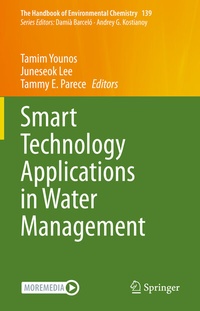
Smart Technology Applications in Water Management
Description

This book reviews the latest advances and practical applications of smart technologies applied to water resource management. Bridging environmental chemistry, engineering, and information technology, the book offers a multidisciplinary perspective on how digital innovations are reshaping water monitoring, infrastructure diagnostics, and decision-making processes.
Chapters by expert contributors cover topics such as the applications of machine learning for drinking water pipeline replacement, geospatial technologies, satellite and remote sensing technologies, Internet - of - Things (IOT), cybersecurity, robotics in water monitoring and artificial intelligence. Particular attention is given to the applications in real-time modelling of flood forecasting in urban drainage systems and the implementation of smart water networks.
With detailed case studies and industry insights, this book highlights practical implementations such as smart water networks, optimal sensor deployment, and AI-driven service line material detection. Given its breadth, the book is a valuable resource for researchers, scholars and students, and serves as a roadmap for water resource engineers and planners tackling water security and diverse water resources portfolios.
"Chapter 1197" is available open access under a Creative Commons Attribution 4.0
More details
Other editions
Additional editions
Persons
Dr. Tamim Younos has a doctoral degree in urban and environmental engineering from the University of Tokyo, Japan. His research and educational interests include sustainable water management and water and energy nexus in urban environments. Dr. Younos has led and/or participated in numerous interdisciplinary water research and educational projects and advised students in various disciplines including engineering, environmental sciences, geosciences, biology, economics, geography and urban planning. He has authored/co-authored 160+ publications, edited 9 books on water science & management topics, and has offered numerous national and international seminars, lectures and workshops. His recognitions include the American Water Resources Association (AWRA) Icko Iben Award; AWRA Fellow Award; Fulbright Scholar Award; President, Universities Council on Water Resources (UCOWR); and Japan Society for Promotion of Science (JSPS) Award.
Dr. Juneseok Lee is a Professor of Civil and Environmental Engineering at Manhattan University, a licensed Professional Engineer in California, and a board-certified Diplomate, Water Resources Engineer (D.WRE) with the American Academy of Water Resources Engineers. He holds both an M.S. and a Ph.D. in Civil and Environmental Engineering from Virginia Tech. Dr. Lee has authored or edited six books and published over 100 technical works, including peer-reviewed journal articles, book chapters, and research reports. He has delivered invited talks at numerous national and international conferences on water, environmental, and infrastructure engineering. He currently serves as an Associate Editor and Editorial Board Member for the ASCE Journal of Water Resources Planning and Management and AWWA Water Science , and is a Fellow of both ASCE and the Environmental and Water Resources Institute (EWRI).
Dr. Tammy E. Parece is an Assistant Professor of Teaching in Geography at The Ohio State University, USA. She has a PhD in Geospatial and Environmental Analysis from Virginia Tech, USA. Her research includes the physical and social evaluations of urban areas for urban agriculture. She has authored several book chapters and journal articles and presented many conference papers, related to urban agriculture. Additionally, she is interested in geographic education, including geospatial technology courses. Her publications include book chapters, journal articles, and several technical and laboratory manuals related to geospatial technology education. She has taught numerous professional development workshops in geospatial technologies. Additionally, she taught at Colorado Mesa University, USA, both traditional geography courses and geospatial technology courses, from 2016 to 2022, and developed their Geography Education and Outreach Program.
Content
Introduction: The evolution of smart technology applications in water management.- Real-time modelling of flood forecasting in urban drainage systems using Information and Communication Technology (ICT) and data assimilation.- The watershed health assessment framework: Integrating geospatial data and system science to advance natural resource management in Minnesota.- The technological evolution of Landsat Satellite System and its potential for water resources management.- Robotic technology applications in water environments: An overview.- Optimal sensor deployment technologies: An industry review with case studies.- Evolving strategies in drinking water pipeline replacement: From past practices to machine learning innovations.- Hydraulic transient-based pipeline condition assessment and its potential in smart water networks Service line material detection with the Internet of Things (IoT) devices and artificial intelligence (AI).- Service line material detection with the Internet of Things (IoT) devices and artificial intelligence (AI).- Cybersecurity application in water infrastructure: An overview.
