

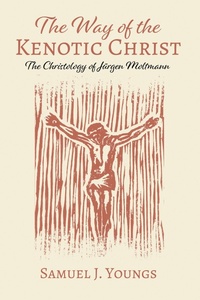
The Way of the Kenotic Christ
The Christology of Jürgen Moltmann
Published on 25. October 2019
180 pages
978-1-5326-6192-1 (ISBN)
Description

Despite his vast importance to twentieth-century theology, Jurgen Moltmann's Christology has yet to receive the same level of in-depth exploration as other topics in his thought. Samuel Youngs addresses this lacuna, providing the first exhaustive analysis of Moltmann's doctrine of Christ, including its key developments and controversial elements.
Youngs argues that Moltmann's doctrine of Christ is best understood as a unique variation of kenotic Christology. This vision of Christ encapsulates not only a series of vibrant ethical and eschatological points, but also serves Moltmann's overarching theological goal of empowering a church that lives and ministers "under the cross."
Part I highlights key facets of Moltmann's theological method before unfolding the range of diverse themes that characterize his Christology. Part II explores Moltmann's use of the "kenosis hymn" of Philippians 2, before interrogating Moltmann's relationship to christological tradition. Part III engages in an original systematization of Moltmann's Christology, centered on the theme of manifold, relational kenosis.
More details
Other editions
Additional editions
Book
10/2019
Wipf & Stock Publishers
€22.90
Shipment within 3-4 weeks
Book
10/2019
Wipf & Stock Publishers
€40.80
Shipment within 3-4 weeks
Person
Samuel J. Youngs is Associate Professor of Christan Studies at Bryan College, Adjunct Professor of Church History and Theology at Richmont Graduate University, and Academic Dean of the Mission School of Ministry (missionschoolofministry.com). He lives in Chattanooga, Tennessee, with his wife and three children.
Content
- Intro
- Title Page
- Acknowledgments
- Abbreviations
- Introduction
- Part I: Moltmann's Theological Method and Christological Thematics
- Chapter 1: Distinctives of Moltmann's Theological Approach
- The Christological Center of Moltmann's Theology
- Situating Moltmann's Christology: Methodological Considerations
- Conclusion: Christological Preliminaries
- Chapter 2: Themes in Moltmann's Christology
- Moltmann's Messianic/Promise Christology
- Moltmann's Solidarity/Firstborn Christology
- Moltmann's Pneumatological/Developmental Christology
- Conclusion: Looking Toward Moltmann's Kenotic Christology
- Part II: Locating Christological Kenosis in Moltmann
- Chapter 3: Moltmann's Hermeneutics of the Kenosis Hymn
- Philippians 2:5-8 and Its Christological Interpretations
- Exploring Moltmann's View
- Conclusion: From Kenotic Hymn to Kenotic Christ
- Chapter 4: Moltmann's Commitments
- Christology, Context, and Creed
- Conflicting Interpretations of Moltmann and Chalcedon
- Kenosis as Key to Moltmann's Incarnational Thought
- Conclusion: Toward the Kenotic Life of Christ
- Part III: The Life of Christ in Kenotic Key
- Chapter 5: The Way of the Kenotic Christ (I)
- Kenotic Mission: The Will of the Father
- Kenotic Efficacy: The Power of the Spirit
- Conclusion: Messiah-in-Process
- Chapter 6: The Way of the Kenotic Christ (II)
- Kenotic Identity: The Community of the Poor
- Kenotic Embodiment: The Frailty of the Flesh
- Conclusion: An Empathetic and Suffering Christ
- Chapter 7: Following the Way of the Kenotic Christ
- Summarizing the Christology: The Whole Self-Emptying
- The Christology's Horizon: Constructive Trajectories
- Conclusion: The Kenotic Christ in Moltmann's Thought
- Bibliography
