

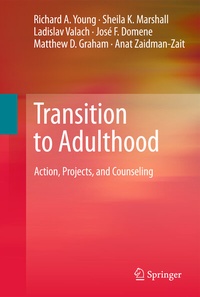
Transition to Adulthood
Action, Projects, and Counseling
1st Edition
Published on 8. September 2010
X, 238 pages
978-1-4419-6238-6 (ISBN)
Description

The transition to adulthood involves, for most individuals, moving from school to work, establishment of long-term relationships, possibly parenting, and a number of other psychosocial transformations. Now more than ever, there is a concern within popular and research literature about children growing up too soon or too late or failing to realize changes associated with being adult. With this in mind, the book intends to answer a series of timely questions in regard to transition to adulthood and propose a wholly new approach to counseling that enables youth to engage fully in their lives and achieve their best. Active Transition to Adulthood: A New Approach for Counseling will discuss the authors' work on the transition to adulthood (including early and late adolescence) from an entirely innovative perspective - action theory. Over a period of 10-15 years the authors have collected substantial data on adolescents and youth in transition, and will present an approach to counseling based on these data and cases. The action theory perspective in which the authors have grounded their work addresses the intentional, goal-directed behavior of persons and groups that is expressed through particular actions, longer-term projects, and life-encompassing careers. In this book, both transition to adulthood and counseling will be covered in the language of goal-directed action. In this way both transition and counseling reflect and capture the action, projects, and careers in which families, youth, and clients are engaged and use to construct on-going identity and other narratives.
Reviews / Votes
From the reviews:"Much research on youth focuses on general patterns within populations or subpopulations and is not very helpful for understanding - let alone helping - individual young people. This book provides a powerful new framework for understanding individual youth as they take on the tasks associated with becoming adults - identity, love, career, life style, and meaning. This framework (approach) helps us think about how these tasks are negotiated in daily contexts - and particularly in and through relationships with significant others. Useful for both researchers and practitioners, this book could serve as an excellent text for a course on the transition to adulthood, adolescence, or related topics. It also includes excellent case examples that make the concepts/ framework tangible." - Reed W. Larson, University of Illinois, Urbana, IL "This extraordinary team of authors brings remarkable insight and years of research to bear on the many facets of the dynamic transition to adulthood. The book attends to the very social nature of this transition by skillfully applying an action theoretical perspective to compelling case material. This masterfully written book is destined to become a landmark. It is intellectual and at the same time accessible. Brilliant!" - Donna Schultheiss, Cleveland State University, Cleveland, OH"Richard Young and colleagues present an extremely restrictive, intellectualized, analytical model of psychological processes that occur during development. . It is a conscious, purposeful attempt to devise a model of psychological functioning based on contemporary philosophical ideas and concerns. . The literature reviews in the chapters illustrating the application of action theory to various realms (e.g., relationships, career, suicide) are well researched and informative. This book would be most appreciated by academics and scholars interested in thecentral subject matter and associated philosophies." (Judith Kingstone, PsycCRITIQUES, Vol. 56 (40), October, 2011)More details
Series
Language
English
Place of publication
New York
United States
Publishing group
Springer US
Target group
Professional and scholarly
Product notice
Reflowable
Illustrations
IX, 235 p.
File size
2,16 MB
ISBN-13
978-1-4419-6238-6 (9781441962386)
DOI
10.1007/978-1-4419-6238-6
Schweitzer Classification
Other editions
Additional editions
Richard A. Young | Sheila K. Marshall | Ladislav Valach
Transition to Adulthood
Action, Projects, and Counseling
Book
10/2014
Springer
€106.99
Shipment within 15-20 days
Richard A. Young | Sheila K. Marshall | Ladislav Valach
Transition to Adulthood
Action, Projects, and Counseling
Book
09/2010
Springer
€149.79
Shipment within 15-20 days
Persons
Richard A. Young, Ph.D., is Professor of Counselling Psychology at the University of British Columbia. He is a Fellow of the American and Canadian Psychological Associations, a Registered Psychologist in British Columbia, and President of Division 16 (Counselling Psychology) of the International Association of Applied Psychology. He is a founding member of the Aeschi Group on Meeting the Suicidal Person. His current interests include the application of action theory and the qualitative action-project method to a variety of research topics, including the transition to adulthood, families, career development, health, and suicide.Sheila K. Marshall is an Associate Professor of Family Studies at the University of British Columbia. Her research investigates adolescent-parent interactions and the transfer and uptake of rights and responsibilities during the transition to adulthood. She is particularly interested in the management of information between adolescents and parents and how it, in turn, influences actions such as identity construction and resource sharing.Ladislav Valach is Oberassistant at the Institute of Psychology, Psychopathology and Clinical Intervention, University Zurich and a private practitioner. He is a founding member of the Aeschi Group on Meeting the Suicidal Person. His current interests include questions on organization and flow of actions, projects and long-term processes such as career, health, suicide, work, and life enhancement. Together with his colleagues he deals with practical, theoretical and methodological issues in his writing, teaching, discussing, counseling and psychotherapy.
Content
Transition to Adulthood: Introduction.- Transition to Adulthood as Goal-Directed Action.- Action and the practice of counseling for transitions.- Studying Transition Processes.- Relationships.- Emotion and the Transition to Adulthood.- Identity.- Family.- Work.- Culture.- Romantic Relationships.- Transition in the Context of Disability.- Suicide in the Context of the Transition to Adulthood.- Working with Narrative and Interpretation.- Using the Self-Confrontation Procedure in Counseling.
