

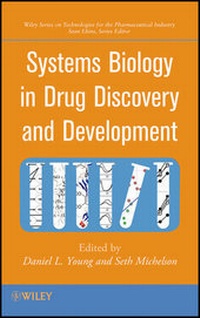
Systems Biology in Drug Discovery and Development
Description

Reviews / Votes
"I enjoyed reading this book as it should be essentialreading for those involved in drug discovery and development forall others who share an interest in this field." (International Society for the Study of Xenobiotics,2012) "In short, this is an indispensable tool for both experiencedand early stage investigators and others to understand the currentand future impact of systems biology on the drug discovery anddevelopment process." (Doody's, 6 January 2012)More details
Other editions
Additional editions
Persons
Content
Chapter 1. Introduction to systems biology in drug discovery and development.
1.1 Introduction.
Chapter 2. Methods for In Silico Biology: Model Construction and Analysis.
2.1 Introduction.
2.2 Model building.
2.3 Parameter estimation.
2.4. Model analysis.
2.5 Conclusions.
Chapter 3. Methods in In Silico Biology: Modeling Feedback Dynamics in Pathways.
3.1 Introduction.
3.2 Statistical modeling.
3.3 Mathematical modeling.
3.4 Feedback and feedforward.
3.5 Conclusions.
Chapter 4. Simulation of Population Variability in Pharmacokinetics.
4.1 Introduction.
4.2 PBPK modeling.
4.3 Simulation of pharmacokinetic variability.
4.4 Conclusions and future directions.
Part II: Applications to Drug Discovery.
Chapter 5. Applications of Systems Biology Approaches to Target Identification and Validation in Drug Discovery.
5.1 Introduction.
5.2 Typical drug discovery paradigm.
5.3 Integrated drug discovery.
5.4 Drivers of the disease phenotype: clinical endpoints and hypotheses.
5.5 Extracellular disease drivers: mechanistic biotherapeutic models.
5.6 Relevant cell models for clinical endpoints.
5.7 Intracellular disease drivers: signaling pathway quantification.
5.8 Target selection: dynamic pathway modeling.
5.9 Conclusions.
Chapter 6. Lead Identification and Optimization.
6.1 Introduction.
6.2 The systems biology toolkit.
6.3 Conclusions.
Chapter 7. The role of core biological motifs in dose-response modeling: an example with switch-like circuits.
7.1 Introduction: systems perspective in drug discovery.
7.2 Systems biology and toxicology.
7.3 Mechanistic/computational concepts in a molecular/cellular context.
7.4 Response motifs in cell signaling and their role in dose response.
7.5 Discussion and conclusions.
Chapter 8. Mechanism Based Pharmacokinetic-Pharmacodynamic Modeling During Discovery and Early Development.
8.1 Introduction.
8.2 Challenges in drug discovery and development: the need to bring together PK and PD.
8.3 Methodological aspects and concepts.
8.4 Application during lead optimization.
8.5 Application during clinical candidate selection.
8.6 Entry into human (EIH) preparation and translational PK/PD modeling.
8.7 PK/PD for toxicology study design and evaluation.
8.8 Justification of starting dose, calculation of safety margins, and support of phase I design.
8.9 Phase I and beyond.
8.10 Support of early formulation development.
8.11 Outlook and conclusions.
Part III: Applications to Drug Development.
Chapter 9. Developing Oncology Drugs Using Virtual Patients of Vascular Tumor Diseases.
9.1 Introduction.
9.2 Modeling angiogenesis.
9.3 Use of rigorous mathematical analysis for gaining insight on drug development.
9.4 Use of angiogenesis models in theranostics.
9.5 Use of angiogenesis models in drug salvage: the virtual patient technology.
9.6 Summary and conclusions.
Chapter 10. Systems Modeling Applied to Candidate Biomarker Identification.
10.1 Introduction.
10.2 Biomarker discovery approaches.
10.3 Examples of systems modeling approaches for identification of candidate biomarkers.
10.4 Conclusions.
Chapter 11. Simulating Clinical Trials.
11.1 Introduction.
11.2 Types of models used in clinical trial design.
11.3 Sources of prior information for designing clinical trials.
11.4 Aspects of a trial to be designed and optimized.
11.5 Trial simulation.
11.6 Optimizing designs.
11.7 Real world examples.
11.8 Conclusions.
Part IV: Synergies with other technologies.
Chapter 12. Pathway Analysis in Drug Discovery.
12.1 Introduction: pathway analysis, dynamic modeling, and network analysis.
12.2 Software systems for pathway analysis.
12.3 Pathway analysis in modern drug development pipeline.
12.4 Conclusions.
Chapter 13. Functional mapping for predicting drug response and enabling personalized medicine.
13.1 Introduction.
13.2 Functional mapping.
13.3 Predictive modeling.
13.4 Future directions.
Chapter 14. Future Outlook of Systems Biology.
14.1 Introduction.
14.2 Systems complexity in biological systems.
14.3 Models for quantitative integration of data.
14.4 Changing requirements for systems approaches during drug discovery and development.
14.5 Better models for better decisions.
14.6 Advancing personalized medicine.
14.7 Improving clinical trials and enabling more complex treatment approaches.
14.8 Collaboration and training for systems biologists.
14.9 Conclusions.
