

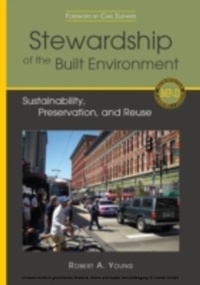
Stewardship of the Built Environment
Description

When we think of green building, we tend to picture new construction. But Robert A. Young argues that the greenest building is often the one that has already been built. In Stewardship of the Built Environment, he shows how rehabilitating and reusing existing structures holds untapped potential for achieving sustainable communities. Students and professionals alike will discover the multifaceted benefits of reuse. Young begins by describing how historic preservation in the United States, often overlooked because of the predominant focus on new construction, is actually an important sustainable design strategy. He then examines the social, environmental, and economic benefits of preservation-from the societal value of reusing existing buildings to financial incentives available for rehabilitation. Young concludes with insights into the future of reusing buildings as a sustainability strategy. He also provides several informative appendices, including a glossary of key terms and acronyms and recommendations for further reading. Readers will become familiar with essential terminology; sustainability and historic preservation metrics; government oversight processes; and opportunities for smart growth afforded by rehabilitation. This knowledge is key to preserving the past while building a sustainable future.
All prices
More details
Other editions
Additional editions
Person
Robert A. Young is Professor of Architecture and Director of the Historic Preservation Program at the University of Utah College of Architecture and Planning and is a LEED accredited professional engineer.
Content
Foreword
Preface
Acknowledgments
1. Overview and Introduction
Stewardship of the Built Environment
Application of SEE to the Built Environment
Social Contributions of Preservation and Reuse
Environmental Contributions of Preservation and Reuse
Economic Contributions of Preservation and Reuse
Sustainable Stewardship
2. Social Factors
Seeking Urbanism: Social Implications for Preservation and Reuse
Perspectives from Europe
Preservation Tools and Processes
Sociopolitical Framework
Collaborative Practice
Connecting the Dots
3. Environmental Factors
Environmental Indicators
Architectural Form as Environmental Control
Increasing Sustainability
4. Economic Factors
Economic Incentives
Economic Planning and Development Tools
Economic Indicators
5. Putting It All Together
Creating Community: Fort Douglas, Salt Lake City, Utah
Affirming the Environmental Contribution: Christman Company Headquarters, Lansing, Michigan
Creating an Economic Catalyst: The Old Post Office, St. Louis, Missouri
Lessons Learned
Future Directions and Imperatives
Appendix A: Abbreviations
Appendix B: Recommendations for Further Reading
References
Index.

