

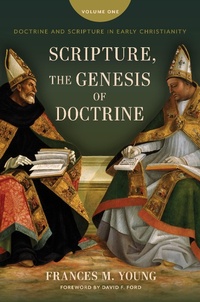
Scripture, the Genesis of Doctrine
Doctrine and Scripture in Early Christianity, Vol 1
Published on 19. October 2023
220 pages
978-1-4674-6628-8 (ISBN)
Description

How did we get from Scripture to creed?Historical criticism has revealed a gap between Scripture and the mainstream doctrines that define Christianity today. Not the least of these are the Trinity and two natures of Christ-widely accepted since the fifth century, but unfounded in historical readings of Scripture. How did these dogmas become so integral to the faith in the first place?Frances M. Young tackles this monumental question in a culmination of decades of biblical and patristic research. The first of two volumes exploring the emergence of doctrine in the early church, Scripture, the Genesis of Doctrine reframes the relationship between Scripture and doctrine according to the intellectual context of the first few centuries CE. Young situates the early Christians' biblical hermeneutic within the context of Greco-Roman learning without espousing historical relativism. Ultimately, Young argues that the scriptural canon and the Rule of Faith emerged concurrently in the early Church, and both were received as apostolic. The perceived gap between the two may in fact be the product of our modern assumptions rather than an ancient reality.Nuanced and ecumenical, Scripture, the Genesis of Doctrine explores early Christians' biblical hermeneutic, with an eye toward how we interpret the bible today. Young's magisterial study holds widespread implications for not only patristics but also exegesis and systematic theology.
More details
Other editions
Additional editions
Frances M. Young
Scripture, the Genesis of Doctrine
Doctrine and Scripture in Early Christianity, Vol 1.
Book
10/2023
William B Eerdmans Publishing Co
€38.50
Shipment within 15-20 days
Content
- Intro
- Title Page
- Copyright
- Dedication
- Contents
- Foreword by David F. Ford
- Preface
- List of Abbreviations
- 1. Doctrine and Scripture: Mutually Coinherent? What Are the Problems?
- 1. A Widening Gap?
- 2. The Developmental Model
- 3. Hellenization of the Gospel
- 4. Changed Perspectives
- 2. Rethinking the Context: The School-Like Character of Early Christian Groups
- 1. Christianity: A Religion or What?
- 2. Synagogues and Schools
- 3. The Sociological Turn
- 4. Schools within "Fractionated" Churches: Two Key Examples
- 4.1. Rome in the Second Century
- 4.2. Alexandria in the Second and Early Third Centuries
- 5. Hellenization or the Acculturation of a Distinct Identity?
- 5.1. Acculturation as a Network of Schools
- 5.2. A School with a Distinct Identity?
- 6. Conclusion and Prospect
- 3. Reading Texts, Asking Questions: Key Second-Century Conclusions
- 1. Scripture and Its Exegesis
- 1.1. Marcion's Biblical Criticism and Its Context
- 1.2. Ptolemaeus's Letter to Flora
- 1.3. Justin's Reading of Scripture
- 2. God and Creation
- 2.1. Marcion and the God of the Scriptures
- 2.2. Marcion's Good God and the God of the Beyond
- 2.3. From Marcion's Duality to God's Monarchia
- 3. Conclusion
- 4. Summing up Scripture: From Gospel of Truth to Canon of Truth
- 1. Gnosticism
- 1.1. The Gospel of Truth
- 1.1.1. Overview
- 1.1.2. Saving the Lost: Gospel of Truth 31-34
- 1.1.3. Jesus as Revealer: Gospel of Truth 18.7-20.2 and 30.35-31.35
- 1.1.4. Names in the Book of the Living: Gospel of Truth 19.34-23.31 and 37.35-43.22
- 1.2. Behind and Beyond the Gospel of Truth
- 1.2.1. The Gospel of Truth and the Valentinian System
- 1.2.2. The Gospel of Truth and Scripture
- 2. The Canon of Truth
- 2.1. Irenaeus's Demonstration of the Apostolic Preaching and the Rule of Faith
- 2.2. Proof from Prophecy
- 2.3. The Threefold Shape of the Rule of Faith / Canon of Truth
- 2.4. The Names
- 2.5. The Rule of Faith and Rule of Life
- 2.6. The Rule of Faith as the Hypothesis of Scripture
- 2.7. Irenaeus's Reading of Scripture in the Light of Scripture's Hypothesis
- 3. So Was It Gnosticism That Provoked Definition of the Scriptural Canon and the Canon of Faith?
- 3.1. Irenaeus and the Gospel of Truth: Parallels and Contrasts
- 3.2. Did Gnosticism Provoke Canonical Definition?
- 3.2.1. On God and Creation
- 3.2.2. On Recapitulation
- 3.2.3. On the Scriptural Canon
- 4. Conclusion
- 5. Divine Pedagogy: Unearthing the Intent of the Holy Spirit
- 1. Doctrine as Pedagogy
- 1.1. Different Levels and the Learning Journey
- 1.2. The Intent of the Divine Author
- 1.3. Paideia and Dogma
- 2. Right Doctrine, Right Reading
- 2.1. Against Celsus-Replaying the Second-Century Arguments
- 2.1.1. Oracles and Prophecies
- 2.1.2. God's Knowledge of Us: Judgment, Providence, and Creation
- 2.1.3. Our Knowledge of God: Knowing and Worshipping the One Unknowable Creator of All
- 2.1.4. Scripture: Wrong Doctrine, Wrong Reading
- 2.1.5. Conclusion
- 2.2. First Principles: Toward a "Single Body of Doctrine"
- 2.2.1. The Rule of Faith
- 2.2.2. Inquiries into Meaning and Truth
- 2.2.3. From Scripture to Doctrine: The Holy Spirit
- 2.2.4. From Doctrine to Scripture: God
- 2.2.5. Beyond Doctrine and Scripture
- 3. Retrospect and Prospect
- 3.1. Doctrine and Scripture
- 3.2. Divine Pedagogy
- 6. Creeds: From Confession to Dogma
- 1. Cyril of Jerusalem: Scripture Digested for Catechesis
- 1.1. What Did Cyril Mean by "Summary"?
- 1.2. Cyril's Scriptural Proofs and Quotations
- 1.3. So What about Alternative Readings?
- 2. "Holy Dogmas": Scriptural Roots, Doctrinal Legacies
- 2.1. God
- 2.2. Lord Jesus Christ, Son of God
- 2.3. Born of the Virgin Mary
- 2.4. Crucified under Pontius Pilate, Was Dead and Buried
- 2.5. Resurrection and Ascension
- 2.6. Judgment
- 2.7. Sin
- Excursus: Original Sin
- 2.8. Final Clauses: The Church, the Resurrection of the Body, and the Last Things
- 2.8.1. Bodily Resurrection and Eternal Life
- 2.8.2. The Church
- 2.8.2.1. Images of the Church Deriving from Scripture
- 2.8.2.2. Cyprian: The Unity of the Catholic Church and Beyond
- 2.9. Conclusion
- 3. Christian Teaching as Dogmatic Truth Grounded in a Plain Reading of Scripture
- 3.1. Epiphanius: Creedal Dogma and Scripture
- 3.2. Dogma and the Reaction against Allegory
- 3.3. Conclusion
- 7. Scripture, the Genesis of Doctrine: Conclusions and Consequences
- 1. Augustine's Teaching Christianity: Context and Purpose
- 1.1. From Augustine's Inventio to Canon Criticism
- 1.2. From Augustine's "Signs" to Scriptural Language and Doctrinal Concepts
- 1.3. From Augustine's Pedagogy to the Twenty-First-Century Renaissance in Theological Interpretation of Scripture
- 2. Beyond That Gap: An Interim Report
- Bibliography
