

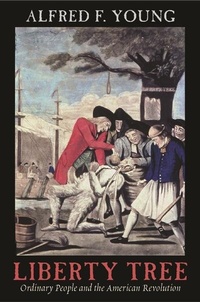
Liberty Tree
Ordinary People and the American Revolution
Published on 6. November 2006
277 pages
978-0-8147-2935-9 (ISBN)
Description

With the publication of Liberty Tree, acclaimed historian Alfred F. Young presents a selection of his seminal writing as well as two provocative, never-before-published essays. Together, they take the reader on a journey through the American Revolution, exploring the role played by ordinary women and men (called, at the time, people out of doors) in shaping events during and after the Revolution, their impact on the Founding generation of the new American nation, and finally how this populist side of the Revolution has fared in public memory.
Drawing on a wide range of sources, which include not only written documents but also material items like powder horns, and public rituals like parades and tarring and featherings, Young places ordinary Americans at the center of the Revolution. For example, in one essay he views the Constitution of 1787 as the result of an intentional accommodation by elites with non-elites, while another piece explores the process of ongoing negotiations would-be rulers conducted with the middling sort; women, enslaved African Americans, and Native Americans. Moreover, questions of history and modern memory are engaged by a compelling examination of icons of the Revolution, such as the pamphleteer Thomas Paine and Boston's Freedom Trail.
For over forty years, history lovers, students, and scholars alike have been able to hear the voices and see the actions of ordinary people during the Revolutionary Era, thanks to Young's path-breaking work, which seamlessly blends sophisticated analysis with compelling and accessible prose. From his award-winning work on mechanics, or artisans, in the seaboard cities of the Northeast to the all but forgotten liberty tree, a major popular icon of the Revolution explored in depth for the first time, Young continues to astound readers as he forges new directions in the history of the American Revolution.
Drawing on a wide range of sources, which include not only written documents but also material items like powder horns, and public rituals like parades and tarring and featherings, Young places ordinary Americans at the center of the Revolution. For example, in one essay he views the Constitution of 1787 as the result of an intentional accommodation by elites with non-elites, while another piece explores the process of ongoing negotiations would-be rulers conducted with the middling sort; women, enslaved African Americans, and Native Americans. Moreover, questions of history and modern memory are engaged by a compelling examination of icons of the Revolution, such as the pamphleteer Thomas Paine and Boston's Freedom Trail.
For over forty years, history lovers, students, and scholars alike have been able to hear the voices and see the actions of ordinary people during the Revolutionary Era, thanks to Young's path-breaking work, which seamlessly blends sophisticated analysis with compelling and accessible prose. From his award-winning work on mechanics, or artisans, in the seaboard cities of the Northeast to the all but forgotten liberty tree, a major popular icon of the Revolution explored in depth for the first time, Young continues to astound readers as he forges new directions in the history of the American Revolution.
Reviews / Votes
";To read these eloquent essays by one of the wisest historians of our time is to be drawn into a remarkable conversation: practical, eloquent, decent, and shrewd. Behind Alfred Young's mesmerizing prose lies dazzling detective work that finds courageous people in all the fullness of their lives, who made a revolution as surely as did more famous leaders. Within the lively stories he tells is also a sharp skepticism of the ways that, over the years, tales of the Revolution have been spun to serve selfish political needs. And throughout Al Young's interpretations there sings a humane vision for our future, as readers of history, as tourists, and as citizens." - Linda K. Kerber,author of No Constitutional Right to Be Ladies: Women and the Obligations of Citizenship "“t;Drawing on his unsurpassed knowledge of the American Revolution, and his powerful commitment to the idea of 'history from below,' Alfred Young gives us a stirring reminder of the role of 'the people' in the Revolution. He challenges the orthodox emphasis on the 'great men' of that time, and with vivid specificity provides an analysis which is subtle, complex, and bold." - Howard Zinn,Professor Emeritus, Boston University and author, A People's History of the United States "This fascinating collection of essays makes a gripping display of the American historian's efforts to construct a more inclusive, nuanced vision of the Revolutionary War era. . . . A social historian committed to rounding out our cultural memory, Young includes traditionally marginalized groups (women, the poor, the working class, African Americans and Native Americans), but is interested neither in adding token representations nor in replacing the founding fathers. Rather, Young seeks to re-imagine the Revolutionary War era holistically, and what emerges is not only a first look at key but forgotten Revolutionary players, but also a fresh look at figures like Hamilton, Revere and Adams, portrayed here with a richness and humanity lacking in more celebratory treatments. Although these are serious academic essays, Young's prose is clear and concise, and he judiciously relegates the more technical, scholarly matters to end notes. The result is a work that will be of equal interest to professional scholars and amateur historians." (Publishers Weekly) "The key point that shines through all these essays is how dependent our hallowed Founding heroes were on the shifting political alliances they had to form with citizens of lower economic status in order to provide the leadership we honor them for today." (Washington Times) ";Young assists the construction of a fuller historical picture of the Revolutionary American era by focusing on the common peoplet o gain a more complete understanding of the interplay between the political and social elite and these groups. Highly recommended." (Choice)More details
Language
English
Place of publication
New York
United States
Target group
Professional and scholarly
File size
4,84 MB
ISBN-13
978-0-8147-2935-9 (9780814729359)
Copyright in bibliographic data and cover images is held by Nielsen Book Services Limited or by the publishers or by their respective licensors: all rights reserved.
Schweitzer Classification
Other editions
Additional editions
Book
11/2006
New York University Press
€39.50
Shipment within 15-20 days
Person
Alfred F. Young is Alfred Young is Emeritus Professor of History, Northern Illinois University. His numerous books include The Shoemaker and the Tea Party: Memory and the American Revolution and Liberty Tree: Ordinary People and the American Revolution (NYU Press).
Content
ContentsList of IllustrationsIntroduction: Why Write the History of Ordinary People? Part I. The People Out of DoorsThe Mechanics of the Revolution: "By Hammer and Hand All Arts Do Stand” "Persons of Consequence”: The Women of Boston and the Making of the American RevolutionTar and Feathers and the Ghost of Oliver Cromwell: English Plebeian Culture and American Radicalism Part II. AccommodationsConservatives, the Constitution, and the "Genius of the People” How Radical Was the American Revolution? Part III. Memory: Lost and FoundThe Celebration and Damnation of Thomas PaineThe Freedom Trail: Walking the Revolution in Boston Liberty Tree: Made in America, Lost in America Index About the Author
