

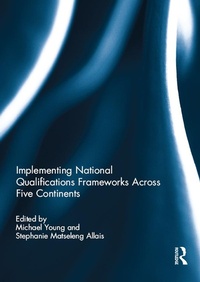
Implementing National Qualifications Frameworks Across Five Continents
1st Edition
Published on 8. April 2016
296 pages
978-1-134-92570-4 (ISBN)
Description

This book assesses the impact and implementation of national qualifications frameworks in sixteen different countries. It presents two major lessons for policy makers thinking of introducing a National Qualifications Framework (NQF). First, that an NQF is only a way of framing existing provision; it cannot on its own, lead to the acquisition of skills or knowledge. Second, as an attempt to standardize learning- something that is only to a limited extent standardizable, NQFs have disadvantages as well as advantages.
The research was funded by the International Labour Organization (ILO) and the European Training Foundation (ETF) and, partly as a result of the ILO/ETF Report, the Editors were asked by the World Bank to help them in advising the government of India on introducing a NQF for vocational qualifications. Building on the findings of the report, the editors of this book presented an NQF implementation strategy to the Government of India on behalf of the World Bank. It laid out the steps and stages that would be involved and took account of the earlier experiences of introducing an NQF. Although this strategy was prepared specifically for the Government of India, others who have read it felt it deserved wider circulation. The report has therefore been included in this volume.
Since this research was undertaken, the number countries, especially developing countries, implementing or introducing a NQF has continued to increase. This book will be of interest to policy makers and researchers.
This book was originally published as a special issue of the Journal of Education and Work.
The research was funded by the International Labour Organization (ILO) and the European Training Foundation (ETF) and, partly as a result of the ILO/ETF Report, the Editors were asked by the World Bank to help them in advising the government of India on introducing a NQF for vocational qualifications. Building on the findings of the report, the editors of this book presented an NQF implementation strategy to the Government of India on behalf of the World Bank. It laid out the steps and stages that would be involved and took account of the earlier experiences of introducing an NQF. Although this strategy was prepared specifically for the Government of India, others who have read it felt it deserved wider circulation. The report has therefore been included in this volume.
Since this research was undertaken, the number countries, especially developing countries, implementing or introducing a NQF has continued to increase. This book will be of interest to policy makers and researchers.
This book was originally published as a special issue of the Journal of Education and Work.
More details
Edition
1. Auflage
Language
English
Place of publication
London
United Kingdom
Publishing group
Taylor & Francis Ltd
Target group
College/higher education
Professional and scholarly
ISBN-13
978-1-134-92570-4 (9781134925704)
Copyright in bibliographic data and cover images is held by Nielsen Book Services Limited or by the publishers or by their respective licensors: all rights reserved.
Schweitzer Classification
Other editions
Additional editions
Michael Young | Stephanie Allais
Implementing National Qualifications Frameworks Across Five Continents
Book
10/2024
1st Edition
Routledge
€68.35
Shipment within 10-20 days
Michael Young | Stephanie Allais
Implementing National Qualifications Frameworks Across Five Continents
Book
06/2013
1st Edition
Routledge
€208.33
Shipment within 15-20 days
Persons
Stephanie Matseleng Allais is a Senior Researcher at the Education Policy Unit of the University of the Witwatersrand, South Africa. Her research interests include the sociology of education, policy, education and development, curriculum, and political economy of education. Prior to joining Wits University she was a postdoctoral fellow at the Centre for Educational Sociology at the University of Edinburgh, UK, and before this, she managed and conducted research for the International Labour Organization. She was also the director of the Research and Development unit of Umalusi, the statutory body responsible for the quality assurance of primary, secondary, and vocational education and training in South Africa. She has worked in various parts of the South African education system, including working for a non-governmental organization in distance education, running the education department of a trade union, and teaching. She served on many committees by appointment of Ministers of Education in South Africa, and has been involved in numerous policy processes. She has a PhD in Education Policy from the School of Public and Development Management at Wits University in South Africa.
Michael Young, BA, BSc, MA, PhD (Hon caus), FCGLI is Professor of Education (Emeritus) at the Institute of Education, University of London, UK. He is a Sociologist. His recent publications include Bringing Knowledge Back In (Routledge, 2008) and (edited with Hugh Lauder) Educating for the knowledge economy? Critical Perspectives (Routledge, 2012). His research focuses on the role of knowledge in qualifications, and curricula. He has been an adviser/consultant on National Qualifications Frameworks for the ILO, OECD, the ETF, and national organizations in a number of countries including the UK, South Africa, Australia, Slovenia, Pakistan and Ethiopia.
Michael Young, BA, BSc, MA, PhD (Hon caus), FCGLI is Professor of Education (Emeritus) at the Institute of Education, University of London, UK. He is a Sociologist. His recent publications include Bringing Knowledge Back In (Routledge, 2008) and (edited with Hugh Lauder) Educating for the knowledge economy? Critical Perspectives (Routledge, 2012). His research focuses on the role of knowledge in qualifications, and curricula. He has been an adviser/consultant on National Qualifications Frameworks for the ILO, OECD, the ETF, and national organizations in a number of countries including the UK, South Africa, Australia, Slovenia, Pakistan and Ethiopia.
Content
Preface Michael Young and Stephanie Allais; Introduction Michael Young and Stephanie M. Allais 1. Education, economic globalisation and national qualifications frameworks Hugh Lauder 2. The educational implications of introducing a NQF for developing countries Michael Young 3. The impact and implementation of national qualifications frameworks: a comparison of 16 countries Stephanie M. Allais 4. National vocational qualifications in the United Kingdom: their origins and legacy Michael Young 5. Are 'communications frameworks' more successful? Policy learning from the Scottish Credit and Qualifications Framework David Raffe 6. The implementation, evolution and impact of New Zealand's national qualifications framework Robert Strathdee 7. From old to new: the Australian qualifications framework Leesa Wheelahan 8. The changing faces of the South African national qualifications framework Stephanie M. Allais 9. Qualifications frameworks: implementation and impact in Botswana Daniel Tau and Stanslaus T. Modesto 10. Implementing competence frameworks in Mexico Maria Luisa de Anda 11. The Malaysian qualifications framework. An institutional response to intrinsic weaknesses Jack Keating 12. The NQF in Mauritius Carmel Marock 13. Implementing a national qualifications framework in Lithuania Vidmantas Tutlys and Irma Spudyte 14. Options for Designing an NVQF for India Michael Young and Stephanie M. Allais
