

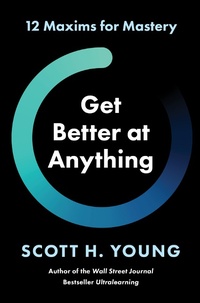
Get Better at Anything
Description

The author of the Wall Street Journal bestseller Ultralearning explores why it's so difficult for people to learn new skills, arguing that three factors must be met to make advancement possible, and offering 12 maxims to improve the way we learn.
Life revolves around learning-in school, at our jobs, even in the things we do for fun. Yet learning is often mysterious. Sometimes it comes fairly effortlessly: quickly finding our way around a new neighborhood or picking up the routine at a new job. In other cases, it's a slog. We may spend hours in the library, yet still not do well on an exam. We may want to switch companies, industries, or even professions, but not feel qualified to make the leap. Decades spent driving a car, typing on a computer, or hitting a tennis ball don't reliably make us much better at them. Improvement can be fickle, if it comes at all.
In Get Better At Anything, Scott Young argues that there are three key factors in helping us learn:
See-Most of what we know comes from other people. The ease of learning from others determines, to a large extent, how quickly we can improve.
Do-Mastery requires practice. But not just any practice will do. Our brains are fantastic effort-saving machines, which can be both a tremendous advantage and a curse.
Feedback-Progress requires constant adjustment. Not just the red stroke of a teacher's pen, but the results of hands-on experience.
When we're able to learn from the example of other people, practice extensively ourselves, and get reliable feedback, rapid progress results. Yet, when one, or all, of these factors is inhibited, improvement often becomes impossible. Using research and real-life examples, Young breaks down these elements into twelve simple maxims. Whether you're a student studying for an exam, an employee facing a new skill at work, or just want to get better at something you're interested in, his insights will help you do it better.
This book unpacks the science of learning with practical maxims that show you how to:
- A Framework for Mastery: Learn the three essential factors?See, Do, and Feedback?that determine whether you make rapid progress or get stuck.
- Effective Problem Solving: Understand why problem solving is a search, and how learning from others dramatically accelerates your ability to find creative solutions.
- Cognitive Load Management: Discover why the mind is not a muscle and how to work within your cognitive limits to learn complex skills without feeling overwhelmed.
- Actionable Learning Maxims: Apply twelve simple but powerful rules, from ?Creativity Begins with Copying? to ?Fears Fade with Exposure,? to guide your own self-improvement journey.
More details
Other editions
Additional editions
Person
Scott Young is the Wall Street Journal bestselling author of Ultralearning, a podcast host, computer programmer, and an avid reader. Since 2006, he has published weekly essays to help people learn and think better. His work has been featured in the New York Times, Pocket, and Business Insider, on the BBC, at TEDx, and other outlets. He doesn't promise to have all the answers, just a place to start.
