

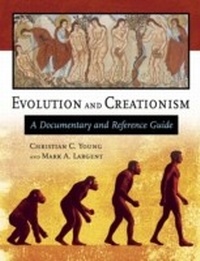
Evolution and Creationism
A Documentary and Reference Guide
1st Edition
Published on 30. June 2007
320 pages
978-0-313-08673-1 (ISBN)
Description

As recently seen by the Kitzmiller vs. Dover case, the evolution versus creation debate never goes away. The best way to understand these debates is to read the arguments of the individuals involved. This reference work provides over 40 of the most important documents to help readers understand the debate in the eyes of the people of the time. Each document is from a major participant in the debates - from the predecessors of Darwin to the judges of the influential court cases of the present day. The editors have included an introduction and analysis of each document that places it within historical and scientific context.
Evolution and Creationism: A Documentary and Reference Guide aims to enhance our understanding of the debate by presenting over 40 documents that shed light on the origins, goals, and history of the ongoing debate. The volume examines such topics as Darwin's theory of natural selection, the rise of Fundamentalism and its opposition to evolution, and evolution and its discontents at the beginning of the 21st century. In addition, the work includes an extensive bibliography and reference guide to relevant print and electronic resources.
Evolution and Creationism: A Documentary and Reference Guide aims to enhance our understanding of the debate by presenting over 40 documents that shed light on the origins, goals, and history of the ongoing debate. The volume examines such topics as Darwin's theory of natural selection, the rise of Fundamentalism and its opposition to evolution, and evolution and its discontents at the beginning of the 21st century. In addition, the work includes an extensive bibliography and reference guide to relevant print and electronic resources.
More details
Series
Language
English
Place of publication
New York
United States
Publishing group
Bloomsbury Publishing Plc
Target group
College/higher education
Professional and scholarly
File size
13,11 MB
ISBN-13
978-0-313-08673-1 (9780313086731)
Copyright in bibliographic data and cover images is held by Nielsen Book Services Limited or by the publishers or by their respective licensors: all rights reserved.
Schweitzer Classification
Other editions
Additional editions
Book
06/2007
Greenwood Press
€106.80
Shipment within 15-20 days
Persons
Christian C. Young teaches introductory biology, evolution, environmental studies, and the relationship between science and society at Alverno College in Milwaukee, Wisconsin. He is assistant professor of biology and a member of the department for Developing a Global Perspective. His research focuses on social controversies about and within science, particularly over environmental topics.
Mark A. Largent is assistant professor of science policy in James Madison College at Michigan State University, where he teaches courses on the history of science and U.S. science policy. His research and writing focuses on the history of biology, in particular the evolution/creation debates and the history of the American eugenics movement. Trained as a historian of science and technology, his work explores the role of American biologists in various political and social movements as well as the impact of science on policy debates in the early twentieth century.
Mark A. Largent is assistant professor of science policy in James Madison College at Michigan State University, where he teaches courses on the history of science and U.S. science policy. His research and writing focuses on the history of biology, in particular the evolution/creation debates and the history of the American eugenics movement. Trained as a historian of science and technology, his work explores the role of American biologists in various political and social movements as well as the impact of science on policy debates in the early twentieth century.
Content
- Cover
- Contents
- Preface
- Introduction
- 1. Evolution before Darwin's On the Origin of Species
- Erasmus Darwin, Zoonomia (1794-1796)
- Jean-Baptiste Lamarck, Zoological Philosophy (1809)
- Baron Georges Cuvier, Discourse on the Revolutionary Upheavals on the Surface of the Globe and on the Changes Which They Have Produced in the Animal Kingdom (1825)
- William Paley, Natural Theology (1802)
- Robert Chambers, Vestiges of the Natural History of Creation (1844)
- 2. Darwin's Theory of Natural Selection
- Charles Darwin, The Voyage of the Beagle (1839)
- Charles Darwin, On the Origin of Species (1859)
- Alfred Russel Wallace, "Letters and Reminiscences" (1916)
- Thomas H. Huxley, "On a Piece of Chalk" (1868)
- Charles Darwin, The Descent of Man (1871)
- 3. Reviews of Darwin's Work
- Asa Gray, "Design versus Necessity: Discussion between Two Readers of Darwin's Treatise On the Origin of Species, upon Its Natural Theology" (1860)
- Louis Agassiz, Essay on Classification (1851)
- Charles Lyell, The Antiquity of Man (1863)
- Fleeming Jenkin, "The Origin of Species [Review Article]" (1867)
- Samuel Wilberforce, "Review of Darwin's Origin of Species" (1860)
- 4. Evolution and Anti-Evolution in the Interphase
- Vernon Kellogg, Darwinism To-Day (1907)
- William Bateson, "Evolutionary Faith and Modern Doubts" (1921)
- Henry Fairfield Osborn, "William Bateson on Darwinism" (1922)
- J. Arthur Thomson, "Why We Must be Evolutionists" (1928)
- Richard Goldschmidt, "Some Aspects of Evolution" (1933)
- 5. The Rise of Fundamentalism and Its Opposition to Evolution
- World's Christian Fundamentals Association Doctrinal Statement (1919)
- Vernon Kellogg, Headquarters Nights: A Record of Conversations and Experiences at the Headquarters of the German Army in France and Belgium (1917)
- Butler Act, Public Acts of the State of Tennessee (1925)
- John Thomas Scopes v. The State, Supreme Court of Tennessee (1926)
- William Jennings Bryan, "Summary Argument in Scopes Trial" (1925)
- "A Brief Reply by Clarence Darrow, Likens Bryan Speech to Lawyer's Argumentative Statement" (1925)
- Walter Lippmann, American Inquisitors: A Commentary on Dayton and Chicago (1928)
- 6. The Modern Evolutionary Synthesis
- Pierre Teilhard de Chardin, "The God of Evolution" (1953)
- Reinhold Niebuhr, "Christianity and Darwin's Revolution" (1958)
- Julian Huxley, "Darwin and the Idea of Evolution" (1958)
- Theodosius Dobzhansky, "Nothing in Biology Makes Sense Except in the Light of Evolution" (1973)
- Repeal of the Butler Act (1967)
- Epperson v. Arkansas (1968)
- 7. From Equal Time to the De-Emphasis of Evolution in American Schools
- George Gaylord Simpson, Colin S. Pittendrigh, and Lewis H. Tiffany, Life (1958)
- Henry Morris, "Evolution, Creation, and the Public Schools" (1973)
- Henry Morris, "The Mathematical Impossibility of Evolution" (1972)
- William R. Overton, McLean v. Arkansas (1982)
- Larry Laudan, "Science at the Bar-Causes for Concern" (1982)
- Michael Ruse, "Pro Judice" (1982)
- Pope John Paul II, "Truth Cannot Contradict Truth" (1996)
- Michael Ruse, American Association for the Advancement of Science Symposium, "The New Antievolutionism" (1993)
- 8. Intelligent Design and the School Board Debates
- Michael Behe, Darwin's Black Box: A Biochemical Challenge to Evolution (1996)
- Michael Ruse, "They're Here!" (1989)
- Phillip E. Johnson, Defeating Darwinism by Opening Minds (1997)
- The Discovery Institute, Center for the Renewal of Science & Culture, "The Wedge Document" (1998)
- John E. Jones III, Kitzmiller v. Dover (2005)
- Resources: Electronic and Print
- Index
- A
- B
- C
- D
- E
- F
- G
- H
- I
- J
- K
- L
- M
- N
- O
- P
- R
- S
- T
- U
- V
- W
