

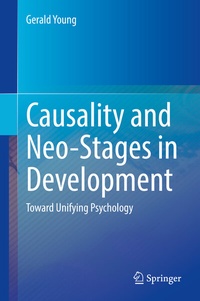
Causality and Neo-Stages in Development
Description

This book represents a broad integration of several major themes in psychology toward its unification. Unifying psychology is an ongoing project that has no end-point, but the present work suggests several major axes toward that end, including causality and activation-inhibition coordination. On the development side of the model building, the author has constructed an integrated lifespan stage model of development across the Piagetian cognitive and the Eriksonian socioaffective domains. The model is based on the concept of neo-stages, which mitigates standard criticisms of developmental stage models. The new work in the second half of the book extends the primary work in the first half both in terms of causality and development. Also, the area of couple work is examined from the stage perspective. Finally, new concepts related to the main themes are represented, including on the science formula, executive function, stress dysregulation disorder, inner peace, and ethics, all toward showing the rich potential of the present modeling.
More details
Other editions
Additional editions
Person
Gerald Young
is a Full Professor in Psychology at Glendon College, York University, Toronto, Canada. He is a Fellow of the
Association for Psychological Science
(APS) and the
American Psychological Association
(APA). He has received awards from the
American Psychological Association
and the
Canadian Psychological Association
(CPA). Young is Editor-in-Chief of the journal
Psychological Injury and Law
, which he founded. His most recent books are
Revising the APA Ethics Code
(Springer, 2017) and
Causality and Development: Neo-Eriksonian Perspectives
(Springer, 2019). He has appeared as an expert witness for a case involving the Supreme Court of Canada. His practice covers rehabilitation and couples/ families.
