

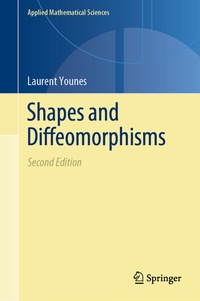
Shapes and Diffeomorphisms
Description

This book covers mathematical foundations and methods for the computerized analysis of shapes, providing the requisite background in geometry and functional analysis and introducing various algorithms and approaches to shape modeling, with a special focus on the interesting connections between shapes and their transformations by diffeomorphisms. A direct application is to computational anatomy, for which techniques such as large-deformation diffeomorphic metric mapping and metamorphosis, among others, are presented. The appendices detail a series of classical topics (Hilbert spaces, differential equations, Riemannian manifolds, optimal control).
The intended audience is applied mathematicians and mathematically inclined engineers interested in the topic of shape analysis and its possible applications in computer vision or medical imaging. The first part can be used for an advanced undergraduate course on differential geometry with a focus on applications while thelater chapters are suitable for a graduate course on shape analysis through the action of diffeomorphisms.
Several significant additions appear in the 2nd edition, most notably a new chapter on shape datasets, and a discussion of optimal control theory in an infinite-dimensional framework, which is then used to enrich the presentation of diffeomorphic matching.
Reviews / Votes
"The book is an in-depth, modern, clear exposition of the advanced theory of shapes and diffeomorphisms . . This makes the book accessible to a large audience, including graduate and postgraduate students. Moreover the book is extremely well written and very pleasant to read. . I strongly recommend this excellent book to every researcher or graduate student in the field of shapes and geometric analysis. Naturally, it will also be of interest to many Mathematicians . ." (Diaraf Seck, SIAM Review, Vol. 64 (1), March, 2022)More details
Other editions
Additional editions
Previous edition
Person
A former student of the Ecole Normale Supérieure in Paris, Laurent Younes received his Ph.D. from the University Paris Sud in 1989. Now a professor in the Department of Applied Mathematics and Statistics at Johns Hopkins University (which he joined in 2003), he was a junior, then senior researcher at CNRS in France from 1991 to 2003. His research is in stochastic modeling for imaging and biology, shape analysis and computational anatomy. He is a core faculty member of the Center for Imaging Science and of the Institute for Computational Medicine at JHU.
