

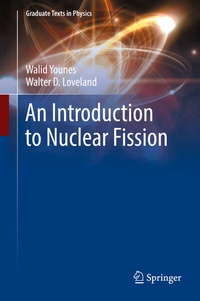
An Introduction to Nuclear Fission
Description

This hands-on textbook introduces physics and nuclear engineering students to the experimental and theoretical aspects of fission physics for research and applications through worked examples and problem sets. The study of nuclear fission is currently undergoing a renaissance. Recent advances in the field create the opportunity to develop more reliable models of fission predictability and to supply measurements and data to critical applications including nuclear energy, national security and counter-proliferation, and medical isotope production. An Introduction to Nuclear Fission provides foundational knowledge for the next generation of researchers to contribute to nuclear fission physics.
More details
Other editions
Additional editions
Persons
Walter D. Loveland is Professor at the department of Chemistry of the Oregon State University, US. He received his PhD in Nuclear Chemistry from the University of Washington after obtaining the SB in Chemistry from MIT. He held postdoctoral positions in Argonne and Oregon State Universities, becoming a faculty member at Oregon State University in 1968. He spent some periods at LBNL, Uppsala, and Argonne as visiting scientist. Prof. Loveland has worked on various aspects of nuclear chemistry, such as the study of heavy ion induced reactions, fast neutron induced fission, environmental chemistry and nuclear chemistry education. He is the author of several nuclear chemistry textbooks. He has published more than 250 scientific articles in the open, refereed literature, given 62 talks at APS meetings, and over 300 talks at professional meetings. He is NSF Sigma Xi (Washington), Tartar, ACS, and AAAS fellow. He was awarded the Sigma Xi Award for Research, Gillfillan award, Beaver Champion Award (Oregon State), and G.T. Seaborg Award.
