

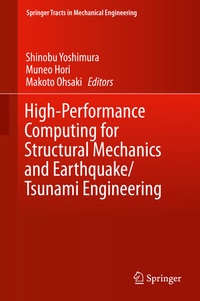
High-Performance Computing for Structural Mechanics and Earthquake/Tsunami Engineering
Description

Huge earthquakes and tsunamis have caused serious damage to important structures such as civil infrastructure elements, buildings and power plants around the globe. To quantitatively evaluate such damage processes and to design effective prevention and mitigation measures, the latest high-performance computational mechanics technologies, which include telascale to petascale computers, can offer powerful tools. The phenomena covered in this book include seismic wave propagation in the crust and soil, seismic response of infrastructure elements such as tunnels considering soil-structure interactions, seismic response of high-rise buildings, seismic response of nuclear power plants, tsunami run-up over coastal towns and tsunami inundation considering fluid-structure interactions. The book provides all necessary information for addressing these phenomena, ranging from the fundamentals of high-performance computing for finite element methods, key algorithms of accurate dynamic structural analysis, fluid flows with free surfaces, and fluid-structure interactions, to practical applications with detailed simulation results. The book will offer essential insights for researchers and engineers working in the field of computational seismic/tsunami engineering.
More details
Other editions
Additional editions
Persons
Professor Shinobu Yoshimura is professor at the Department of Systems Innovation, School of Engineering, The University of Tokyo. He has been working on high-performance and intelligent computational mechanics with real world's applications for 25 years. He has published 220 peer reviewed journal papers, 54 review papers and 6 books.
Professor Muneo Hori is currently working at the Earthquake Research Institute, The University of Tokyo. His major interest is applied mechanics, applying it to establish a new research field of computational earthquake engineering. He has published more than 200 peer reviewed journal papers, 10 monographs and 2 books.
Professor Makoto Ohsaki is teaching as a professor at the Department of Architecture, Graduate School of Engineering, Hiroshima University. He has been working on structural optimization, building engineering, structural stability and high-performance computing for 25 years. He has published 160 peer reviewed journal papers (including 84 SCI journal papers), 44 review papers and 9 books.
