

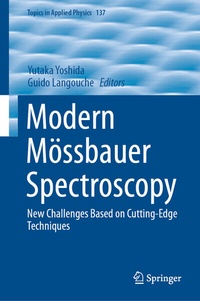
Modern Mössbauer Spectroscopy
Description

This book presents an overview of the latest Mössbauer spectroscopy research. It sheds light on various cutting-edge research subjects: (i) nuclear resonance scattering experiments implemented at synchrotron radiation facilities, e.g., ESRF, DESY and Spring-8; (ii) multidisciplinary materials research related to chemistry, biology, geoscience, molecular magnetism of metal complexes, batteries, and magnetism; (iii) novel imaging techniques based on probing diffusion in solids using Mössbauer spectroscopy.
The first three chapters introduce recent research on modern Mössbauer spectroscopy, including nuclear resonant scattering experiments and development of related techniques at synchrotron accelerator facilities. Chapters 4 and 5 then demonstrate the applications of such pioneering techniques to chemistry, biology and geoscience. Chapters 6 and 7 describe the applications to new functional materials, i.e., metal complexes and Li- and Na-ion batteries, while the final two chapters are devoted to two important measuring techniques: Mössbauer spectroscopy under external magnetic fields, and microscopic Mössbauer techniques on diffusion in solids, which are expected to play an essential role in the investigation and characterization of magnetic structures and microstructures in materials.
The cutting-edge content provides readers with quick updates on the latest research topics in the field, while the tutorial-style descriptions allow readers unfamiliar with Mössbauer spectroscopy to learn and implement the techniques. As such, the book is especially useful for advanced undergraduate and early graduate students who have recently been assigned to a laboratory.
More details
Other editions
Additional editions
Persons
Yutaka Yoshida is a professor of Materials and Bioscience at Shizuoka Institute of Science and Technology, Japan. He received his doctoral degree from Osaka University in 1983. After serving as Guest Scientist in the group led by Professor Gero Vogl at the Hahn-Meitner Institute, Berlin, and as Research Assistant at the Institute of Solid State Physics, Universität Wien, he was appointed to associate professor at Shizuoka Institute of Science and Technology in 1991, and promoted to his current position in 2004. Since 1993 he has held a position as Guest Scientist at the Japanese scientific research institute, RIKEN.
Guido Langouche is Emeritus Professor of Nuclear Solid-State Physics at the University of Leuven. He received his PhD and habilitation in Physics from K. U. Leuven in 1973 and 1986, respectively. After carrying out postdoctoral research at K. U. Leuven, the University of Groningen and Stanford University, he was appointed to assistant professor in 1986, associateprofessor in 1989, and full professor in 1991. He has held positions as Guest Professor at Osaka University, the University of Lyon, and the University of Kinshasa. He has served in various positions throughout his career, such as Vice-Rector of K. U. Leuven, Chairman of the Coimbra Group, Vice-president of the Accreditation Organization of the Netherlands and Flanders (NAVO), Secretary General of the International Network for Quality Assurance Agencies in Higher Education (INQAAHE). Furthermore, he is the Editor-in-Chief of the Hyperfine Interaction Journal.
