

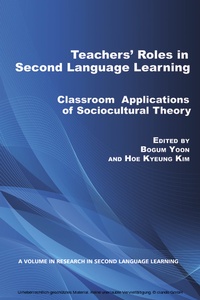
Teachers' Roles in Second Language Learning
Classroom Applications of Sociocultural Theory
1st Edition
Published on 1. September 2012
305 pages
978-1-61735-849-4 (ISBN)
Description

This book is designed to provide practical applications of sociocultural theory with regard to teachers' roles in second language education. By providing specific examples of teachers' roles in the classroom, the book aims to help researchers, teacher educators, and classroom teachers make clear connections between practice and theory in second language learning. All the studies in this edited book are conducted in the PreK-16 classroom setting. Each chapter presents rigorous research analysis within the framework of sociocultural theory and provides rich descriptions of teachers' roles.
The book is intended to be used in teacher education courses. The primary audience of the book is in-service teachers who work with second language learners (SLLs) in their classrooms including ESL/Bilingual classrooms or regular classrooms. Since many SLLs receive instructions both in the ESL/Bilingual classrooms and in the regular classrooms, it is important to discuss teachers' roles in both settings. The secondary audience of the book is teacher educators and researchers who work with pre-service and in-service teachers in teacher education. This book will be an excellent resource for book study groups and practitioners working with professional learning communities.
All prices
More details
Other editions
Additional editions
Bogum Yoon | Hoe Kyeung Kim
Teacher's Roles in Second Language Learning
Classroom Applications of Sociocultural Theory
Book
06/2012
Information Age Publishing
€122.80
Shipment within 3-4 weeks
Content
- Intro
- Teachers' Roles in Second Language Learning
- Classroom Applications of Sociocultural Theory
- A Volume in Research in Second Language Learning
- Series Editor: JoAnn Hammadou Sullivan, University of Rhode Island
- CONTENTS
- PART I: LINGUISTIC PERSPECTIVES
- 1. How Teacher Talk Can Guide Student Exploratory Talk: Communication, Conjecture, and Connections in a Fourth and Fifth Grade ELL Classroom
- 2. Mediating Meaning in Interaction: Researching the Connection Between Professional Development and Teacher Practice José David Herazo and Richard Donato 19
- 3. Mediating Learning and Negotiating Curricular Ideologies in a Fourth Grade Bilingual Classroom
- 4. Teacher and Students' Use of Gesture as a Meaning-Making Affordance for Second Language Learning
- 5. Teacher Discourse and Code Choice in a Swedish EFL Classroom
- 6. How do Teachers Participate, Mediate, and Intervene in the Co-construction of Language Knowledge During Learner Interactions?
- Part II: Cultural Perspectives
- 7. Teacher's Use of Funds of Knowledge to Promote Class Participation and Engagement in an EFL Context
- 8. Teachers' Roles in Facilitating Novice Writers From Generation 1.5
- 9. Teachers' Cultural Inclusivity and ELLs' Participation in Language and Literacy Activities
- 10. Working with Preschool English Language Learners: A Sociocultural Approach
- Part III: Social Perspectives
- 11. Teacher Discourse and Peer Interaction in Linguistically Diverse Classrooms
- 12. An ESL Instructor's Strategic Teaching in a Collaborative Learning Community
- 13. Teachers' Roles and Mediating Strategies of Learners' Engagement in the L2 Classroom
- 14. Second Grade ESL Literacy Success in a U.S. Mainstream Classroom
- Research in Second Language Learning
- Teachers' Roles in Second Language Learning
- Classroom Applications of Sociocultural Theory
- edited by
- Bogum Yoon
- State University of New York at Binghamton
- and
- Hoe Kyeung Kim
- Cleveland State University
- Information Age Publishing, Inc.
- Charlotte, North Carolina www.infoagepub.com
- FOREWORD
- Leo van Lier
- References
- ACKNOWLEDGMENTS
- Introduction
- Sociocultural Theory as a Theoretical Framework for Understanding Teachers' Roles in Second Language Learning
- Bogum Yoon and Hoe Kyeung Kim
- Vygotsky and Key Concepts of Sociocultural Theory
- Vygotsky and His Influence
- Zone of Proximal Development
- Language as Mediation
- Unique Features of the Book
- Organization of the Book
- References
- CHAPTER 1
- How Teacher Talk can Guide Student Exploratory Talk
- Communication, Conjecture, and Connections in a Fourth and Fifth Grade ELL Classroom
- Maureen P. Boyd
- Theoretical Framework
- Literature Review
- Contingent Questioning
- Positioning Students To Have Interpretive Authority
- Use of Reasoning Words
- Methodology
- Findings
- 1. Jordan: Uh, over by Alaska-well, I hear on the news, Mr. Sims told us in social studies, there were seven whales that were coming to the Pacific Ocean
- 2. Zach: Oh yea, they got trapped by ice
- 3. Jordan: And they got trapped by ice over there, by Alaska
- 4. Zach: [inaudible] this story
- 5. Ms Charlotte: Aha
- 6. Jordan: They got trapped there were seven whales
- 7. Zach: Man, they they got to use seven thousand dollars
- 8. Ms Charlotte: And so, what did they have to do?
- 9. Jordan: They were trapped, they were trapped there
- 10. Zach: They use seven thousand dollars to get those whales
- 11. Ms Charlotte: Why do you think they got trapped?
- 12. Jordan: Because there was too many ice.
- 13. Zach: No, no, they didn't go out when the right time should be out
- 14. Ms Charlotte: Oh, so they didn't go out?
- 15. Zach: They they stay alone like a few more minutes and eh hour
- 16. Ms Charlotte: Than when it was time for them to leave and then
- 17. Jordan: And he said there were like right up
- 18. Zach: Huge
- 19. Jordan: Too much ice,
- 20. Ms Charlotte: Ok
- 21. Jordan: And they
- 22. Ms Charlotte: Why do you think there might be too much ice?
- 23. Ms Charlotte: What about, does that remind you of anything that happened in Orca Song? Did anything happen there that would sound like
- 24. Lucy: Temperature
- 25. PD: Is very high
- 26. Jordan: It's been cold over there
- 27. Zach: It's cold from near pole-North pole
- 28. Ms Charlotte: Right
- 29. Lucy: I read in a book and they said em whales em they get stuck in the ice, they like to sit in the water...
- 30. Ms Charlotte: What about, does that remind you of anything that happened in Orca Song? Did anything happen there that would sound like
- 31. Rosey: Yeah, they got trapped
- 32. Jordan: Yea, what d'ya call it?
- 33. Rosey: The baby whale
- 34. Jordan: The whale got trapped in the netting
- 35. Ms Charlotte: The baby got trapped and then what happened, what was the other time? Did he get trapped in any other time?
- 36. Several students: No
- 37. Rosey: Yea, the, the beach
- 38. Ms Charlotte: The beach what happened there?
- 1. Charlotte: Ok this, ah, I brought this in (igloo artifact) to show you because we are going to be looking at the story that we read yesterday and then we are going to be looking at another story.
- 2. Jordan: Could we study about them people?
- 3. Zach: We are studying about whales
- 4. Charlotte: These are the people that we talked about yesterday, do you remember what they are called?
- 5. Zach: Yes
- 6. Charlotte: What?
- 7. Zach: Kayu (reading title of book)
- 8. Charlotte: Ok, that was his name
- 9. Jordan: Maybe like they from Alaska
- 10. Charlotte: They are from Alaska, aha
- 11. Lucy: How come they speak some kind of other language?
- 12. Jordan: What do you call this? I forgot.
- 13. Choral students: Igloo, igloo
- 14. Jordan: How do they make 'em?
- 15. Charlotte: It's made of ice
- 16. Rosey: No, no ice, ice cubes
- 17. Choral students: Ice, ice
- 18. Rosey: They cut the exact shape and then put them in the water, I think
- 19. Jordan: Yea, but how do they make squares?
- 20. Charlotte: How do they make the squares? Who's going to say that?
- 21. Jordan: And then how do they make the tent?
- 22. Charlotte: Who thinks they know how to make the squares?
- 23. Lucy: Oh, I know
- 24. Steve: They dig a hole, like a square hole, then put water in it, and then, it change to a..
- 25. Zach: Ice
- 26. Steve: Ice
- 27. Charlotte: Oh, is that how they do it?
- 28. Choral students: Yeah
- 29. Steve: Then they put them on
- 30. Charlotte: Oh ok-so you think they dig a hole, and then they put water in there and the water freezes?
- 31. Jordan: One more
- 32. Charlotte: And then they get it out?
- 33. Rosey: What? No I think..
- 34. Lucy: No, I think something else
- 1. Charlotte: reading story out loud: "For a feeling instant Aknik's shark eyes fixed on a moving smudge of gray that whisked across the glacial ice and faded away. A shadow he thought, just a shadow. Aknik reset the snare" (or the trap) "and...
- 2. Rosey: There's a little snow, right? The fox is big, right? Then, he only saw a shadow, right?
- 3. Zach: Whoops
- 4. Rosey: How come it's a shadow, um, and he didn't see it when there's a lot of grass?
- 5. Charlotte: Well, what do you think?
- 6. PD: He's blind?
- 7. Charlotte: Well, I don't think he's blind
- 8. Zach: He's stupid
- 9. PD: Color blind?
- 10. Charlotte: Well, maybe ... what do you think?
- 11. Steve: I think those are probably the shadows
- 12. Charlotte: You think those are supposed to be the shadows of the drawings?
- 13. Zach: It could
- 14. Choral students: unclear
- 15. PD: I just thought of something, if you trying to kill but it runs away?
- Discussion
- Conclusion
- References
- part i
- Linguistic Perspectives
- CHAPTER 2
- Mediating Meaning in Interaction
- Researching the Connection Between Professional Development and Teacher Practice
- José David Herazo and Richard Donato
- Sociocultural Theory and L2 Learning
- Mediation and L2 Learning
- L2 Teacher-Student Interaction as a Mediated Activity
- Study Design and Methods
- Participants and Their Context
- Data Sources
- Data Analysis
- Findings
- Monica as Mediator
- 1. M okay, now guys/ can you say like, Alex Rodriguez is a sports sta::r, right, now let's do it umm, with a singer please yeah a singer, can you say like SHAKIRA is a singer, right another one, S4 ((points to S4))
- 2. S4 Paris Hilton is a singer too
- 3. M well she's not a singer SINger
- 4. S1 , LLeona Lewis
- 5. S2 , LLeona Lewis
- 6. M who/
- 7. S2 Leona Lewis
- 8. M okay Leona Lewis
- 9. S3 Daddy Yankee
- 10. S4 LGavilan
- 11. M but say it like the whole sentence, again
- 12. S3 Daddy Yankee
- 13. M Daddy Yankee what/
- 14. S5 Diomedez Diaz
- 15. M What does he do?
- 16. S laughter
- 17. M Daddy Yankee is/
- 18. S6 a singer
- 19. M La singer okay, S3/ ((points to S3))
- 20. S? Eminen
- 21. M Eminen is a singer ((points to S6))
- 22. S6 my mom is a [business] person
- 23. M a BUSINESS person really/
- 24. S6 ((nods))
- 25. M coo::l okay, so S6's mom is a business person, very good, S7
- 26. S7 Diomedez Diaz
- 27. M Diomedez Diaz is a singer, that's right
- 28. SS laughter
- 29. M yeah, he's a very good, well he used to be a very good singer
- Kelly as Mediator
- 1. K so, tell me WHY, is only about problems/ is only about companies/ or is about MY DECISION
- 2. S1 money
- 3. K is about money/
- 4. S2 is my decision
- 5. K money is another factor/
- 6. S3 no
- 7. K money is another factor/
- 8. SS yes, yes
- 9. K why? why?
- 10. S4 yo creo que si ((I think so))
- 11. K why? why? is it important?
- 12. S4 la necesitan en el colegio para trabajar ((they need it in school, to work))
- 13. K if you work you get drugs/
- 14. S5 no teacher, quieren estudiar y no tienen la posibilidad de negociar ((they want to study and don't have the chance to do business))
- 15. K uh hu/ they don't have the/
- 16. S? possibility
- 17. K possibility they don't have the possibility
- 18. S3 ,Lteacher
- 19. S3 in the work don't affect
- 20. K uh hu/
- 21. S3 osea porque::: ((I mean because::))
- 22. K LLwhy::?
- 23. SS ((giggles))
- 24. S3 Lis . two jornal ((jornal: one section of the day, morning or afternoon))
- 25. K LLyeah/
- 26. S3 in ... in a one jornal work/ in the ot- in the other jornal::: study
- 27. K Luh uh/
- 28. K oh:: so:: they can study/, so according to S3 money is not a factor because.in the morning they can study/ and in the afternoon/ in the afternoon/
- 29. S3 work
- 30. K they can/ work\ ... in the afternoon/ they can work\ okay
- Cross-Case Comparison
- Discussion
- Conclusions and Recommendations
- Acknowledgments
- Notes
- References
- Table 2.1. Cross-Case Comparison of Mediational Moves
- CHAPTER 3
- Mediating Learning and Negotiating Curricular Ideologies in a Fourth Grade Bilingual Classroom
- Lara J. Handsfield
- Relevant Literature Review
- Theoretical Grounding
- Research Context and Methods
- Participants and Setting
- Data Sources and Analysis
- Findings: Mediating Language, Learning, and Curricular Ideologies
- Isabel's Instructional Approach
- Plant Life Unit and Activity-Based Learning
- True/False Activity: Negotiating Roles, Ideologies, and Learning
- Moment 1: Establishing Rules of Participation
- Moment 2: Content Integrity
- Moment 3: "Let's Talk About That"
- Moment 4: Personal Narrative
- Moment 5: Logical Reasoning
- Discussion and Implications
- acknowledgment
- References
- CHAPTER 4
- Teacher and Students' Use of Gesture as a Meaning- Making Affordance for Second Language Learning
- Alessandro Rosborough
- Literature Review
- Gesture Promotes Interaction in Second Language Learning Activities
- Awareness of Pedagogical Restrictions
- Methodology
- Subjects, Setting, and Procedure
- Coding and Transcription
- Findings
- Discussion
- APPENDIX A: TRANSCRIPTION DATA DESCRIPTION
- 1. Speech is transcribed fully from the videotape in ordinary orthography
- 2. Gesture is typed in italics below the speech. Gesture codes include the following:
- 3. Gestures were analyzed according to the following points:
- 1. Identification of the movements that are gestures (particularly the hands but also the arm, head, and body movements).
- 2. Identification of the stroke phase, and in some cases the preparation or retraction phases. In the stroke, a concentration was placed on the trajectory, shape, and posture.
- 3. Location the boundaries of the gesture phases in the relevant part of the phonological transcription.
- 4. Codings for gesture types include the following:
- 1. Representational (i.e., represents attributes, actions, or relationships of objects or characters)
- two kinds: 1. Iconic 2. Metaphoric
- 2. Deictic (i.e., finger points or other indications of either concrete or imaginary objects or people)
- 3. Beats (i.e., formless hands that convey no information but move in rhythmic relationship to speech). This category can be confirmed by means of the beat filter below.
- 4. Emblems/Italianate: (i.e., deliberate and standardized movements that have a direct verbal equivalent known to others in the same speech community. Typically these movements continually demonstrate the same meaning when performed).
- References
- CHAPTER 5
- Teacher Discourse and Code Choice in a Swedish EFL Classroom
- Kristy Beers Fägersten
- Purpose of the study
- Theoretical framework
- Literature review
- Classroom Discourse
- Classroom Code-Switching
- Method
- Results
- 1. Teacher: Jonas! Don't you want to say something? Something about the book?
- 2. Jonas: I don't know what to say because I only read up to page 116.
- 3. Teacher: What about when he eats breakfast with the group. That happened in the beginning of the section.
- 4. Jonas: No, I don't think I remember that.
- 5. Alice: Finns det en film till det här?
- 6. Teacher: In English?
- 7. Alice: Mm-hmm.
- 8. Teacher: No, say it in English.
- 9. Alice: Ah men! (sighs)
- 10. Finns det en film till det här?
- 11. Teacher: But say it in English.
- 12. Alice: Ah men Gud! (addressing her neighbor, Roger). Va' fan ska jag saga?
- 13. Roger: Is there a movie based on the book?
- 14. Teacher: Ah! Thank you Roger!
- 15. Alice: (laughs) Det är min sekretärare!
- 16. Teacher: We can find out if there's a movie. Are you interested in seeing it?
- 1. The first question. How many states are there?
- 2. You can say this in English.
- 3. No, (pause) 52? I don't think so.
- 17. Okay number three then?
- 18. Simon?
- 19. And what does DC stand for?
- 20. No, I think it's District of Columbia.
- 21. Ah men tyst! Jag hör inte vad Rasmus säger.
- 39. Next one?
- 40. Jane.
- 41. Pratar du hela tiden David?
- 42. Ah, hela tiden? Du måste försöka vara tyst för jag hör inte vad de andra säger.
- Discussion
- Implications
- Appendix I: Full transcript of Examples 2a-2c
- 1. The first question. How many states are there.
- 2. You can say this in English.
- 3. No, (pause) 52? I don't think so.
- 4. Well, we have someone from America here with us. Let's ask her.
- 5. Yes, that's what I thought.
- 6. Okay next one.
- 7. No. Take it out of your ear.
- 8. Rasmus. Rasmus!
- 9. Jonaton.
- 10. (gestures to a female pupil, who answers) Yes.
- 11. Max!
- 12. David.
- 13. (attending to the female pupil's answer) The queen?
- 14. Sebastian, wait please.
- 15. Simon.
- 16. The correct answer was Prime Minister. Number two.
- 17. Okay number three then?
- 18. Simon?
- 19. And what does DC stand for?
- 20. No, I think it's District of Columbia.
- 21. Ah men tyst! Jag hör inte vad Rasmus säger.
- 22. And then there was a question about Halloween.
- 23. And we-
- 24. So I guess you- (unintelligible)
- 25. (hearing correct answer) Yes.
- 26. Max!
- 27. Anders. Anders!
- 28. Then there was a picture of-
- 29. David.
- 30. Jonas please.
- 31. What is it? (referring to the question
- looks around classroom)
- 32. (attending to pupil who has raised her hand) Ida!
- 33. World Trade Center. The World Trade Center.
- 34. Good.
- 35. So that's X.
- 36. David? David.
- 37. World Trade Center.
- 38. Simon? Simon!
- 39. Next one?
- 40. Jane.
- 41. Pratar du hela tiden David?
- 42. Ah, hela tiden? Du måste försöka vara tyst för jag hör inte vad de andra säger.
- 43. Ylva, yes.
- 44. David? Do you know David?
- 45. The statue on the island?
- 46. Anders?
- 47. What is liberty in Swedish?
- 48. Sebastian?
- 49. What about number nine?
- 50. Has anyone been to London?
- 51. Okay, did you see the square?
- 52. X, yes. Trafalgar Square.
- 53. Question ten. That was about the policemen and the strange hats.
- 54. Jane!
- 55. Good. A bobby.
- References
- CHAPTER 6
- How do Teachers Participate, Mediate, and Intervene in the Co-construction of Language Knowledge during Learner Interactions?
- Melinda Martin-Beltrán
- Literature Review
- Methodology
- Research Setting and Participants
- Data Collection
- Data Analysis
- Findings
- Asking Questions Across Languages Inspires Co-construction and Transformation
- Inspiring Deeper Thinking about Word Choice and Expanding the ZPD
- Patterns in Teaching Practices that Mediate Language Learning Opportunities
- Table 6.1. Teaching Strategies That Mediate Students' Language Learning Opportunities
- 1. Creating classroom context for languaging
- 2. Modeling
- 3. Intervention in peer interactions
- Implications for Research and Practice
- Notes
- References
- CHAPTER 7
- Teacher's Use of Funds of Knowledge to Promote Class Participation and Engagement in an EFL context
- Hoe Kyeung Kim and Soyoung Lee
- Literature Review
- Roles of the Teacher in Language Teaching
- Cultural Funds of Knowledge
- Study
- EFL Settings
- Participant
- Data Collection and Analysis
- Findings
- Using Linguistic Knowledge
- Using Students' Funds of Knowledge
- Taking Up Students' Funds of Knowledge as Scaffolding
- 01 T: And lastly here, what is a hitch hiker?
- 02 Ss: (some students showing their thumbs up)
- 03 T: ,Right. (showing his thumb up) so.
- 04 Ss: (laughing)
- 05 T: Actually, I was wondering. Is it what you use in Korea (showing his thumb up) if you want to get a ride? (He looked around) No? Usually (He puts his thumb down.and copied one student's gesture and put his both hands together). Usually like ...
- 06 Ss: (laughing)
- 07 T: You beg? (laughing and putting both of his hands together)
- 08 Ss: (laughing and nodding)
- 09 T: But actually, hitch hiking is not very popular in Korea, I think. But in a western.country, if you want to ask somebody to give you a free ride if you are on the side of the road, if you do like this (showing his thumb up), they will, well, the...
- Conclusions and Implications
- References
- part ii
- Cultural Perspectives
- CHAPTER 8
- Teachers' Roles in Facilitating Novice Writers from Generation 1.5
- Paula M. Carbone
- Theoretical Framework
- Relevant Literature Review
- Methodology
- Findings
- Mediating Between Students' Funds of Knowledge and Academic Literacy
- Mediating Students' Cultural and Social Backgrounds and Experiences
- Discussion
- 1. accessing and valuing students' everyday literacies
- 2. questioning for discovery
- and
- 3. focusing on what students' can do to provide assistance with what they cannot do on their own.
- Implications
- note
- References
- CHAPTER 9
- The Teacher's Cultural Inclusivity and English Language Learners' Participation in Language and Literacy Activities
- Bogum Yoon
- Sociocultural Perspectives and the Teacher's Role
- Methodology
- Data Collection and Analysis
- Profile of Mrs. Young and Focal Students
- Researcher's Role
- Findings
- Teachers' Awareness of ELLs' Current Status
- Teacher's Cultural Inclusivity
- Teacher's Impact on ELLs' Interaction and Participation
- Discussion
- References
- CHAPTER 10
- Working with Preschool English Language Learners
- A Sociocultural Approach
- Joyce Bezdicek and Georgia Earnest García
- Theoretical Framework
- Related Literature
- Methods
- Findings and Discussion
- Validating ELLs' Home Cultures and Languages
- Supporting the Children's English Language Acquisition
- Conclusions and Implications
- References
- CHAPTER 11
- Teacher Discourse and Peer Interaction in Linguistically Diverse Classrooms
- Ester J. de Jong
- Theoretical Framework
- Peer Interaction and the Role of Teachers
- The Study
- Setting
- Data Collection
- Data Analysis
- Findings
- Helping Students Negotiate the Activity and Content
- Excerpt 1 MM Spanish (11.18.09)
- 1. Sra. Esperanza:Ahora la pregunta que les hice fue ¿Qué aprendiste del
- 2. Master Cooke? El Master Cooke fue el peregrino que vino ayer y yo podría hacer
- 3. una lista de cien cosas que aprendí, pero yo quiero que le cuentes a tu pareja tres
- 4. (mostrando tres dedos) cosas que aprendiste, entonces vas a decirle a tu pareja, la
- 5. pregunta primera vas a ser a tu pareja es ¿Qué aprendiste del Master Cooke? Y tu
- 6. pareja te va a contestar: aprendí. que los peregrinos. que los Wampanoags . tres
- 7. cosas (muestra tres dedos), pero una pregunta ¿debo de decir mis tres cosas de
- 8. inmediato y mi pareja se queda ahí esperando o podríamos turnarnos?
- 9. Students (all): Turnarnos.
- 10. Sra. Esperanza: Digo una cosa, mi pareja me cuenta otra cosa, cuento una
- 11. cosa, mi pareja me cuenta otra cosa, le cuento la tercera cosa y mi pareja me
- 12. cuenta la tercera cosa. La única persona que no puede hacer, contar tres cosas es
- 13. Elizabeth que tristemente no estuvo ayer, pero los demás sí tres cosas sí tenemos
- 14. tiempo para más de tres cosas pueden seguir ¿ok?
- 15. Primero hacen la pregunta, ¿Qué aprendiste del Master Cooke?
- 16. (student turn to one another and begin talking)
- English Translation
- 1. Sra. Esperanza: Now the question I asked was, what did you learn from Master
- 2. Cooke? Master Cooke was the pilgrim that came yesterday and I could make a list of
- 3. a hundred things that I learned from him, but I want you to tell your partner three
- 4. things (shows three fingers) you learned, so you will tell your partner, the first
- 5. question you will ask your partner is, what did you learn from Master Cooke? And
- 6. your partner will answer: I learned ... that the pilgrims . that the Wampanoags...
- 7. three things (showing three fingers), but I have a question, should I tell my three
- 8. things all at once and then my partner has to wait? Or should we take turns?
- 9. Students (together): Take turns
- 10. Sra. Esperanza: I say one thing, my partner says another thing, I tell one thing, my
- 11. partner tells another thing, I tell my partner the third thing and then my partner tells
- 12. me the third thing. The only person that cannot tell three things is Elizabeth who was
- 13. not here yesterday, but everybody else should tell three things. If we have some time
- 14. for more, you can continue, ok? First, you ask the question, what did you learn from
- 15. Master Cooke?
- 16. (students turn to one another and begin talking)
- Providing Access to Language
- Excerpt 2MM Spanish (11.18.09)
- 1. Sra. Esperanza:(interactuando con un grupo de estudiantes, sentada en el suelo con
- 2. los estudiantes) entre los peregrinos y los Wampanoags y lo más chistoso, cuéntale
- 3. del pelaje del castor (a un estudiante) ¿sabes lo que es un castor? (a toda la clase) Un
- 4. castor es un animal, el castor si estás buscando la palabra, el castor es el animal que
- 5. usa sus dientes así (mostrando sus dientes) y es mas marrón (usando sus manos).
- 6. usa sus dientes así, se llama un castor, el pelaje del castor fue lo que usaron los
- 7. peregrinos para, ¡perdón! los Wampanoags para algo chistoso.
- 8. (Students continue to talk among one another. The following interaction takes place
- 9. with one of the pair during this Pair Talk Phase.)
- 10. Sra. Esperanza: ¿Qué comía qué? Comidas duras ¿Te acuerdas que tenía ese
- 11. pan que era tan duro y toco la mesa así y sonó, sonó como si fuera un tambor?
- 12. ¿Te acuerdas?
- 13. Sra. Esperanza: (interactuando con otro grupo de estudiantes) Quiero que
- 14. cuenten también sobre la comida de los peregrinos, sobre la ropa de los niñas y las
- 15. 15 niños. (a todo el grupo)sigan, sigan.la comida, la ropa, el viaje, los animales, el
- 16. olor que los peregrinos estaban comentando que había (pausa) su familia ¿dónde dejo
- 17. su familia? (a un estudiante) Cuéntales una cosa que aprendiste de los peregrinos ¿ya
- 18. terminaron? ¿Me pueden mostrar que terminaron? ¿Me puedenmostrarque
- 19. terminaronasí? (tocandosucabeza)
- English Translation Spanish Excerpt 2
- 1. Sra. Esperanza: (interacting with a group of students, sitting on the floor with the
- 2. students) between the pilgrims and the Wampanoags and you can talk about the funny
- 3. thing about the fur of the beaver (to one student) Do you know what a beaver is? (to
- 4. the entire class) A beaver is an animal, if you are looking for the word, a beaver is an
- 5. animal that has teeth like that (shows front teeth) and it is brown (uses her hands)...
- 6. has front teeth, it is a beaver, the fur of the beaver was used by the pilgrims to (makes
- 7. a face, puts her hand in front of her mouth) I mean the Wampanoags for something
- 8. funny
- 9. (Students continue to talk among one another. The following interaction takes place with one of the pair during this Pair Talk Phase.)
- 10. Sra. Esperanza: What did they eat? Hard foods. Do you remember that they had that
- 11. bread that was so hard that when it touched the table it sounded like a drum? Do you
- 12. remember?
- 13. Sra. Esperanza: (interacting with another group of students) I also want you to talk
- 14. about the foods of the pilgrims, the clothing of the boys and the girls... (to the entire
- 15. class) continue, continue... the foods, the trip, the animals, the smell the pilgrims were
- 16. talking about (pause) the family, where was the family? (to a student). Talk about one
- 17. thing you learned from the pilgrims, do you finish? Can you show me that you finish?
- 18. Can you show me that you finish like this? (touches her head)
- Excerpt 3 Social Studies ELD (11.19.09)
- 1. Mrs. Moore: So, today we're going to be looking at some pictures . luckily, Ana and
- 2. Robert are ready to go . we're going to be looking at some pictures of some Pilgrims
- 3. and Wampanoag. When you and your partner get a picture, your job is going to be to
- 4. find out.. Who is this? And your job is also going to be to find out.. What are they
- 5. doing? Let's practice saying those questions.
- 6. Students: (Collectively repeat after teacher) "Who is this?"."What are they doing?"
- 7. Mrs. Moore: So if I, for example, looked at this picture that we saw from the book
- 8. with Mrs. Taylor.. I might say to my partner."Who is this?" .What do you think
- 9. they might say?
- 10. (one student gives an answer, unintelligible)
- 11. Mrs. Moore: So you answered my question."What are they doing?" .. Right? If I
- 12. said "What are they doing?" And then if I said."Who is this.?"
- 13. Robert: "The Wampanoag"
- 14. (Teacher leans over toward Robert to look at the picture with him)
- 15. Mrs. Moore: I think it's the Wampanoag's too.
- 16. So Robert and I have talked about, who they are, and what they're doing, we can put
- 17. our hands on our heads to show that we're ready. Alright.any questions? Let's see,
- 18. we're going to have to use our brains, some of these are a little bit tricky. .(Teacher
- 19. hands out pictures) Put the picture in between you.on one leg of each partner. "Who
- 20. is this?".and."What are they doing?" You can start.
- 21. Students talk with their partner as they receive a picture.
- 22. Mrs. Moore: ok everybody ok.Let's put your pictures right down on the floor.and
- 23. let's have Jack and Robert share with us first.so when it's your turn to share, you
- 24. can lift your picture up and show it to us.
- Encouraging Extended Student Talk
- Teachers Roles During TPS
- Discussion and Implications
- References
- Figure 11. 1. Teacher roles and scaffolding strategies for each of the TPS phases.
- part iii
- Social Perspectives
- CHAPTER 12
- An ESL Instructor's Strategic Teaching in a Collaborative Learning Community
- Eun-Jeong Kim
- Instructional Scaffolding
- Methodology
- Findings
- Creating a Collaborative Learning Community
- 01 T: Wow, that was very nice, you guys. Good job. All right, Suho, any idioms that you have heard?
- 02 Suho: Make sure.
- 03 T: Who used it and how?
- 04 Suho: Make sure [inaudible]
- 05 T: Make sure what?
- 06 Suho: I can't remember.
- 07 T: You can't remember that. Did anyone hear that one?
- 08 Issa: Make sure.
- 09 T: I didn't get that one either.
- 10 Anna: Make sure you take the bull on the horns.
- 11 T: Make sure you take the bull by the horns. Good. Asante. Did you get anything?
- 01 Issa: What is persuasive?
- 02 T: Persuasive? Chul, can you explain what persuasive means?
- 03 Chul: Uhmn. To change opinion.
- 04 T: Who? [wait] the speaker, the people?
- 05 Asante: Audience
- 06 T: To convince. Yeah, you have to convince your audience to change their opinion about something or to have the same opinion that you have. To persuade them to have the same opinion that you have.
- 01 T: The next thing that I wanna do is kind of difficult, but I wanna do it anyway. Uhm, take 5 minutes, just review ch. 1 idioms, ch. 7 idioms, and ch. 8 idioms. Just 5 minutes. That's all you would get. Just review them.
- 02 Issa: Will we take a test?
- 03 T: No, I'm not gonna give you a test. It's gonna be much more difficult than the test but it will be fun ... okay, everybody ready? I would like Tomoko, Youri, Chul, and Issa to stand in front of the room. I know it is very very difficult. Don...
- 04 Anna: Tops
- 05 T: They are at Tops.
- 06 Ss: [laugh]
- 07 T: Anything else?
- 08 Tamer: Zoo
- 09 T: Zoo?
- 10 Hiro: Mike's house.
- 11 T: At Mike's house. Okay, that's good. They are at Mike's house. Uhm, who are they? They are no longer Tomoko, Youri, Chul and Issa. Who are they? Who is Issa?
- 12 Yasu: [inaudible]
- 13 T: Who is Tomoko?
- 14 Heechun: Mother.
- 15 T: Who's Youri?
- 16 Hiro: Wife.
- 17 T: Wife of whom?
- 18 Ss: Mike. [laugh]
- 19 T: Youri is Mike's wife, and Chul is a neighbor. All right, you guys. Ready? You have no time to prepare. I have 5 idioms up here. Okay, you know where you are. You are at Mike's house. You know who you are. When I show you the idiom, you must...
- Strategic Teaching to Promote Learners' Academic Competence
- 01 T: . Customer, very good. Does anybody want to describe with some detail the conversation between Jess and his wife? Who wants to try? Yasu, do you want to try?
- 02 Yasu: Yeah.
- 03 T: Okay, let's hear. Don't read to me. Just remember the conversation. Try to describe to me the whole, you know, she came home from work, right?
- 04 Yasu: Yeah.
- 05 T: Okay, continue.
- 06 Yasu: She gave some gift, no, watch to Jess, Jess?
- 07 T: Jess.
- 08 ss: [laugh]
- 09 Yasu: But he said they cannot afford to buy the watch. Maybe expensive. So, [pause]
- 10 Youri: Uh, she says his birthday [pause][laugh]
- 11. T: Not his birthday.
- 12 Youri: it is not his birthday but she said, just I love you.
- 13 T: Uh-hum.
- 14 Youri: But Jess couldn't understand how, because they, they couldn't afford buy.
- 15 T: Perfect. That's exactly, wonderful. No.8, Minji.
- 01 T: Okay, Tae, picture no. 3. What do you think is going to happen?
- 02 Tae: Nobody is there.
- 03 Ss: [laugh]
- 04 T: Yes. Why (do) you think no one is there?
- 05 Tae: Uhm
- 06 T: Why is nobody there?
- 07 Chul:[inaudible]
- 08 Chul: It is
- 09 Hiro: midnight?
- 10. Ss: [laugh]
- 11 T: Okay. Nobody is there because it is midnight. Anna, picture no. 4, what do you think is gonna happen?
- 12 Anna: Brashov invites some musician to café.
- 13 T: Why does he invite them?
- 14 Anna: to a party.
- 15 T: Okay. Suho, picture no. 5?
- 16 Suho: Oh, one of the customers is looking for Mr. Brashov because this customer wants to see him.
- 17 T: Perfect, very nice.
- 1 T: Okay, Tae, let's go over this together. First one, Asante and Tae. Let's hear it.
- 2 Asante: Henry has to work hard because Rosa is absent today.
- 3. T: Okay, but I think Katharine is absent.
- 4 Asante: Uh, Katherine have to work hard because, uh, Henry, Henry has to work hard because Katherine is absent today.
- 5 T: Yes, good. No. 2 Yasu and Minji
- 6 Yasu: Henry, Henry and customer who was from India, we have argument because of [inaudible].
- 7 T: Wow, very good. Nice. No., Tamer and Youri.
- 8 T: And finally, no. 6, Tomoko and Anna?
- 9 Tomoko: Rosa takes a manager, manager position because everybody change the work place.
- 10 T: Good. Rosa takes the manager position because everybody changes the work place.
- Discussion and Implications
- Note
- References
- CHAPTER 13
- Teachers' Roles and Mediating Strategies of Learners' Engagement in the L2 classroom
- Jennifer R. Smiley and Marta Antón
- Sociocultural Perspective on Language Learning and Classroom Interaction
- 1. Recruitment-enlisting the learner's interest in the task.
- 2. Reduction in degrees of freedom-simplifying the task.
- 3. Direction maintenance-keeping the learner motivated and in pursuit of the goal
- 4. Marking critical features-highlighting certain relevant features and pointing out discrepancies between what has been produced and the ideal solution,
- 5. Frustration control-reducing stress and frustration during problem solving, and
- 6. Demonstration-modeling an idealized form of the act to be performed by completing the act or by explicating the learner's partial solution
- Research Questions
- Method of Study
- Participants
- Data Collection and Analysis
- Results
- Providing Linguistic Models
- Assisting With Language Problems
- 01 T:.Número u:no, dice así, tengo ((extends arms)) la ropa más bonita ((slows speech on each word)) en mi tienda.(3s) la ropa más bonita ((slows speech on each word)) ((extends arms)) Whooosh! ((quickly puts arms together and hold up one fin...
- 02 S1: las compran em
- 03 T: ¿es lo que tienes tú? ((looks at student))
- 04 S1: ¿qué?
- 05 T: ¿es lo que tienes ((points to student)) en tu papel?
- 06 S1: em, no, uh, dijo muchas personas comprarla
- 01 T:.Number one, it says, I have ((extends arms)) the cutest clothes ((slows speech on each word)) in my store.(3s) the cutest clothes ((slows speech on each word)) ((extends arms)) Whooosh! ((quickly puts arms together and hold up one finger))...
- 02 S1: They buy them, em
- 03 T: Is that what you have? ((looks at student))
- 04 S1: what?
- 05 T: Is that what you have ((points at student)) in your paper?
- 06 S1: em, no, uh, I said [wrong verb form] many people to buy them
- 01 T: .Ok. ¿Cuáles son las terminaciones en A-R, de los verbos, de las terminaciones en el presente en los verbos que terminan en A- R? ((pauses and looks at students)) Las terminaciones ((pauses and looks at students)) ¿Saben qué son las termi...
- 02 S1: o
- 03 T: ((writes 'yo -o'))
- 01 T: .Ok. What are the verb endings of A-R, verbs, the endings in the present in the verbs that end in A-R? ((pauses and looks at students)) The endings ((pauses and looks at students)) Do you guys know what the endings are ((writes 'the endings...
- 02 02 S1: o
- 03 03 T: ((writes 'I -o'))
- Creating a Participatory Environment
- 01 T: .¿Qué más sabemos? ((holds hand out and looks at students)). (4s)
- 02 S1: °¿sobre qué?°
- 03 T: La Celestina, lo que supuestamente leyero:n anoche.(4s) ((looks at students))
- 04 S2: Tiene dieciséis (°autos°)
- 05 T: ((walks to get megaphone and puts it to his ear))
- 06 S1: Tiene dieciséis °autos°
- 07 S2: no triente uno
- 08 T: ((still holds megaphone to his ear and looks at S1))..(4s)
- 09 S1: Pues, original tiene dieciséis autos
- 10 T: ¿Dieciséis autos? ¿Qué són? ((crosses arms and looks at student))
- 11 S1: em no sé cómo, autos
- 12 T: ¿Es una colección de carros?
- 13 S1: ¡No::::!
- 14 SS: ((students laugh))
- 15 S1: No se cómo explicarlo.
- 16 T: hmmmm[
- 17 S1: [cuándo (como, em) cuentas °pequeñas°
- 18 T: ¿Dices autos o actos?
- 19 S1: Autos, auctos
- 20 T: ((looks at student))=
- 21 S3: =o carros
- 22 T: ((looks at S3)) Sí, es como la colección de Jay Leno
- 23 SS: ((students laugh))
- 24 T: ((looks back to S1)) ...(4s) Entonces, ¿esta obra de teatro tiene un garaje grande?
- 25 S1: Sí
- 26 T: ¿Es eso? ((arms still crossed)) o todo:, toda la obra tiene, dura en, un garaje
- 27 S4: ¡Sí!.
- 28 T: Ah-ha. ¿autos? ¿Qué son autos?... (3s)
- 29 S2: [[los partes de, no sé]]
- 30 T: [[((puts hands together and moves them the left))]]. ¿Partes de qué? ((holds hands out))
- 31 S1: [[de obra]]
- 32 S2: [[cuenta]]
- 33 T: Huh
- 34 S5: ¿capítulos de °obra °?
- 35 T: Capí:tulos de una obra de teatro ((has a confused look on his face))
- 36 S1: ¿Cómo?
- 37 T: ((walks to board to write)) Ah-ha. ((writes 'actos' on board))
- 01 T: .What else do we know? ((holds hand out and looks at students)). (4s)
- 02 S1: °about what?°
- 03 T: La Celestina, what you were supposed to read last night.(4s) ((looks at students))
- 04 S2: It has sixteen acts (autos)
- 05 T: ((walks to get megaphone and puts it to his ear))
- 06 S1: It has sixteen acts (autos)
- 07 S2: no thirty-one
- 08 T: ((still holds megaphone to his ear and looks at S1))..(4s)
- 09 S1: Well, the original has sixteen acts (autos)
- 10 T: Sixteen autos? What are they? ((crosses arms and looks at student))
- 11 S1: em I don't know, like, autos
- 12 T: Is it a collection of cars?
- 13 S1: ¡No::::!
- 14 SS: ((students laugh))
- 15 S1: I don't know how to explain it
- 16 T: hmmmm[
- 17 S1: [when (like, em) °short stories° [incorrect words]
- 18 T: Do you mean autos or actos?
- 19 S1: Autos, auctos
- 20 T: ((looks at student))=
- 21 S3: =or cars
- 22 T: ((looks at S3)) Yes, it is like Jay Leno's collection
- 23 SS: ((students laugh))
- 24 T: ((looks back to S1)) ...(4s) then, this play has a big garage?
- 25 S1: Yes
- 26 T: Is that it? ((arms still crossed)) or the whole, the whole play has, takes place in a garage?
- 27 S4: Yes!
- 28 T: Ah-ha, autos? What are autos?... (3s)
- 29 S2: [[parts of, I don't know]]
- 30 T: [[((puts hands together and moves them left))]] Parts of what? ((holds hands out))
- 31 S1: [[of a play]]
- 32 S2: [[story]]
- 33 T: Huh
- 34 S5: chapters of a °play °?
- 35 T: Chapters of a play ((has a confused look on his face))
- 36 S1: What?
- 37 T: ((walks to board to write)) Ah-ha. ((writes 'actos' on board))
- Creating Community
- Discussion and Implications
- References
- CHAPTER 14
- Second Grade ESL Literacy Success in a U.S. Mainstream Classroom
- Amma K. Akrofi, Carole Janisch, Amira Zebidi, and Karla Lewis
- Background
- Theoretical Framework
- Related Literature
- Research Methods
- Data Collection
- Data Analysis
- Findings
- The Teacher as a Team-Builder
- The Teacher as a Captain of the Team
- Discussion
- Implications
- References
- About the contributors
- Editor Bios
- Author Bios

