

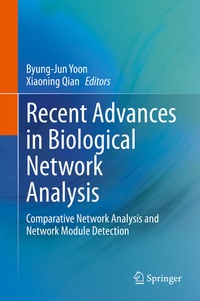
Recent Advances in Biological Network Analysis
Description

This book reviews recent advances in the emerging field of computational network biology with special emphasis on comparative network analysis and network module detection. The chapters in this volume are contributed by leading international researchers in computational network biology and offer in-depth insight on the latest techniques in network alignment, network clustering, and network module detection. Chapters discuss the advantages of the respective techniques and present the current challenges and open problems in the field.
Recent Advances in Biological Network Analysis: Comparative Network Analysis and Network Module Detection will serve as a great resource for graduate students, academics, and researchers who are currently working in areas relevant to computational network biology or wish to learn more about the field. Data scientists whose work involves the analysis of graphs, networks, and other types of datawith topological structure or relations can also benefit from the book's insights.
More details
Other editions
Additional editions
Persons
Prof. Byung-Jun Yoon received the B.S.E. ( summa cum laude ) degree from the Seoul National University (SNU), Seoul, Korea, and the M.S. and Ph.D. degrees from the California Institute of Technology (Caltech), Pasadena, CA, all in Electrical Engineering. He is currently an Associate Professor in the Department of Electrical and Computer Engineering at Texas A&M University, College Station, TX, USA. Prof. Yoon also holds a joint appointment at the Brookhaven National Laboratory (BNL), Upton, NY, where he is a Scientist in Computational Science Initiative (CSI). His awards and honors include the National Science Foundation (NSF) CAREER Award, the Best Paper Award at the 9th Asia Pacific Bioinformatics Conference (APBC), the Best Paper Award at the 12th Annual MCBIOS Conference, and the SLATE Teaching Excellence Award from the Texas A&M University System. Prof. Yoon's main research interests include bioinformatics, computational network biology, machine learning, and signal processing.
Prof. Xiaoning Qian received the Ph.D. degree in Electrical Engineering from Yale University, New Haven, CT, USA. He is currently an Associate Professor with the Department of Electrical and Computer Engineering. He is also a member of the TEES (Texas A&M Engineering Experiment Station)-AgriLife Center for Bioinformatics and Genomic Systems Engineering and the Center for Translational Environmental Health Research at Texas A&M University. His awards include the National Science Foundation CAREER Award, the Texas A&M Engineering Experiment Station (TEES) Faculty Fellow, and the Montague-Center for Teaching Excellence Scholar at Texas A&M University. His research focuses on developing mathematical models and computational algorithms in signal processing, machine learning, and Bayesian methods, especially in learning, uncertainty quantification, and experimental design. He has actively applied probabilistic models and optimization algorithms for systematic analysis of biomedical data and systems, including biomedical signals, images, gene expression, and molecular networks. He has been working on several funded interdisciplinary projects applying developed computational algorithms in biomedicine.
