

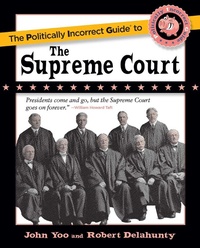
The Politically Incorrect Guide to the Supreme Court
Published on 27. June 2023
256 pages
978-1-68451-432-8 (ISBN)
Description

Justice in the Balance
Alexander Hamilton famously predicted that the judiciary would be "the least dangerous" branch of government. How's that working out?
The Supreme Court stands as arbiter over a country increasingly unable to govern itself. Americans can't agree on the meaning of the Constitution or even the rule of law. Are the nine high priests enthroned in their marble temple the saviors of the Republic or the pallbearers of democracy? Are they defenders of the Constitution as written or super-legislators who make law from the bench? What did the Founders envision when they vested the "judicial Power" in "one supreme Court"?
John Yoo, a professor of law at UC Berkeley, and Robert J. Delahunty, a fellow at the Claremont Institute Center for the American Way of Life, provide the answers with an incisive reading of the law and constitutional history. The Politically Incorrect Guide to the Supreme Court explains:
The Politically Incorrect Guide to the Supreme Court offers a penetrating and irreverent account of the justices?ideologues and cowards, geniuses and mediocrities, all of them thoroughly human?and a fascinating analysis of a Court that has swung like a pendulum from preserving the Republic to undermining government by the people and back to defending the Constitution. Sprightly, informative, and powerfully argued, this book is guaranteed to give the reader a deeper understanding of America's most powerful judicial body.
Alexander Hamilton famously predicted that the judiciary would be "the least dangerous" branch of government. How's that working out?
The Supreme Court stands as arbiter over a country increasingly unable to govern itself. Americans can't agree on the meaning of the Constitution or even the rule of law. Are the nine high priests enthroned in their marble temple the saviors of the Republic or the pallbearers of democracy? Are they defenders of the Constitution as written or super-legislators who make law from the bench? What did the Founders envision when they vested the "judicial Power" in "one supreme Court"?
John Yoo, a professor of law at UC Berkeley, and Robert J. Delahunty, a fellow at the Claremont Institute Center for the American Way of Life, provide the answers with an incisive reading of the law and constitutional history. The Politically Incorrect Guide to the Supreme Court explains:
- The turbulent history of the court's early years, and the eventual triumph of "judicial supremacy"
- The Bill of Rights: how the Court has defined free speech, freedom of religion, and the right to bear arms
- The Court's notorious rulings and how they were overturned?from Dred Scottto Roe v. Wade
- Why "court-packing" is a constant temptation for Democratic presidents
- The Supreme Court's best and worst justices?and what qualities distinguished them
- The future of the Supreme Court: Will it be the rubber stamp of corrupt administrations or the ultimate watchdog protecting our nation's liberties?
The Politically Incorrect Guide to the Supreme Court offers a penetrating and irreverent account of the justices?ideologues and cowards, geniuses and mediocrities, all of them thoroughly human?and a fascinating analysis of a Court that has swung like a pendulum from preserving the Republic to undermining government by the people and back to defending the Constitution. Sprightly, informative, and powerfully argued, this book is guaranteed to give the reader a deeper understanding of America's most powerful judicial body.
More details
Other editions
Additional editions
John Yoo | Robert J. Delahunty
The Politically Incorrect Guide to the Supreme Court
Book
06/2023
Regnery Publishing
€21.00
Shipment within 3-4 weeks
Persons
JOHN YOO is Emanuel S. Heller Professor of Law at the University of California at Berkeley and a fellow of the American Enterprise Institute and the Hoover Institution He has served as Deputy Assistant Attorney General and General Counsel for the U.S. Senate Judiciary Committee. He holds an A.B. from Harvard University and a J.D. from Yale Law School.
Content
- Intro
- Title Page
- Dedication
- Part I: Judicial Review
- Chapter 1: Least Dangerous?
- It's Not Just 'Dobbs'
- My, How Things Have Changed
- Two Ways of Judging
- Chapter 2: 'Marshall, Marbury', and 'McCulloch'
- Judicial Review
- "Necessary and Proper"
- Interstate Commerce
- Chapter 3: From the Civil War to the New Deal
- The Worst Decision Ever
- The 'Lochner' Era
- "The Switch in Time That Saved Nine"
- Chapter 4: Equality before the Law
- Incorporating the Bill of Rights
- Beyond the Text
- Part II: Substantive Due Process, Privacy, and Abortion
- Chapter 5: Abortion and the Current Supreme Court
- Constitutional Cage Match
- The Makeup of the Court Today
- Reconsidering 'Roe'-and Everything Else
- Chapter 6: The Leak
- Politics by Other Means
- Back to the Text
- The Court Steps Back
- Chapter 7: Overruling 'Roe': The 'Dobbs' Decision
- Not So Radical
- Opening a Can of Worms
- Justice Thomas Weighs In
- The Post-'Dobbs' Landscape
- Back to the States, the People, and Congress
- Part III: Gun Control or Gun Rights?
- Chapter 8: 'Heller': The Court Takes Up the Second Amendment
- Three Groundbreaking Cases
- The First Major Second Amendment Case in Seventy Years
- How to Understand the Preamble-and the Militia
- "A Pre-Existing Right"
- The Dissents
- A Right like Any Other
- Chapter 9: 'McDonald': Incorporating the Second Amendment
- The Fourteenth Amendment
- The 'Slaughter-House Cases', Substantive Due Process, and Privileges or Immunities
- Chapter 10: 'Bruen': Do You Need a "Special Need" to Carry a Gun?
- A "Special Need for Self-Protection"
- The Right to Self-Defense
- Concluding Observations
- Part IV: The Supreme Court and the Administrative State
- Chapter 11: The "Living Constitution" and the Fourth Branch
- Government by Technocracy
- A "New Constitution"
- Delegation
- Chapter 12: Is It Too Late?
- The Major Questions Doctrine and the Clear Statement Rule
- "Chief Justice Roberts Delivered the Opinion of the Court"
- "Gorsuch, J., Concurring"
- A Constitution of Necessity
- Precedents Distinguished, Not Overruled
- Part V: In Conclusion
- Chapter 13: Looking Ahead
- A Turning Point
- A New Direction
- Overrule This! (A Supreme Court Wish List)
- Grappling with 'Stare Decisis'
- Principle versus Practice
- 'Stare Decisis' versus the Constitution
- Looking for 'Stare Decisis' in the Constitution
- 'Gamble v. United States': Justice Thomas Weighs In
- 'Casey' versus 'Dobbs'
- Reliance Interests
- Institutional Positioning
- What Would the Founders Do?
- Acknowledgments
- About the Authors
- Notes
- Index
- Copyright
