

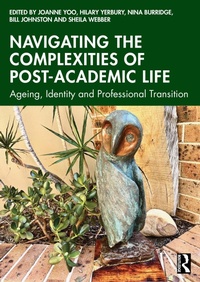
Navigating the Complexities of Post-Academic Life
Ageing, Identity and Professional Transition
Published on 14. May 2026
212 pages
978-1-040-53405-2 (ISBN)
Description

This thoughtful exploration examines the complex and multifaceted transition of retirement from academia, addressing fundamental questions of when and how to retire, and what retirement looks like. The work challenges assumptions about ageing while acknowledging the profound sense of loss that often accompanies the end of an academic career.
Through engaging autoethnographies, this book reveals both challenges and opportunities inherent in this significant life stage, offering unique insights into how academic identities evolve beyond formal employment. It focuses on the ongoing development of self and community in post-academic life, examining themes including the cultural production of retirement, the impact of political and social changes on academic careers, and the role of metacognition in shaping personal narratives. By presenting these complex issues through deeply personal stories, the work invites readers to reflect on their own experiences within the broader context of academic work and professional identity transformation.
This volume will interest current academics contemplating retirement, retired academics navigating post-career life, and researchers studying workforce transitions and ageing. It holds particular value for students and professionals in social work, social policy, gerontology, and higher education administration, offering both guidance and inspiration for understanding the complexities of post-retirement academic life.
Through engaging autoethnographies, this book reveals both challenges and opportunities inherent in this significant life stage, offering unique insights into how academic identities evolve beyond formal employment. It focuses on the ongoing development of self and community in post-academic life, examining themes including the cultural production of retirement, the impact of political and social changes on academic careers, and the role of metacognition in shaping personal narratives. By presenting these complex issues through deeply personal stories, the work invites readers to reflect on their own experiences within the broader context of academic work and professional identity transformation.
This volume will interest current academics contemplating retirement, retired academics navigating post-career life, and researchers studying workforce transitions and ageing. It holds particular value for students and professionals in social work, social policy, gerontology, and higher education administration, offering both guidance and inspiration for understanding the complexities of post-retirement academic life.
More details
Language
English
Place of publication
London
United Kingdom
Publishing group
Taylor & Francis Ltd
Target group
College/higher education
Professional and scholarly
Illustrations
3 Line drawings, black and white; 9 Halftones, black and white; 12 Illustrations, black and white
File size
8,00 MB
ISBN-13
978-1-040-53405-2 (9781040534052)
Copyright in bibliographic data and cover images is held by Nielsen Book Services Limited or by the publishers or by their respective licensors: all rights reserved.
Schweitzer Classification
Other editions
Additional editions
Joanne Yoo | Hilary Yerbury | Nina Burridge
Navigating the Complexities of Post-Academic Life
Ageing, Identity and Professional Transition
Book
05/2026
1st Edition
Routledge
€50.00
Shipment within 10-20 days

Joanne Yoo | Hilary Yerbury | Nina Burridge
Navigating the Complexities of Post-Academic Life
Ageing, Identity and Professional Transition
Book
05/2026
1st Edition
Routledge
€215.41
Shipment within 10-20 days
Persons
Joanne Yoo is a senior lecturer at the Faculty of Arts and Social Sciences, University of Technology Sydney (UTS). Her research interests include teaching as an embodied practice, autoethnography, and arts-based research methodologies. She continues to write creatively within academia to understand the links between academic inquiry and human flourishing.
Hilary Yerbury is an honorary research fellow at the University of Technology Sydney. Her background in European social and political cultures, information management, and anthropology has given her a broad-based approach to the use of information in everyday decision-making and in social change.
Nina Burridge is an industry fellow at the University of Technology Sydney. She was a Founding Director of the Institute of Aboriginal Studies and Research at Macquarie University and a Co-Director of the Cosmopolitan Civil Societies Research Centre at UTS. Her research interests centre on education for social justice and human rights within Australia and in international contexts.
Bill Johnston is a retired academic from the University of Strathclyde, Glasgow, Scotland. Before retiring in 2010, he was a senior lecturer and assistant director at Strathclyde University's Centre for Academic Practice and Learning Enhancement. His academic interests include information literacy; strategic academic development; the First Year Experience at university; curriculum and course design; and critical pedagogy.
Sheila Webber is a senior lecturer in the School of Information, Journalism and Communication, University of Sheffield, UK. Her core areas for research and teaching are information literacy and information behaviour.
Hilary Yerbury is an honorary research fellow at the University of Technology Sydney. Her background in European social and political cultures, information management, and anthropology has given her a broad-based approach to the use of information in everyday decision-making and in social change.
Nina Burridge is an industry fellow at the University of Technology Sydney. She was a Founding Director of the Institute of Aboriginal Studies and Research at Macquarie University and a Co-Director of the Cosmopolitan Civil Societies Research Centre at UTS. Her research interests centre on education for social justice and human rights within Australia and in international contexts.
Bill Johnston is a retired academic from the University of Strathclyde, Glasgow, Scotland. Before retiring in 2010, he was a senior lecturer and assistant director at Strathclyde University's Centre for Academic Practice and Learning Enhancement. His academic interests include information literacy; strategic academic development; the First Year Experience at university; curriculum and course design; and critical pedagogy.
Sheila Webber is a senior lecturer in the School of Information, Journalism and Communication, University of Sheffield, UK. Her core areas for research and teaching are information literacy and information behaviour.
Content
Preface 1. Introduction: autoethnography and the context of academic retirement 2. Heavenly Pursuits 3. Working in the weekends: A talanoa on retirement from the afternoon of an academic life 4. A post-retirement autoethnographer on the edge? 5. Contemplating the life after 6. The Spiralling Academic: An Activist Institutionalised/Liberated by Higher Education in Australia 7. Past, present and future: continuity without sameness 8. Reflections on the meaning of life within academia and beyond 9. In search of a good enough ending: retiring, leaving and letting go 10. Academic separation, despair, and creating a new life 11. Aftercare: Retiring from the University 12. The Poetry of Reason 13. The blessings of mindfulness 14. Living at the 'end,' without having yet arrived 15. Relinquishing tenure before I retire: Returning to the profession in my 'pracacademic' life 16. Conclusion Index
