

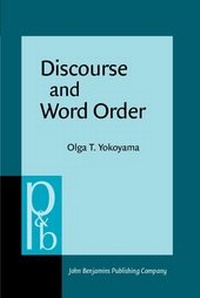
Discourse and Word Order
1st Edition
Published on 1. January 1987
XII, 361 pages
978-90-272-7889-0 (ISBN)
Description

Integrating various aspects of human communication traditionally treated in a number of separate disciplines, Olga T. Yokoyama develops a universal model of the smallest unit of informational discourse, and uncovers the regularities that govern the intentional verbal transfer of knowledge from one interlocutor to another. The author then places these processes within a new framework of Communicational Competence, which legitimizes certain nebulous but important linguistic phenomena hitherto caught in a noman's land between the formal and functional approaches to language. Russian word order, a classical problem of Slavic linguistics, is subjected to a rigorous examination within this theoretical framework; Yokoyama demonstrates how this "free word order language" can only be described by taking into account such generally neglected factors as the speakers' subjectivity and attitude. Of particular interest to Slavists is a new generative theory of Russian intonation, which is consistently incorporated into the description of Russian word order.
More details
Other editions
Additional editions
Olga T. Yokoyama
Discourse and Word Order
Book
01/1987
John Benjamins Publishing Co
€127.20
Shipment within 10-15 days
Person
Content
- DISCOURSE AND WORD ORDER
- Editorial page
- Title page
- Copyright page
- Table of contents
- FOREWORD
- PART ONE. A MODEL OF KNOWLEDGE TRANSACTIONS
- CHAPTER ONE. FOUR SETS OF KNOWLEDGE IN CONTACT
- 0. The Minimal Unit of Discourse
- 1. Communicable Knowledge
- 1.1 Seven kinds of knowledge
- 1.2 The relationship between different kinds of knowledge
- 2. Sharing Knowledge
- 3. Two Individuals in Discourse
- NOTES TO CHAPTER 1
- CHAPTER TWO. THE PROCEDURES FOR KNOWLEDGE TRANSACTIONS
- 0. Constraining Subjectivity
- 1. Assessment and Acknowledgment
- 1.1 Assessment
- 1.2. Acknowledgment
- 2. Misassessment
- 2.1. Assessment errors and adjustment
- 2.2. Imposition and acceptance
- 2.3. Assessment and context
- NOTES TO CHAPTER 2
- CHAPTER THREE. DISCOURSE-INITIAL UTTERANCES
- 0. Sentences, Illocutionary Acts, and Utterances
- 1. Directives
- 2. Statements
- 2.1 Propositional statements
- 2.2 Specificational statemenss
- 2.4 Predicational statemenss
- 2.5 Referential statemenss
- 2.6 Metinformaiionls statements
- 2.7 Summary of statements
- 3. Effusions
- 3.1 Impositional effusions
- 3.2 Non-impositional effusions
- 3.3 Summary of effusions
- 4. Questions
- 4.1 Specificational quesiions
- 4.2 Propositional questioss
- 4.3 Referential quesiions
- 4.4 Existential quesiions
- 4.5 Predicational quesiions
- 4.6 Metinformational questions
- 4.7 Summary of questions
- NOTES TO CHAPTER 3
- CHAPTER FOUR. NON-DISCOURSE-INITIAL UTTERANCES
- 0. Responses
- 1. Obligatory Responses
- 1.1 Answert to questions
- 1.2 Acknowledgment
- 1.3 Adjustment
- 2. Voluntary Contributions
- NOTES TO CHAPTER 4
- CHAPTER FIVE. GRAMMAR AND PRAGMATICS
- 1. The Model: a Summary
- 2. Between grammar and pragmatics
- 2.1 Deaccentuation of nouns
- 2.2 Compatibility of indefinite subjects and stative predicates
- 3. Communicational Competence
- NOTES TO CHAPTER 5
- PART TWO. RUSSIAN WORD ORDER
- CHAPTER SIX. HISTORY AND PRELIMINARIES
- 1. Word Order Permutations in Linguistic Theory
- 2. Russian Intonation and Word Order
- 2.1 The problem
- 2.2. An outline of Russian intonation
- 2.2.1 Utterance intonation "Type I
- 2.2.2 Utterance intonation "Type II
- 2.2.3 Intonation types and word order
- NOTES TO CHAPTER 6
- CHAPTER SEVEN. DISCOURSE-INITIAL UTTERANCES - I: ASSESSMENT
- 1. Directives
- 1.1 First person direciives
- 1.2 Second person direciives
- 1.3 Third person direciives
- 2. Statements
- 2.1 Propositional statements
- 2.2 Referential statements and statements about the CODE
- 2.3 Existential and predicational statements
- 3. Questions
- 3.1 Specificational quesiions
- 3.2 Propositional questioss
- 3.3 Rererential and CODE questions
- 3.4 Existential and predicaiional questioss
- 4. Effusions
- 5. Summary
- NOTES TO CHAPTER 7
- CHAPTER EIGHT DISCOURSE-INITIAL UTTERANCES - II: IMPOSITION AND GRAMMATICAL RELATIONS
- 1. Imposition
- 1.1 Personal Empathy: Imposition of referential knowledge
- 1.2 Imposition of propositional knowledge
- 2. Grammatical Relations
- 2.1 Tee terms: their semantic roles, case, and animacy
- 2.1.1 Unspecified propositionls statements
- 2.1.2 Multiple questions
- 2.1.3 Pronominal sequences
- 2.2 The preverbal position
- 2.2.1 Imposition of anthropological Empathy ?
- 2.2.2 Epic style or a different system?
- 2.3 Non-rererential items
- NOTES TO CHAPTER 8
- CHAPTER NINE. NON-DISCOURSE-INITIAL UTTERANCES
- 1. Answers to Questions
- 1.1 Specificational answess
- 1.2 Propositional answers
- 2. Voluntary Contributions Based on Links by Identity
- 2.1 Statements
- 2.2 Questions
- 3. Voluntary Contributions Based on Links by Associated Knowledge
- 3.1 Statements
- 3.2 Questions
- 4. Summary
- NOTES TO CHAPTER 9
- CONCLUSION
- REFERENCES
- SUBJECT INDEX
- NAME INDEX
