

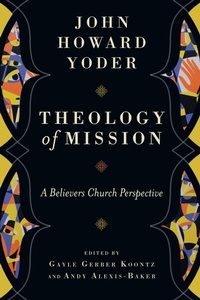
Theology of Mission
Description

- 2014 Best Texts of Missiology, from Byron Borger, Hearts and Minds Bookstore
More details
Other editions
Additional editions

Person
John Howard Yoder (1927-1997), author of The Politics of Jesus (1972), was best known forhis writing and teaching on Christian pacifism. He studied theology and served as a Mennonite mission staff person in post-war Europe from 1949-1957 and continued in overseas mission administration from the agency's base in Elkhart, Indiana, from 1959-1965. He received his doctorate from the University of Basel. During the 1960s he began teaching at Associated Mennonite Biblical Seminaries, leaving it in 1984. He continued his teachingand scholarly work as professor of theology at the University of Notre Dame until his death at the age of 70.
Andy Alexis-Baker (M.A., Associated Mennonite Biblical Seminary) is general editor with Tripp York of the Peaceable Kingdom series from Cascade Books. He recently published an essay on Christian pacifism in A Faith Not Worth Fighting For: Addressing Commonly Asked Questions about Christian Nonviolence edited by Tripp York and Justin Barringer (Cascade, 2012). He is currently finishing work on a Ph.D. in systematic theology and theological ethics at Marquette University.Alexis-Baker holds memberships in the International Jacques Ellul Society, the North American Patristics Society, the Mennonite Historical Society and the American Academy of Religion.
Gayle Gerber Koontz (Ph.D., Boston University) is professor of theology and ethics at Anabaptist Mennonite Biblical Seminary. Among her many published essays is "Unity with Integrity: John H. Yoder's Ecumenical Theology and Practice," which appeared in the 2010 book Radical Ecumenicity: Pursuing Unity and Continuity after John Howard Yoder (edited by John C. Nugent).
Content
Editors' Preface, by Gayle Gerber Koontz and Andy Alexis-Baker Introduction: John Howard Yoder's Mission Theology: Context and Contribution, by Wilbert Shenk Yoder's Introduction To The Topic 1. The Prophets: Israel and the Nations 2. Jesus's Public Ministry and the Nations 3. The Great Commission and Acts 4. The Ministry of Paul in Salvation History 5. Other Texts and the New Testament's Theology of Mission 6. Mission and Systematic Theology 7.Church Types and Mission: A Radical Reformation Perspective 8. Pietist Perspective on Mission 9. The Church as Missionary 10. The Church as Responsible 11. The Church as Local 12. The Church as Laity 13. Ministry in a Missionary Context 14. People Movements and the Free Church 15. Salvation is Historical 16. Salvation is for the World 17. Message and Medium: Presence 18. Message and Medium: Servanthood 19. Theology of Religions: Particularity and Universalism 20. Radical Reformation Perspectives on Religion 21. Christianity and Other Faiths 22. The Missionary Challenge of Non-non-Christian Faiths 23. Judaism as a Non-non-Christian Faith Afterword: As You Go Appendix Subject Index Name Index Scripture Index
