

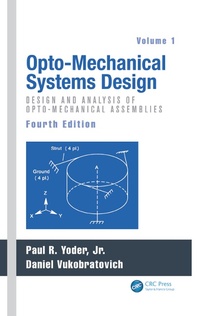
Opto-Mechanical Systems Design, Volume 1
Design and Analysis of Opto-Mechanical Assemblies
4th Edition
Published on 19. December 2017
770 pages
978-1-4822-5771-7 (ISBN)
Description

Opto-Mechanical Systems Design, Fourth Edition is different in many ways from its three earlier editions: coauthor Daniel Vukobratovich has brought his broad expertise in materials, opto-mechanical design, analysis of optical instruments, large mirrors, and structures to bear throughout the book; Jan Nijenhuis has contributed a comprehensive new chapter on kinematics and applications of flexures; and several other experts in special aspects of opto-mechanics have contributed portions of other chapters. An expanded feature-a total of 110 worked-out design examples-has been added to several chapters to show how the theory, equations, and analytical methods can be applied by the reader. Finally, the extended text, new illustrations, new tables of data, and new references have warranted publication of this work in the form of two separate but closely entwined volumes.
This first volume, Design and Analysis of Opto-Mechanical Assemblies, addresses topics pertaining primarily to optics smaller than 50 cm aperture. It summarizes the opto-mechanical design process, considers pertinent environmental influences, lists and updates key parameters for materials, illustrates numerous ways for mounting individual and multiple lenses, shows typical ways to design and mount windows and similar components, details designs for many types of prisms and techniques for mounting them, suggests designs and mounting techniques for small mirrors, explains the benefits of kinematic design and uses of flexures, describes how to analyze various types of opto-mechanical interfaces, demonstrates how the strength of glass can be determined and how to estimate stress generated in optics, and explains how changing temperature affects opto-mechanical assemblies.
This first volume, Design and Analysis of Opto-Mechanical Assemblies, addresses topics pertaining primarily to optics smaller than 50 cm aperture. It summarizes the opto-mechanical design process, considers pertinent environmental influences, lists and updates key parameters for materials, illustrates numerous ways for mounting individual and multiple lenses, shows typical ways to design and mount windows and similar components, details designs for many types of prisms and techniques for mounting them, suggests designs and mounting techniques for small mirrors, explains the benefits of kinematic design and uses of flexures, describes how to analyze various types of opto-mechanical interfaces, demonstrates how the strength of glass can be determined and how to estimate stress generated in optics, and explains how changing temperature affects opto-mechanical assemblies.
Reviews / Votes
"... [the previous edition] is my go-to reference for all things optomechanics, so I anticipate the new edition will get just as much use. ... The large number of illustrations, real-world examples, material property data, and additional references make this an excellent resource for any practicing optomechanical engineer."-Katie Schwertz, Edmund Optics
More details
Edition
4th edition
Language
English
Place of publication
London
United Kingdom
Publishing group
Taylor & Francis Ltd
Target group
College/higher education
Optical and mechanical engineers and engineering students.
Edition type
Revised edition
Illustrations
564 s/w Abbildungen, 34 farbige Abbildungen, 94 s/w Tabellen
94 Tables, black and white; 34 Illustrations, color; 564 Illustrations, black and white
File size
174,67 MB
ISBN-13
978-1-4822-5771-7 (9781482257717)
Copyright in bibliographic data and cover images is held by Nielsen Book Services Limited or by the publishers or by their respective licensors: all rights reserved.
Schweitzer Classification
Other editions
Additional editions
Paul Yoder | Daniel Vukobratovich
Opto-Mechanical Systems Design, Volume 1
Design and Analysis of Opto-Mechanical Assemblies
Book
03/2015
4th Edition
CRC Press
€288.10
Article not available for order
Persons
Paul Yoder (BS physics, Juniata College, Huntingdon, Pennsylvania, 1947, and MS physics, Penn State University, University Park, Pennsylvania, 1950) learned optical design and opto-mechanical engineering at the U.S. Army's Frankford Arsenal (1951-1961). He then applied those skills at Perkin-Elmer Corporation (1961-1986) and served the optical community as a consultant in optical and opto-mechanical engineering (1986-2006). A fellow of the OSA and SPIE, Yoder has authored numerous chapters on opto-mechanics, published more than 60 papers, been awarded 14 U.S. and several foreign patents, and taught more than 75 short courses for SPIE, U.S. government agencies, and industry.
Daniel Vukobratovich is senior principal multidisciplinary engineer at Raytheon Systems, Tucson, Arizona, and adjunct professor at the University of Arizona. He has authored more than 50 papers, taught short courses in opto-mechanics in 12 different countries, and consulted for more than 40 companies. A SPIE fellow, he is a founding member of the opto-mechanics working group. He holds international patents and received an IR-100 award for work on metal matrix composite optical materials. He led development on a series of ultra-lightweight telescopes using new materials, and worked on space telescope systems for STS-95, Mars Observer, Mars Global Surveyor, and FUSE.
Daniel Vukobratovich is senior principal multidisciplinary engineer at Raytheon Systems, Tucson, Arizona, and adjunct professor at the University of Arizona. He has authored more than 50 papers, taught short courses in opto-mechanics in 12 different countries, and consulted for more than 40 companies. A SPIE fellow, he is a founding member of the opto-mechanics working group. He holds international patents and received an IR-100 award for work on metal matrix composite optical materials. He led development on a series of ultra-lightweight telescopes using new materials, and worked on space telescope systems for STS-95, Mars Observer, Mars Global Surveyor, and FUSE.
Content
Opto-Mechanical Design Process. Environmental Influences. Opto-Mechanical Characteristics of Materials. Mounting Individual Lenses. Mounting Multiple Lens Assemblies. Design and Mounting of Windows, Domes, and Filters. Prism Design and Applications. Techniques for Mounting Prisms. Design and Mounting of Small Mirrors. Kinematic Design and Applications of Flexures. Analysis of the Opto-Mechanical Design. Summary of Methods for Testing Optical Components and Optical Instruments under Adverse Environmental Conditions.
