

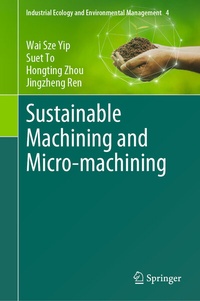
Sustainable Machining and Micro-machining
Description

This book explores the technical challenges and technological gaps in sustainable machining and micro-machining. It underscores the critical role of sustainability in manufacturing, a sector pivotal to addressing global environmental challenges. As micro-manufacturing expands, it mirrors traditional manufacturing environmental impact, prompting the need for sustainable strategies. The book delves into methodologies such as network analysis, text mining, and classification algorithms to help readers understand the interplay between machining parameters, stakeholders, and sustainability factors. It concludes with an analysis of the current status and future prospects of sustainable machining and micro-machining. Additionally, it highlights the importance of integrating sustainable manufacturing to enhance efficiency, reduce resource consumption, and meet the increasing demands from society and stakeholders for environmentally responsible manufacturing solutions. Finally, the book examines the current status and future perspectives of sustainable machining and micro-machining, offering a comprehensive view of how industries can reformulate their approaches to ensure continuous development and sustainability.
More details
Other editions
Additional editions
Persons
Prof. Suet TO is Professor of the Department of Industrial and Systems Engineering of the Hong Kong Polytechnic University, and Associate Director of State Key Laboratory of Ultra-precision Machining Technology and Advanced Optics Manufacturing Centre. She obtained her M.Phil. degree in materials science from Brunel University in UK and Ph.D. in ultra-precision machining technology from the Hong Kong Polytechnic University. She started her academic career as Assistant Professor in 2005 and promoted to Associate Professor and Professor in 2010 and 2018, respectively. She is Active Researcher who focuses on ultra-precision machining and material science. Her research interests include ultra-precision machining, advanced optics manufacturing technology, ultra-precision machining of micro/nano-structure and effect on materials. She has published 3 research books, more than 250 international SCI referred journal papers and over 150 international conference papers as well as obtained more than 20 patents in China and the USA.
Dr. Wai Sze YIP is currently Research Assistant Professor in the Department of Industrial and Systems Engineering of the Hong Kong Polytechnic University. She received Ph.D. degree in ultra-precision machining from the Hong Kong Polytechnic University in 2018. She obtained double degrees of B.B.A. in marketing and B.Eng. in industrial and systems engineering from the Hong Kong Polytechnic University in 2014 and B.Eng. degree in electronic and communication engineering from City University of Hong Kong in 2006. Before joining ISE of PolyU, Dr. Yip worked as Research Fellow in National University of Singapore. Her researches focus on ultra-precision machining of difficult to cut materials, sustainable precision machining and sustainability development of precision manufacturing. Dr. Yip has published in top-tier SCI journals. In 2018, one of the papers in Scientific Reports was awarded for top 100 papers in materials science.
Mr. Hongting ZHOU received the B.Sc. and M.Phil. degree in Department of Industrial and System Engineering from the Hong Kong Polytechnic University, in 2018 and 2021, respectively. He is currently pursuing the Ph.D. degree with the Department of Civil Engineering, McMaster University. His research interests include the applications of machine learning in manufacturing and supply chain. He has published papers in top-tier SCI journals such as Journal of Manufacturing Systems and Advanced Engineering Informatics.
Dr. Jingzheng REN is currently Associate Professor at the Hong Kong Polytechnic University. He has been selected as the only winner of the 2022 Asia-Pacific Economic Cooperation (APEC) Science Prize for Innovation, Research and Education (ASPIRE Prize), in recognition of his scientific contribution commitment to excellence in "Innovation to achieve economic, environmental, and social goals" and Bio-Circular-Green Economy. He has published more than 300 publications including more than 250 SCI indexed journal papers, 1 authored book by Springer, more than 20 edited books (published by Elsevier, Springer, World Scientific Publishing and AIP, etc.), and more than 50 book chapters. All his papers were published in the top-tier journals such as Nature Series Journals (Nature Food and Nature Communications) and Cell Press Series or Partner Journals (the Innovation and STAR Protocols). He is also ranked in the top 2% scientists listed in the Stanford List since 2020.
Content
Definition concepts and framework of sustainable machining and micro machining.- Introduction to sustainable ultra precision machining.- The importance of machining parameters toward sustainable micro milling process.- Evaluation of sustainable machining in the view of triple bottom line.- Text mining in sustainable manufacturing for topic modelling.- Applications of sentiment analysis in sustainable manufacturing.- Stakeholder concerns in sustainable machining using social network analysis.- Investigations of sustainable manufacturing using social network analysis classification algorithm approach.- Challenges and future prospectives of sustainable machining.
