

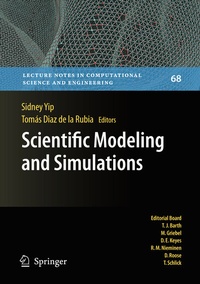
Scientific Modeling and Simulations
1st Edition
Published on 7. April 2010
VI, 402 pages
978-1-4020-9741-6 (ISBN)
Description

Although computational modeling and simulation of material deformation was initiated with the study of structurally simple materials and inert environments, there is an increasing demand for predictive simulation of more realistic material structure and physical conditions. In particular, it is recognized that applied mechanical force can plausibly alter chemical reactions inside materials or at material interfaces, though the fundamental reasons for this chemomechanical coupling are studied in a material-speci c manner. Atomistic-level s- ulations can provide insight into the unit processes that facilitate kinetic reactions within complex materials, but the typical nanosecond timescales of such simulations are in contrast to the second-scale to hour-scale timescales of experimentally accessible or technologically relevant timescales. Further, in complex materials these key unit processes are "rare events" due to the high energy barriers associated with those processes. Examples of such rare events include unbinding between two proteins that tether biological cells to extracellular materials [1], unfolding of complex polymers, stiffness and bond breaking in amorphous glass bers and gels [2], and diffusive hops of point defects within crystalline alloys [3].
More details
Other editions
Additional editions

Sidney Yip | Tomas Diaz Rubia
Scientific Modeling and Simulations
Book
03/2009
1st Edition
Springer
€106.99
Shipment within 15-20 days
Content
Scientific Modeling and Simulations.- A retrospective on the journal of computer-aided materials design (JCAD), 1993-2007.- Extrapolative procedures in modelling and simulations: the role of instabilities.- Characteristic quantities and dimensional analysis.- Accuracy of models.- Multiscale simulations of complex systems: computation meets reality.- Chemomechanics of complex materials: challenges and opportunities in predictive kinetic timescales.- Tight-binding Hamiltonian from first-principles calculations.- Atomistic simulation studies of complex carbon and silicon systems using environment-dependent tight-binding potentials.- First-principles modeling of lattice defects: advancing our insight into the structure-properties relationship of ice.- Direct comparison between experiments and computations at the atomic length scale: a case study of graphene.- Shocked materials at the intersection of experiment and simulation.- Calculations of free energy barriers for local mechanisms of hydrogen diffusion in alanates.- Concurrent design of hierarchical materials and structures.- Enthalpy landscapes and the glass transition.- Advanced modulation formats for fiber optic communication systems.- Computational challenges in the search for and production of hydrocarbons.- Microscopic mechanics of biomolecules in living cells.- Enveloped viruses understood via multiscale simulation: computer-aided vaccine design.- Computational modeling of brain tumors: discrete, continuum or hybrid?.
"Enveloped viruses understood via multiscale simulation: computer-aided vaccine design (p. 363-364)
Z. Shreif · P. Adhangale · S. Cheluvaraja · R. Perera · R. Kuhn · P. Ortoleva
Abstract Enveloped viruses are viewed as an opportunity to understand howhighly organized and functional biosystems can emerge from a collection ofmillions of chaotically moving atoms. They are an intermediate level of complexity between macromolecules and bacteria. They are a natural system for testing theories of self-assembly and structural transitions, and for demonstrating the derivation of principles of microbiology from laws of molecular physics. As some constitute threats to human health, a computer-aided vaccine and drug design strategy that would follow from a quantitative model would be an important contribution. However, current molecular dynamics simulation approaches are not practical for modeling such systems.
Our multiscale approach simultaneously accounts for the outer protein net and inner protein/genomic core, and their less structured membranous material and host fluid. It follows from a rigorous multiscale deductive analysis of laws of molecular physics. Two types of order parameters are introduced: (1) those for structures wherein constituent molecules retain long-lived connectivity (they specify the nanoscale structure as a deformation from a reference configuration) and (2) those for which there is no connectivity but organization is maintained on the average (they are field variables such as mass density or measures of preferred orientation). Rigorous multiscale techniques are used to derive equations for the order parameters dynamics. The equations account for thermal-average forces, diffusion coefficients, and effects of random forces. Statistical properties of the atomic-scale fluctuations and the order parameters are co-evolved. By combining rigorous multiscale techniques and modern supercomputing, systems of extreme complexity can be modeled.
Keywords Enveloped viruses · Structural transitions · All-atom multiscale analysis · Multiscale computation · Liouville equation · Langevin equations
1 Introduction
Deriving principles of microbial behavior from laws of molecular physics remains a grand challenge. While one expects many steps in the derivation can be accomplished based on the classical mechanics of an N-atom system, it is far from clear howto proceed in detail due to the extreme complexity of these supra-million atom systems.
Most notably, molecular dynamics (MD) codes are not practical for simulating even a simple bionanosystem of about 2 million atoms (e.g. a nonenveloped virus) over biologically relevant time periods (i.e. milliseconds or longer). For example, the efficientMDcode NAMD, run on a 1024-processor supercomputer [1], would take about 3000 years to simulate a simple virus over a millisecond; the largest NAMD simulation published to date is for a ribosome system of approximately 2.64 million atoms over few nanoseconds only [2].
We hypothesize that a first step in the endeavor to achieve a quantitative, predictive virology is to establish a rigorous intermediate scale description. Due to their important role in human health, complex structure, and inherent multiscale nature, enveloped viruses provide an ideal system for guiding and testing this approach. Experimental evidence suggests that an enveloped virus manifests three types of organization:"
Z. Shreif · P. Adhangale · S. Cheluvaraja · R. Perera · R. Kuhn · P. Ortoleva
Abstract Enveloped viruses are viewed as an opportunity to understand howhighly organized and functional biosystems can emerge from a collection ofmillions of chaotically moving atoms. They are an intermediate level of complexity between macromolecules and bacteria. They are a natural system for testing theories of self-assembly and structural transitions, and for demonstrating the derivation of principles of microbiology from laws of molecular physics. As some constitute threats to human health, a computer-aided vaccine and drug design strategy that would follow from a quantitative model would be an important contribution. However, current molecular dynamics simulation approaches are not practical for modeling such systems.
Our multiscale approach simultaneously accounts for the outer protein net and inner protein/genomic core, and their less structured membranous material and host fluid. It follows from a rigorous multiscale deductive analysis of laws of molecular physics. Two types of order parameters are introduced: (1) those for structures wherein constituent molecules retain long-lived connectivity (they specify the nanoscale structure as a deformation from a reference configuration) and (2) those for which there is no connectivity but organization is maintained on the average (they are field variables such as mass density or measures of preferred orientation). Rigorous multiscale techniques are used to derive equations for the order parameters dynamics. The equations account for thermal-average forces, diffusion coefficients, and effects of random forces. Statistical properties of the atomic-scale fluctuations and the order parameters are co-evolved. By combining rigorous multiscale techniques and modern supercomputing, systems of extreme complexity can be modeled.
Keywords Enveloped viruses · Structural transitions · All-atom multiscale analysis · Multiscale computation · Liouville equation · Langevin equations
1 Introduction
Deriving principles of microbial behavior from laws of molecular physics remains a grand challenge. While one expects many steps in the derivation can be accomplished based on the classical mechanics of an N-atom system, it is far from clear howto proceed in detail due to the extreme complexity of these supra-million atom systems.
Most notably, molecular dynamics (MD) codes are not practical for simulating even a simple bionanosystem of about 2 million atoms (e.g. a nonenveloped virus) over biologically relevant time periods (i.e. milliseconds or longer). For example, the efficientMDcode NAMD, run on a 1024-processor supercomputer [1], would take about 3000 years to simulate a simple virus over a millisecond; the largest NAMD simulation published to date is for a ribosome system of approximately 2.64 million atoms over few nanoseconds only [2].
We hypothesize that a first step in the endeavor to achieve a quantitative, predictive virology is to establish a rigorous intermediate scale description. Due to their important role in human health, complex structure, and inherent multiscale nature, enveloped viruses provide an ideal system for guiding and testing this approach. Experimental evidence suggests that an enveloped virus manifests three types of organization:"
