

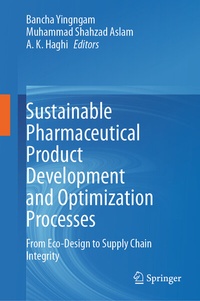
Sustainable Pharmaceutical Product Development and Optimization Processes
Description

This book offers unparalleled insight into the convergence of sustainability and pharmaceutical product development, with a specific focus on optimization processes. By addressing the urgent demand for more environmentally conscious and efficient strategies in the drug development industry, particularly in an era where the world faces the mounting challenges posed by climate change, the book provides a comprehensive guide for integrating sustainability principles throughout the pharmaceutical product lifecycle, directly contributing to the United Nations Sustainable Development Goals (SDGs), such as SDG 12 (Responsible Consumption and Production) and SDG 13 (Climate Action). The chapters cover key topics, including the application of green chemistry, eco-design principles, sustainable sourcing of raw materials, waste reduction strategies, and the use of renewable energy in pharmaceutical manufacturing processes. Throughout the book, case studies are integrated, offering practical insights and concurrently highlighting the economic and environmental advantages of sustainable practices, thereby addressing skepticism regarding the feasibility and profitability of such initiatives. The book also discusses regulatory considerations, ethical implications, and the challenges and opportunities associated with moving toward more sustainable practices in pharmaceutical development.
Importantly, this book seeks to solve the problem of the knowledge gap and lack of practical resources for professionals in the pharmaceutical industry who aspire to implement sustainable and optimized processes. This work consolidates a network of professionals and scholars keenly focused on future sustainability challenges, developing enhancement methodologies, and sharing successful strategies for implementing eco-friendly practices in pharmaceutical sectors worldwide, ultimately contributing to the global effort to achieve the SDGs by 2030. With a focus on pharmaceutical professionals, researchers, academicians, and students, the book serves as a valuable reference for those involved in drug development and process optimization. Policymakers and regulatory bodies might also find it insightful, as it addresses current landscapes, challenges, and future directions in sustainable pharmaceutical product development.
More details
Other editions
Additional editions
Persons
Bancha Yingngam is an Associate Professor at Ubon Ratchathani University, Thailand, with expertise in Pharmaceutical Sciences and Technology. He received his Ph.D. from Ubon Ratchathani University and conducted his postdoctoral fellowship at Karl-Franzens-Universität Graz, Austria.
Muhammad Shahzad Aslam , an assistant professor at Xiamen University, Malaysia, holds a Ph.D. in natural product chemistry, an M.Phil. in Pharmaceutical Chemistry, and a Pharm.D. His research focuses on metabolomics analysis, bioactive compounds, and green extraction techniques.
A. K. Haghi is a Professor Emeritus of Engineering Sciences who has published 250+ academic research-oriented books and 1000+ research papers. He serves as Editor-in-Chief of prestigious journals and is currently appointed the Honorary Research Associate at the University of Coimbra, Portugal. The diverse backgrounds and research interests of editors contribute to their comprehensive understanding of sustainable practices in the pharmaceutical industry.
Content
Chapter 1. The Pillars of Sustainable Pharmaceutical Development.- Chapter 2. Ecodesign Principles.- Chapter 3. Sustainable Pharmaceutical Product Development and Optimization Processes.- Chapter 4. Eco-friendly Pharmaceutical Formulation and Production Strategies and Future Perspectives.- Chapter 5. Design of Experiments (DoE) in Manufacturing Process Optimization.- Chapter 6. IoT and Its Role in Sustainable Pharmaceutical Supply Chains.- Chapter 7. Analysis of the Process and Evaluation of Green Servitization: Sustainability Practices of the Pharmaceutical Industry.- Chapter 8. Design Strategies for Waste Reduction and Enhanced Recyclability in Pharmaceutical Packaging.- Chapter 9. Pharmaceutical Waste Reduction in Hospitals: The Impact of Segregation Practices and Regulatory Compliance.- Chapter 10. Deep Eutectic Solvents for Sustainable Phytochemical Extraction in Pharmaceutical Innovation.- Chapter 11. Invasive Plant-derived Phytochemicals: Turning Threat into Benefit.- Chapter 12. Current Approaches to Food Waste Valorization for Nutraceuticals.- Chapter 13. Eco-friendly Nanoparticle Synthesis for Cancer Treatment: A Sustainable Healthcare Approach.- Chapter 14. Sustainable Strategies for Cancer Phytomedicine: Balancing Efficacy and Environmental Responsibility.- Chapter 15. Enhancing Medicine Quality Sustainably: Evaluating the Impact of WHO Guidelines through Document Analysis.- Chapter 16. Challenges in Sustainable Pharmaceutical Development.- Chapter 17. Sustainable Pharma Case Studies.
