

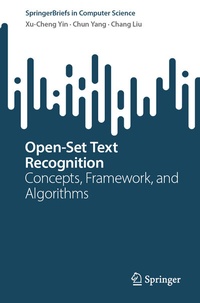
Open-Set Text Recognition
Description

In real-world applications, new data, patterns, and categories that were not covered by the training data can frequently emerge, necessitating the capability to detect and adapt to novel characters incrementally. Researchers refer to these challenges as the Open-Set Text Recognition (OSTR) task, which has, in recent years, emerged as one of the prominent issues in the field of text recognition. This book begins by providing an introduction to the background of the OSTR task, covering essential aspects such as open-set identification and recognition, conventional OCR methods, and their applications. Subsequently, the concept and definition of the OSTR task are presented encompassing its objectives, use cases, performance metrics, datasets, and protocols. A general framework for OSTR is then detailed, composed of four key components: The Aligned Represented Space, the Label-to-Representation Mapping, the Sample-to-Representation Mapping, and the Open-set Predictor. In addition,possible implementations of each module within the framework are discussed. Following this, two specific open-set text recognition methods, OSOCR and OpenCCD, are introduced. The book concludes by delving into applications and future directions of Open-set text recognition tasks.
This book presents a comprehensive overview of the open-set text recognition task, including concepts, framework, and algorithms. It is suitable for graduated students and young researchers who are majoring in pattern recognition and computer science, especially interdisciplinary research.More details
Other editions
Additional editions
Persons
Xu-Cheng Yin is a full professor, the director of Pattern Recognition and Artificial Intelligence Lab, Department of Computer Science and Technology, School of Computer and Communication Engineering, University of Science and Technology Beijing, China. He received the B.Sc. and M.Sc. degrees in computer science from the University of Science and Technology Beijing, China, in 1999 and 2002, respectively, and the Ph.D. degree in pattern recognition and intelligent systems from the Institute of Automation, Chinese Academy of Sciences, in 2006. He was a visiting professor in the College of Information and Computer Sciences, University of Massachusetts Amherst, USA, for three times (in 2013, 2014 and 2016). He recieved the National Science Fund for Distinguished Young Scholars in 2021. His research interests include pattern recognition, document analysis and recognition, computer vision, machine learning, and data mining.
Chun Yang received the B.Sc. and Ph.D. degrees in computer science from the
University of Science and Technology Beijing, China, in 2011 and 2018,
respectively. He is currently a lecturer with the School of Computer and
Communication Engineering, University of Science and Technology Beijing.
His current research interests include pattern
recognition, classifier ensemble, and document analysis and recognition.
Chang Liu received the B.Sc. degree in computer science from the University of
Science and Technology Beijing, China, in 2016, where he is currently pursuing
the Ph.D. degree with the Department of Computer Science and Technology.
His research interests include text detection,
few-shot learning, and text recognition.
