

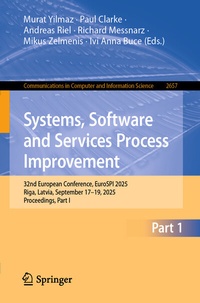
Systems, Software and Services Process Improvement
Description

The two-volume set CCIS 2657 + 2658 constitutes the refereed proceedings of the 32nd European Conference on Systems, Software and Services Process Improvement, EuroSPI 2025, held in Riga, Latvia, during September 17-19, 2025.
The 42 papers included in these proceedings were carefully reviewed and selected from 72 submissions. They were organized in topical sections as follows:
Part I: SPI and Emerging and Multidisciplinary Approaches to Software Engineering; SPI and Standards and Safety and Security Norms; SPI and Functional Safety and Cybersecurity.
Part II: Sustainability and Life Cycle Challenges; SPI and Recent Innovations; Digitalisation of Industry, Infrastructure and E-Mobility; SPI and Agile.
More details
Other editions
Additional editions
Content
.-
SPI and Emerging and Multidisciplinary Approaches to Software Engineering
.- Generative IT Products - be generic to become generative to handle fit for use.
.- Explainable AI for SW Development and Testing.
.- Baseline Evaluation of LLM-Facilitated UI Test-Case Generation from Gherkin Specifications.
.- Hype to Quality: Assessing Generative AI Products Before Use.
.- Trustworthy Artificial Intelligence in Healthcare: a proposed framework.
.- Current AI-based Software Engineering, Strengths and weaknesses - Results from a MLR.
.- Toward the implementation of DevOps: a guide of tools, practices and activities.
.- Inner source, outer source, low code, and no code: Pros, Cons and Contexts - Results from an MLR.
.- Benchmarking AI-Facilitated UI Test-Script Generation: A Reproducible Evaluation Framework.
.- A Review of Estimation in Software Engineering.
.- Programming language selection in software engineering: Results from an adapted MLR focused on Go, Haskell, Python and Rust.
.-
SPI and Standards and Safety and Security Norms.
.- A Process Assessment Model for AI-enabled Medical Device Software.
.- Advancing Risk Management Processes for Automotive Machine Learning Applications: Optimizing A-SPICE® v4.0 with ISO23894 for Safe and Reliable Deployment.
.- Automatic assessment of corporate sustainability due diligence process capability and CS3D compliance.
.- Regulatory Compliance-aware System Change Management via an Ontology-based Approach.
.- Electromechanic for Development of Embedded Systems.
.- Strengthen Process Debt Identification through Process Assessment Standards.
.- A Review of AI Life Cycle-related Standards to Address AI-enabled Medical Device Development.
.- Interpretations of Automotive SPICE Generic Practices on Level 2.
.- Evaluation of IEC 61508 Defenses for Common Cause Failures in Railway Industry.
.- Interfaces between Quality Assurance and ASPICE Assessment and Improvement.
.-
SPI and Functional Safety and Cybersecurity.
.- Cybersecurity vulnerabilities management for small and medium enterprises.
.- Security and safety interrelationships in the V2X context A brief comparison of typical techniques and requirements of standards.
.- Efficiency boosters for the successful execution of functional safety.
.- Enhancing Automotive TARA: The Role of Attacker Motivation in Attack Feasibility Levels.
.- Multi-Layer non-project-based TARA.
.- Updated Experiences with Using ASPICE 4.0 for Safety Audits and Interfacing Safety Assessments.
