

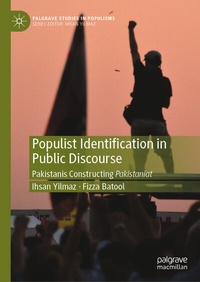
Populist Identification in Public Discourse
Description

Based on semi-structured interviews with ordinary citizens in Pakistan, this book analyses the complex relationship between populism, political identity, and historical experiences in Pakistan, highlighting how populist discourse influences and is influenced by varied interpretations of Pakistaniat - the identification with Pakistan. It introduces a novel theoretical framework for analysing populism in the public sphere, using Laclau's view of populism as a discursive logic and Panizza's definition as a mode of identification. This connection allows for a deeper understanding of how populist constructs form a collective identity amidst diverse demands, particularly through the concept of "the people" as an empty signifier. The book also examines the multiple meanings associated with Pakistani identity and their ties to the rise of populism, addressing gaps in existing literature regarding the demand side of populism and its impact on both politicians and the public.
More details
Other editions
Additional editions
Persons
Ihsan Yilmaz is research chair and professor of political science and international relations at Deakin University's ADI (Alfred Deakin Institute for Citizenship and Globalisation). Previously, he worked at the Universities of Oxford and London. He researches on nation-building, citizenship, minorities, securitisation, intergroup emotions, populism, transnationalism, digital authoritarianism, and legal pluralism. Presently, he leads two Australian Research Council (ARC) Discovery projects: "Religious Populism, Emotions, and Political Mobilisation: Civilisationism in Turkey, Indonesia, and Pakistan" and "Civilisationist Mobilisation, Digital Technologies, and Social Cohesion: The Case of Turkish & Indian Diasporas in Australia." Additionally, he co-leads a 3-year Gerda Henkel Foundation project: "Smart Digital Technologies and the Future of Democracy in the Muslim World: The Pakistani, Iranian, Egyptian and Turkish Cases."
Fizza Batool is an Assistant Professor at SZABIST University, where she teaches courses on Democratisation and South Asian Politics. She is concurrently a Postdoctoral Fellow at the Central European University Democracy Institute. Prior to her academic career, Fizza held senior research positions at prominent Pakistani policy research institutions. In 2020, she was a distinguished South Asian Visiting Fellow at the Stimson Center in Washington, D.C.
Content
Chapter 01: Populist Discourse and Identity Fluidity in Pakistan: Constructing 'Pakistaniat'.- Chapter 02: The Historical and Populist Construction of 'The People' and 'The Anti-People' in Pakistan: Pakistanis and Pakistaniat.- Chapter 03: The Intersection of Muslim Nationalism and the Transnational Ummah: Pakistanis' Quest for Identity.- Chapter 04: Beyond Political Leaders: Anti-Elitism and Institutional Discontent in Pakistan.- Chapter 05: Articulating Democracy, Religion and Politics: The Dynamics of Pakistani Identity and Political Engagement.- Chapter 06: Marginalized Underdogs, Morally Superior Muslim Nation, And Sovereign Democrats.
