

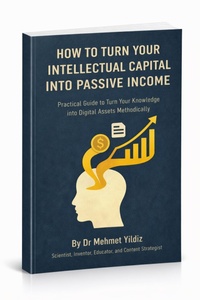
How to Turn Your Intellectual Capital into Passive Income: Practical Guide to Turn Your Knowledge and Experience into Digital Assets Methodically
Description

For almost half a century, I built my life and career by learning deeply, solving real problems, and documenting what I learned along the way. I did this long before terms like "creator economy," "personal brand," or "passive income" became popular. At the time, I was not trying to build passive income.
I had no idea what passive income meant then. As a scientist and technology inventor, I was focused on thinking clearly, doing meaningful work, adding value, and leaving behind something worthwhile.
Only later did I realize what I had built by design. After retirement, my passive income exceeded my active income. This book grew from that realization.
Across decades in research, enterprise environments, consulting, writing, teaching, and invention, I accumulated something more durable than job titles or short-term income.
I accumulated intellectual capital. Experience compressed into insight. Judgment shaped by repetition. Patterns are recognized through success and failure. Knowledge that continued to create value as my working hours gradually reduced. In this book, I explain how intellectual capital forms, how it compounds, and how it can support you later in life with far less pressure than constant active work.
To make this process clear and practical, I introduce two integrated frameworks. ICELAND™ explains how intellectual capital forms through immersion, compression, leverage awareness, articulation, and durable dividends. CAPITAL ENIGEN™ explains how that capital becomes structured intellectual property. Together, they provide a coherent architecture so you can see where you are, what to strengthen next, and how to convert experience into long-term stability.
This is not a book about shortcuts, platforms, or trends. I do not offer formulas or promises of quick results. Instead, I share a calm, realistic path for turning what you already know into assets that continue working long after you step back from full-time effort.
I walk through the progression I experienced myself: first, active intellectual income through hands-on work, employment, consulting, research, coaching, and problem-solving for startups and large organizations; then compounding intellectual income through books, articles, white papers, newsletters, blogs, ghostwriting, patents, designs, audio, video, course materials, and other durable forms of documented thinking.
Documentation is central. Writing, recording, structuring, and revisiting ideas changed everything. Documentation turned effort into leverage. One idea began to support many expressions. Work completed once continued creating value years later.
I explain each major intellectual asset type in practical terms: when books make sense and why they age well; how articles remain relevant; why white papers carry professional weight; how newsletters function as living knowledge systems; when ghostwriting creates invisible value; when patents and designs matter; and how audio and video can extend presence without exhaustion.
I also address semi-retirement. Stepping back from full-time work does not mean stepping away from contribution. For me, it meant shifting leverage, choosing projects instead of chasing them, maintaining income stability without constant hustle, and teaching and writing with intention rather than urgency.
If you are a professional, scholar, consultant, educator, creator, or lifelong learner, you already possess more intellectual capital than you think. You may not recognize it or know how to shape it and let it compound. This book exists to help you do exactly that.
You do not need to reinvent yourself. You need to recognize what you have already built, give it structure, and allow time to work in your favor. That is what I did, and this book shows you how.
More details
Person
Dr Mehmet Yildiz is a technologist who worked as a Distinguished Enterprise Architect certified by the Open Group in multi-billion projects. Working in the IT industry over the last 42 years, leading complex enterprise projects for large corporate organizations like IBM, Siemens, and Microsoft, he focuses on cutting-edge technology solutions, such as IoT, Big Data Analytics, Blockchain, Cognitive Computing, AI, Cloud, Fog, and Edge Computing integration.
He is a seasoned writer and the author of multiple books on technology, health, science, and content development, combining decades of experience in science, technology, enterprise architecture, and corporate business leadership. With an academic, research, innovation, and invention background, Dr. Yildiz has made significant contributions to content creation, marketing, strategy, and digital innovation.
As the chief editor and owner of 15 prominent publications on Medium, he has built a thriving community of over 32,000 writers, supporting them in their creative journeys. His expertise extends to Substack, where he continues to cultivate a large, engaged community, guiding writers to discover their unique voices, grow their audiences, and develop sustainable newsletter-based businesses. Owning three newsletters on Substack, he gained over 28,000 subscribers. In his recent book Substack Mastery, Dr. Yildiz distills decades of knowledge into actionable insights, offering writers practical strategies to succeed in today's competitive digital landscape.
You can connect with the author on several platforms linked to his website digitalmehmet.com
