

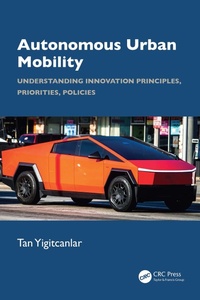
Autonomous Urban Mobility
Understanding Innovation Principles, Priorities, Policies
Published on 12. August 2025
401 pages
978-1-040-38785-6 (ISBN)
Description

This book provides a comprehensive exploration of the rapidly evolving field of autonomous urban mobility, examining its transformative potential and the principles guiding its innovation. This essential resource offers deep insights into the societal, policy, and urban impacts of autonomous vehicles, drawing on an extensive body of research. Beginning with a review of smart urban mobility innovations, the book explores technological advancements such as connected vehicles, mobility-as-a-service platforms, and shared autonomous systems, evaluating their successes and challenges.
This book traces the evolution of autonomous vehicle research over the past two decades, identifying key trends, methodologies, and future research directions, underscoring the importance of interdisciplinary approaches to address complex challenges. Subsequent chapters critically assess the technical capabilities, societal impacts, and policy frameworks necessary for the widespread adoption of autonomous vehicles, with a focus on implications for land use, infrastructure, and environmental planning. Public acceptance is a recurring theme, with an in-depth analysis of socio-demographic, psychological, and contextual factors influencing attitudes towards autonomous mobility. This book also examines the role of shared autonomous systems in addressing urban challenges such as congestion and equity, highlighting their potential to create more sustainable urban transportation networks. Concluding with a discussion on the disruptive impacts of autonomous vehicles on urban form and land use, the author provides a balanced perspective on the opportunities and risks of mobility-as-a-service.
This key reference book equips academics, policymakers, urban planners, and industry professionals with the knowledge to navigate the complex interplay of technology, policy, and societal impact, advancing the vision of smarter and more sustainable cities.
This volume, alongside its companion-Autonomous Urban Mobility: Understanding Adoption Parameters, Perceptions, Perspectives-offers a holistic view of autonomous urban mobility. Together, these books provide a comprehensive exploration of the rapidly evolving landscape of autonomous urban mobility, the principles guiding its innovation, the wide-ranging impacts of its adoption on society, policy, and urban environments, and the transformative potential of autonomous vehicles in the future of urban transportation.
This book traces the evolution of autonomous vehicle research over the past two decades, identifying key trends, methodologies, and future research directions, underscoring the importance of interdisciplinary approaches to address complex challenges. Subsequent chapters critically assess the technical capabilities, societal impacts, and policy frameworks necessary for the widespread adoption of autonomous vehicles, with a focus on implications for land use, infrastructure, and environmental planning. Public acceptance is a recurring theme, with an in-depth analysis of socio-demographic, psychological, and contextual factors influencing attitudes towards autonomous mobility. This book also examines the role of shared autonomous systems in addressing urban challenges such as congestion and equity, highlighting their potential to create more sustainable urban transportation networks. Concluding with a discussion on the disruptive impacts of autonomous vehicles on urban form and land use, the author provides a balanced perspective on the opportunities and risks of mobility-as-a-service.
This key reference book equips academics, policymakers, urban planners, and industry professionals with the knowledge to navigate the complex interplay of technology, policy, and societal impact, advancing the vision of smarter and more sustainable cities.
This volume, alongside its companion-Autonomous Urban Mobility: Understanding Adoption Parameters, Perceptions, Perspectives-offers a holistic view of autonomous urban mobility. Together, these books provide a comprehensive exploration of the rapidly evolving landscape of autonomous urban mobility, the principles guiding its innovation, the wide-ranging impacts of its adoption on society, policy, and urban environments, and the transformative potential of autonomous vehicles in the future of urban transportation.
Reviews / Votes
"Most discussions about autonomous vehicles focus on the image of a driverless car-a narrow view. In Autonomous Urban Mobility, Tan Yigitcanlar presents a thorough analysis of how this transformative technology could reshape the economic, social, and spatial dynamics of cities if understood as a socio-technical system. Through a multidisciplinary lens, he explores its current impacts on urban mobility and its potential to create sustainable and equitable transport systems. Combining theory, critical analysis, and practical insights, this book is an essential guide for urban planners, transportation experts, and anyone shaping the future of cities."Professor Fabio Duarte, Massachusetts Institute of Technology, USA
"Autonomous Urban Mobility dives into the social, technical, and policy landscapes shaping autonomous vehicle adoption in cities. Through empirical research and case studies, the book skilfully examines autonomous vehicles as solutions to urban issues like congestion and access, providing insights for policymakers, planners, and anyone interested in urban mobility's future."
Professor David Levinson, University of Sydney, Australia
"Innovations such as electric mobility, autonomous vehicles, and mobility-as-a-service represent disruptive technologies that drive profound societal transformations. Autonomous Urban Mobility provides a comprehensive guide to navigating the complexities of these advancements, helping to avoid common challenges while accelerating the 'Five Transformations'-vehicle transformation, modal-split transformation, lifestyle transformation, economic transformation, and city transformation-essential for achieving sustainable urban development."
Professor Becky Loo, The University of Hong Kong, China
"Autonomous Urban Mobility by Tan Yigitcanlar provides a timely and essential exploration of the complexities involved in integrating autonomous technologies into urban environments. By addressing foundational principles, actionable policies, and strategic priorities, this book serves as a vital resource for policymakers, urban planners, and professionals in the smart mobility sector."
Professor Jonathan Corcoran, The University of Queensland, Australia
"A timely work, Autonomous Urban Mobility presents a focused collection of Tan Yigitcanlar's research on autonomous driving technology, public acceptance and attitudes towards autonomous vehicles and autonomous transit. This book serves as an invaluable guide for researchers and policymakers, offering insights into public adoption intentions, expectations, and concerns surrounding this transformative mode of mobility."
Professor Sylvia He, The Chinese University of Hong Kong, China
More details
Language
English
Place of publication
London
United Kingdom
Publishing group
Taylor & Francis Ltd
Target group
College/higher education
Professional and scholarly
Illustrations
40 Tables, black and white; 31 Line drawings, black and white; 31 Illustrations, black and white
File size
16,80 MB
ISBN-13
978-1-040-38785-6 (9781040387856)
Copyright in bibliographic data and cover images is held by Nielsen Book Services Limited or by the publishers or by their respective licensors: all rights reserved.
Schweitzer Classification
Other editions
Additional editions
Book
08/2025
1st Edition
CRC Press
€98.60
Shipment within 10-20 days
Book
08/2025
1st Edition
CRC Press
€81.00
Shipment within 10-20 days
Person
Tan Yigitcanlar, a globally recognised Australian researcher and author in urban studies, technology, and planning, is ranked among the world's top 1% of scientists. He is a Professor at Queensland University of Technology's School of Architecture and Built Environment and the Director of the QUT Urban AI Hub in Brisbane, Australia.
Content
1. Smart Urban Mobility Innovations. 2. Autonomous Vehicle Innovations. 3. Understanding Autonomous Vehicles. 4. Predictors of Autonomous Vehicle Acceptance. 5. Shared Autonomous Vehicle Systems. 6. Disruptive Impacts of Autonomous Vehicles. 7. Autonomous Vehicles for Transportation Disadvantage Mitigation. 8. Mobility-as-a-Service for Desired Autonomous Vehicle Impact.
