

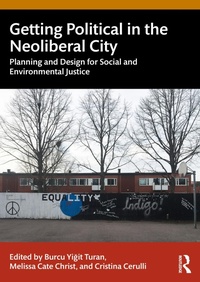
Getting Political in the Neoliberal City
Planning and Design for Social and Environmental Justice
1st Edition
Published on 25. June 2025
180 pages
978-1-040-36693-6 (ISBN)
Description

In a world defined by ever-deepening crises-climate, social, economic, and political-urban spaces emerge as both battlegrounds of injustice and the arenas of possibility. Getting Political in the Neoliberal City interrogates the roles of planners, architects, designers, and urban citizens in challenging the pervasive inequities of neoliberal urbanism. Drawing from critical case studies spanning continents and disciplines, this volume reframes the intersections of spatial and social justice to illuminate how space becomes a site of power, exclusion, and potential resistance.
Through incisive essays and reflective scholarship, this book explores how cities are shaped by market forces and neoliberal governance, yet also serve as sites for insurgent practices at various scale, grassroots movements, and alternative imaginaries that resist dominant modes of urbanization and claim just ways of making cities. Highlighting the emergencess of new epistemologies, subjectivities and critical agencies, Getting Political in the Neoliberal City calls for a transformative rethinking of urban and environmental planning, design, and citizenship.
Featuring contributions from scholars and practitioners in diverse fields, including architecture, geography, political science, and anthropology, the book maps the tensions between depoliticized scholarly and professional practices and the urgent need for politicized action. With compelling examples from Australia, Brazil, Cyprus, Denmark, Germany, Hong Kong, the USA, and Sweden, this book offers fresh insights into ongoing research on the struggles for more equitable, inclusive, and environmentally just cities. It also provides opportunities to understand the historical contextuality of each case and to reflect on the nuances, similarities, and global connections between different cases across different geographies.
Through incisive essays and reflective scholarship, this book explores how cities are shaped by market forces and neoliberal governance, yet also serve as sites for insurgent practices at various scale, grassroots movements, and alternative imaginaries that resist dominant modes of urbanization and claim just ways of making cities. Highlighting the emergencess of new epistemologies, subjectivities and critical agencies, Getting Political in the Neoliberal City calls for a transformative rethinking of urban and environmental planning, design, and citizenship.
Featuring contributions from scholars and practitioners in diverse fields, including architecture, geography, political science, and anthropology, the book maps the tensions between depoliticized scholarly and professional practices and the urgent need for politicized action. With compelling examples from Australia, Brazil, Cyprus, Denmark, Germany, Hong Kong, the USA, and Sweden, this book offers fresh insights into ongoing research on the struggles for more equitable, inclusive, and environmentally just cities. It also provides opportunities to understand the historical contextuality of each case and to reflect on the nuances, similarities, and global connections between different cases across different geographies.
Reviews / Votes
"Getting Political in the Neoliberal City is a timely book that highlights spaces and practices of politics in contemporary cities and offers urgent arguments for advancing spatial justice."Ed Wall, Professor of Landscape Architecture, Greenwich University, UK
"This insightful book offers a compelling overview of the growing focus on social, spatial, and environmental justice within built environment disciplines. Through a series of thoughtfully curated chapters, it helps readers grasp the complex burgeoning inequalities, and the formidable challenges faced by researchers, planners, and activists alike when trying to understand neoliberal space production. By integrating diverse disciplinary perspectives and geographical contexts, the book enriches the ongoing scholarly discourse on justice in the built environment. It is an essential read not only for planners and researchers but also for local activists who see planning, architecture, and design as vital tools in addressing socio-spatial and environmental inequalities. A powerful contribution to understanding and transforming the landscapes of justice."
Irene Molina, Professor of Human Geography, Uppsala University, Sweden
"This collection theorizes struggles for equity and justice in neoliberal urban contexts from different disciplinary perspectives and with a range of professional approaches in geographically diverse cities around the globe. It explores the complex interplay of de- and re-politicizing planning, architecture and urban design, as these fields become shaped by neoliberalism. Based on in-depth empirical detail and creative conceptual exploration, the editors of and contributors to this volume argue for a true transformation of the spatial arts disciplines to vividly include critical knowledge and socio-political forms of civic emancipation, and liberation. A must read for those planners and designers interested in socio-spatial and environmental justice against the background of ever new trends in neoliberal urbanization!"
Sabine Knierbein, Associate Professor for Urban Culture and Public Space, Faculty of Architecture and Planning, TU Wien, Austria
More details
Edition
1. Auflage
Language
English
Place of publication
London
United Kingdom
Publishing group
Taylor & Francis Ltd
Target group
College/higher education
Professional and scholarly
Illustrations
3 Tables, black and white; 15 Line drawings, black and white; 17 Halftones, black and white; 32 Illustrations, black and white
File size
5,78 MB
ISBN-13
978-1-040-36693-6 (9781040366936)
Copyright in bibliographic data and cover images is held by Nielsen Book Services Limited or by the publishers or by their respective licensors: all rights reserved.
Schweitzer Classification
Other editions
Additional editions
Burcu Yigit Turan | Melissa Cate Christ | Cristina Cerulli
Getting Political in the Neoliberal City
Planning and Design for Social and Environmental Justice
Book
06/2025
1st Edition
Routledge
€205.20
Shipment within 15-20 days
Burcu Yigit Turan | Melissa Cate Christ | Cristina Cerulli
Getting Political in the Neoliberal City
Planning and Design for Social and Environmental Justice
Book
06/2025
1st Edition
Routledge
€62.80
Shipment within 15-20 days
Persons
Burcu Yigit Turan is a senior lecturer at the Department of Urban and Rural Development, Swedish University of Agricultural Sciences, Uppsala. Her work lies at the intersection of critical theory and urban and landscape studies and focuses on environmental and socio-spatial justice-oriented histories, theories, methodologies, and practices in planning and design.
Melissa Cate Christ is a landscape architect, academic, artist, and director of transverse studio, a multidisciplinary design, research, and engagement consultancy which focuses on the planning, design, and activation of vibrant and sustainable urban places. Currently Sydney-based, Melissa has lived and worked in Sweden, Hong Kong, Canada, China, and the USA.
Cristina Cerulli is a Professor of Architecture at the University of Reading and a founding director of research-led social enterprise practice Studio Polpo. She works across practice and academia around supporting collective endeavors in the city and countering inequality through practices of care and actively proposing and implementing alternatives.
Melissa Cate Christ is a landscape architect, academic, artist, and director of transverse studio, a multidisciplinary design, research, and engagement consultancy which focuses on the planning, design, and activation of vibrant and sustainable urban places. Currently Sydney-based, Melissa has lived and worked in Sweden, Hong Kong, Canada, China, and the USA.
Cristina Cerulli is a Professor of Architecture at the University of Reading and a founding director of research-led social enterprise practice Studio Polpo. She works across practice and academia around supporting collective endeavors in the city and countering inequality through practices of care and actively proposing and implementing alternatives.
Content
1. Getting Political in the Neoliberal City: An Introduction 2. Plants as Allies in the Recombinant Trajectories of Ultimo, Sydney, Australia 3. From Waste Injustice and Environmental Racism Toward Restorative Justice: Dismantling Socio-Spatial Manifestations of White Supremacy in the Design and Planning of Waste Landscapes 4. Did the Danish Welfare Architects Leave Any Heirs? How Current Practices Operate Within, Against, and Beside Neoliberalism 5. Just Standards: Delineating the Potential of Green Space Provision Standards to Increase Environmental Justice 6. The Stickiness of Conducting Fieldwork in Spatial Design Research: a Case Study in Hong Kong 7. Urban Design In, Against, and Beyond Neoliberal Public Space: Everyday Appropriations and the Redesign of Malmoe's Western Harbor Promenade 8. Temporary Spaces in Peripheral Urban Areas: Building Situated Knowledge, Not Best Practices 9. Countermapping States of Exception in Cyprus: Critical Urban Practice in Architectural Education 10. Vila Autodromo: Governmental Tactics to Remove a Defiant Favela
