

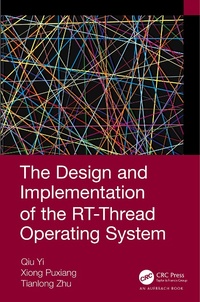
The Design and Implementation of the RT-Thread Operating System
1st Edition
Published on 12. November 2020
412 pages
978-1-000-20526-8 (ISBN)
Description

Since the release of V0.01 in 2006, to the present V4.0 version, RT-Thread has developed a reputation among developers for its open source strategy. RT-Thread has gained a large following among members of the embedded open source community in China with hundreds of thousands of enthusiasts. RT-Thread is widely used in energy, automotive, medical, consumer electronics, among other applications, making it a mature and stable open source embedded operating system.
The purpose of RT-Thread RTOS Design and Implementation is to create an easy learning curve for mastering RT-Thread, so that more developers can participate in the development of RT-Thread and work together to create an open source, tiny, and beautiful Internet of Things operating system. The book's first part introduces the RT-Thread kernel and starts with an overview of RT-Thread before covering thread management, clock management, inter-thread synchronization, inter-thread communication, memory management, and interrupt management. The second part begins with RT-Thread kernel porting and explains how to port RT-Thread to a hardware board to run it. The second part also introduces RT-Thread components and discusses the Env development environment, FinSH console, device management, and network framework. Additional topics covered include:
The I/O device framework
Virtual file systems
Peripheral interfaces
Devices including the PIN device, UART device, and ADC device, among others.
Each chapter features code samples, as well as helpful tables and graphs, so you can practice as you learn as well as perform your own experiments.
The purpose of RT-Thread RTOS Design and Implementation is to create an easy learning curve for mastering RT-Thread, so that more developers can participate in the development of RT-Thread and work together to create an open source, tiny, and beautiful Internet of Things operating system. The book's first part introduces the RT-Thread kernel and starts with an overview of RT-Thread before covering thread management, clock management, inter-thread synchronization, inter-thread communication, memory management, and interrupt management. The second part begins with RT-Thread kernel porting and explains how to port RT-Thread to a hardware board to run it. The second part also introduces RT-Thread components and discusses the Env development environment, FinSH console, device management, and network framework. Additional topics covered include:
The I/O device framework
Virtual file systems
Peripheral interfaces
Devices including the PIN device, UART device, and ADC device, among others.
Each chapter features code samples, as well as helpful tables and graphs, so you can practice as you learn as well as perform your own experiments.
More details
Edition
1. Auflage
Language
English
Place of publication
London
United Kingdom
Publishing group
Taylor & Francis Ltd
Target group
Professional and scholarly
Product notice
Reflowable
Illustrations
50 Illustrations, black and white
ISBN-13
978-1-000-20526-8 (9781000205268)
Copyright in bibliographic data and cover images is held by Nielsen Book Services Limited or by the publishers or by their respective licensors: all rights reserved.
Schweitzer Classification
Other editions
Additional editions
Qiu Yi | Xiong Puxiang | Tianlong Zhu
The Design and Implementation of the RT-Thread Operating System
Book
09/2023
1st Edition
CRC Press
€70.70
Shipment within 15-20 days
Qiu Yi | Xiong Puxiang | Tianlong Zhu
The Design and Implementation of the RT-Thread Operating System
Book
11/2020
1st Edition
CRC Press
€115.00
Shipment within 15-20 days
Persons
Qiu Yi is a co-founder of Shanghai Real-Thread Electronic Technology Co., Ltd. He has been working on the development of the RT-Thread open-source operating system since 2006. RT-Thread has now been widely used in many industries, such as energy, vehicle, medical, consumer electronics, and more. It is a mature and stable open-source embedded operating system with a large installed capacity.
Xiong Puxiang is a founder and CEO of Shanghai Real-Thread Electronic Technology Co., Ltd. He created the RT-Thread open-source operating system in 2006 and has led engineers in the design and develop of the RT-Thread operating system kernel by integrating object-oriented design concepts and developing many mature and stable software components such as file system, command line, and graphical user interface.
Zhu Tianlong is the CTO of Shanghai Real-Thread Electronic Technology Co., Ltd. He has more than 10 years of RTOS development experience and has taken charge of the RT-Thread R&D team, which is committed to researching and developing cutting-edge technology. Also, he is an embedded open-source geek, sharing such open-source software as easylogger, easyflash, and cmbacktrace.
Xiong Puxiang is a founder and CEO of Shanghai Real-Thread Electronic Technology Co., Ltd. He created the RT-Thread open-source operating system in 2006 and has led engineers in the design and develop of the RT-Thread operating system kernel by integrating object-oriented design concepts and developing many mature and stable software components such as file system, command line, and graphical user interface.
Zhu Tianlong is the CTO of Shanghai Real-Thread Electronic Technology Co., Ltd. He has more than 10 years of RTOS development experience and has taken charge of the RT-Thread R&D team, which is committed to researching and developing cutting-edge technology. Also, he is an embedded open-source geek, sharing such open-source software as easylogger, easyflash, and cmbacktrace.
Content
1. Embedded Real-Time Operating System. 2. RT-Thread Introduction. 3. Kernel Basics. 4. Thread Management. 5. Clock Management. 6. Inter-Thread Syncronization. 7. Inter-Thread Communication. 8. Memory Management. 9. Interrupt Management. 10. Kernel Porting. 11. Env-Assisted Development Environment. 12. FinSH Console. 13. I/O Device Framework. 14. General Peripheral Interface. 15. Virtual File System. 16. Network Framework. Appendix A. "Menuconfig Options" Appendix B. SCons. Appendix C. Getting Started with QEMU (Ubuntu). Appendix D. Getting Started with RT-Thread Studio (Windows).
