

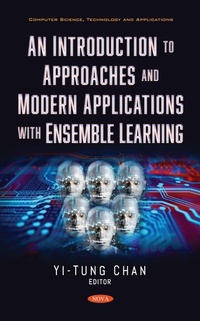
Introduction to Approaches and Modern Applications with Ensemble Learning
Published on 10. November 2020
335 pages
978-1-5361-8846-2 (ISBN)
Description

From the successful application of deep learning (DL) in AlphaGo in 2012 to the recent advances in edge computing, artificial intelligence (AI) has continued to develop over the years. In the face of the current sweeping trend of AI, ensemble learning (EL) is expected to be further applied to DL and AI for developing higher-level ensemble systems in the future. Moreover, it could become an important step for achieving "The Master Algorithm" proposed by Prof. Pedro Domingos. In light of this, EL will continue to make a significant contribution to future development. The purpose of this book is to provide insights into EL for readers not majoring in computer science or related subjects, introduce the latest development and applications of EL; in particular, share its practical applications in various fields. Accordingly, this book intends to present theoretical parts relating to mathematics and computing in a simple and concise manner. The examples and practical use of EL have been used to explain methods that utilize EL to solve readers' issues in their fields, which demonstrates the essence of EL for practical applications. While many AI and ML books are available on the market, most require a certain level of mathematical and machine learning (ML) knowledge. Complicated theories of mathematics and computation may be intimidating for people without a background in computer science and engineering, such as biological and medical researchers. It would be unfortunate if they were to miss the opportunity to use EL as a practical tool to solve data analysis problems at hand. Moreover, EL is usually introduced in the later or advanced chapters of AI and ML books. Beginners in ML, or readers without a technical background, are likely to be frustrated by mathematical or technical terms that only appear occasionally in the book or be anxious about complicated mathematical and computational theories related to classification algorithms. It would be regrettable if they were intimidated, and therefore, missed the opportunity to learn and use EL. From a practical perspective, existing classification techniques, such as decision trees with the C4.5 algorithm, support vector machines, and neural networks are now relatively mature and have been proven to be effective. For readers without a technical background, it is not essential to understand the complicated mathematical and computational theories behind the above techniques. Instead, it is recommended to grasp the logic and meaning of parameters in these classification algorithms and directly conduct tests using EL. Learning through practice can help readers to establish computational thinking. It is the best approach to learning EL, ML, AI, and DL. Furthermore, this book provides references and recommended reading for each technique to satisfy the curiosity of some readers with regard to mathematical theories and algorithms so that they can acquire further knowledge and answer their questions. Finally, the hope is that readers can be made aware, through practical use of EL, that they can build a robust ensemble system and solve problems in their areas without having to learn the absolute details of specific ML algorithms and mathematics behind the algorithms. This book provides insights into EL from worldwide experts and scholars in various fields. This book extensively introduces and discusses the application of EL in various fields and the current and future research directions of its novel applications. It also reviews some of the more popular areas in which EL has received widespread attention in recent years in the ML and AI. Each chapter opens with an introduction to ML and EL techniques, and then, analyzes the applications of EL in different fields, such as signal and image processing, medical care, education, geology, and agriculture. More than two experts and scholars in related fields acted as reviewers for the peer review of each chapter. It is hoped that these applications in various fields can inspire readers to use EL in practice.
More details
Other editions
Additional editions
Book
11/2020
Nova Science Publishers Inc
€303.55
Shipment within 15-20 days
Content
- Intro
- Contents
- Preface
- Acknowledgments
- Chapter 1
- An Introduction to Ensemble Learning in Research and Applications
- Abstract
- 1. Introduction
- 2. What Is Ensemble Learning?
- 3. How does Ensemble Learning Work?
- 3.1. Bagging
- 3.2. Boosting [10]
- 3.3. Stacking
- 4. Where Can Ensemble Learning Be Applied?
- Conclusion
- References
- Chapter 2
- Ensemble Denoising Autoencoders: Ensemble Learning for a Noise Reduction
- Chapter 3
- Computer-Aided Diagnosis System for Bone Fracture Detection and Classification: A Review on Deep Learning Techniques
- Abstract
- 1. Introduction
- 2. Deep Learning Scenario
- 3. Methodology
- 4. Approaches
- Discussion and Conclusion
- References
- Chapter 4
- Decision-Making Strategies with Clustering Based Unsupervised Learning for Smart Grids Planning
- Abstract
- Acronyms
- 1. Introduction
- 2. Clustering in Data Mining to Knowledge Extraction
- 2.1. General Aspects
- 2.2. Stages of the Clustering Process
- 2.3. Clustering Methods
- 2.4. The Validation of Clustering Results
- 3. The Load Profiling in the Electric Distribution Networks
- 3.1. The Load Profiling Process
- 3.1. Data Pre-Processing Stage
- 3.1.1. The Analisys of Big Data
- 3.1.2. Outlier Detection Using a Statistical Deep Learning Based Data Mining Approach
- 3.2. Normalization
- 3.3. Clustering Process
- 4. Energy Losses Estimation for Smart Grids Planning Based on Deep Learning Methods
- 4.1. Smart Grids Planning. Introduction
- 4.2. The Active Losses Forecasting Using a Deep Learning-Based Expert System
- 4.3. The Influence of Outliers on Active Losses Forecasting on Power Transformers Level
- Conclusion
- References
- Chapter 5
- Use of Ensemble Learning Techniques to Analyze Data Related to Education, Health and Standard of Living
- Abstract
- Introduction
- Related Work
- Methodology
- Data Sets
- Data Analysis
- Bagging
- Boosting
- Voting
- Random Forest
- Analysis-Related Results
- Health Dimension
- Education Dimension
- Standard of Living Dimension
- Prediction-Related Results
- IMR Predictions
- MMR Predictions
- TFR Predictions
- Discussion
- Conclusion
- References
- Chapter 6
- Quantitative Textural Measures of the Aeromagnetic Field: Two Examples at Regional Scale
- Chapter 7
- Medical Applications of Ensemble Learning
- Abstract
- Introduction
- Historical Overview
- State-of-the-Art
- Medical Applications
- Introduction
- Digital Healthcare
- Diagnostic Imaging
- Genomics
- Computer-Aided Diagnostics
- Bioinformatics
- Obstetric and Gynecological Applications
- Introduction
- Assisted Reproductive Technologies
- Prenatal Diagnosis
- Stillbirth and Preterm Birth
- Nutrition
- Gynecological Oncology
- Lights and Shadows
- Conclusion
- References
- Chapter 8
- Ensemble Learning Approach in Automated Modal Identification
- Abstract
- 1. Introduction
- 2. Background
- 3. Dissemination and Theoretical Considerations
- 3.1. Ensemble Learning
- 3.2. Dempster-Shafer Theory
- 3.3. Modal Identification
- 3.4. Uncertainty
- 4. Ensemble Modal Identification
- 5. Case Studies
- 5.1. Concrete Arch Dam
- 5.2. Cooling Fan
- Conclusion
- Acknowledgments
- References
- Biographical Sketch
- About the Editor
- Index
- Blank Page
