Alles über E-Books | Antworten auf Fragen rund um E-Books, Kopierschutz und Dateiformate finden Sie in unserem Info- & Hilfebereich.
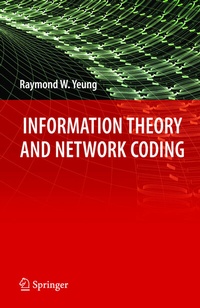
This book is an evolution from my book A First Course in Information Theory published in 2002 when network coding was still at its infancy. The last few years have witnessed the rapid development of network coding into a research ?eld of its own in information science. With its root in infor- tion theory, network coding has not only brought about a paradigm shift in network communications at large, but also had signi?cant in?uence on such speci?c research ?elds as coding theory, networking, switching, wireless c- munications,distributeddatastorage,cryptography,andoptimizationtheory. While new applications of network coding keep emerging, the fundamental - sults that lay the foundation of the subject are more or less mature. One of the main goals of this book therefore is to present these results in a unifying and coherent manner. While the previous book focused only on information theory for discrete random variables, the current book contains two new chapters on information theory for continuous random variables, namely the chapter on di?erential entropy and the chapter on continuous-valued channels. With these topics included, the book becomes more comprehensive and is more suitable to be used as a textbook for a course in an electrical engineering department.
Reviews / Votes
From the reviews:
"This book could serve as a reference in the general area of information theory and would be of interest to electrical engineers, computer engineers, or computer scientists with an interest in information theory. Each chapter has an appropriate problem set at the end and a brief paragraph that provides insight into the historical significance of the material covered therein. . Summing Up: Recommended. Upper-division undergraduate through professional collections." (J. Beidler, Choice, Vol. 46 (9), May, 2009)
"The book consisting of 21 chapters is divided into two parts. Part I, Components of Information Theory . . Part II Fundamentals of Network Coding . . A comprehensive instructor's manual is available. This is a well planned comprehensive book on the subject. The writing style of the author is quite reader friendly. . it is a welcome addition to the subject and will be very useful to students as well as to the researchers in the field." (Arjun K. Gupta, Zentralblatt MATH, Vol. 1154, 2009)
Series
Language
Place of publication
Publishing group
Target group
Primary & secondary/elementary & high school
Illustrations
File size
ISBN-13
978-0-387-79234-7 (9780387792347)
DOI
10.1007/978-0-387-79234-7
Schweitzer Classification
The Science of Information.- The Science of Information.- Fundamentals of Network Coding.- Information Measures.- Information Measures.- Zero-Error Data Compression.- Weak Typicality.- Strong Typicality.- Discrete Memoryless Channels.- Rate-Distortion Theory.- The Blahut-Arimoto Algorithms.- Differential Entropy.- Continuous-Valued Channels.- Markov Structures.- Information Inequalities.- Shannon-Type Inequalities.- Beyond Shannon-Type Inequalities.- Entropy and Groups.- Fundamentals of Network Coding.- The Max-Flow Bound.- Single-Source Linear Network Coding: Acyclic Networks.- Single-Source Linear Network Coding: Cyclic Networks.- Multi-source Network Coding.